
People talk about ghost stories as though the living are the centre of them. A man enters an old house. A woman opens a letter she should have left alone. A child wanders past a boundary. We frame the ghost as a consequence of the living person's action, something triggered by trespass or curiosity, and in doing so we hand all the agency to the wrong party.
A ghost story is a transaction. Something has been disturbed, or a moment has arrived that the dead have been waiting for, or a person has been deemed fit to receive what the ghost carries. The common thread across all of these is that it is the ghost who decides. The living merely arrive at a place the dead have prepared.
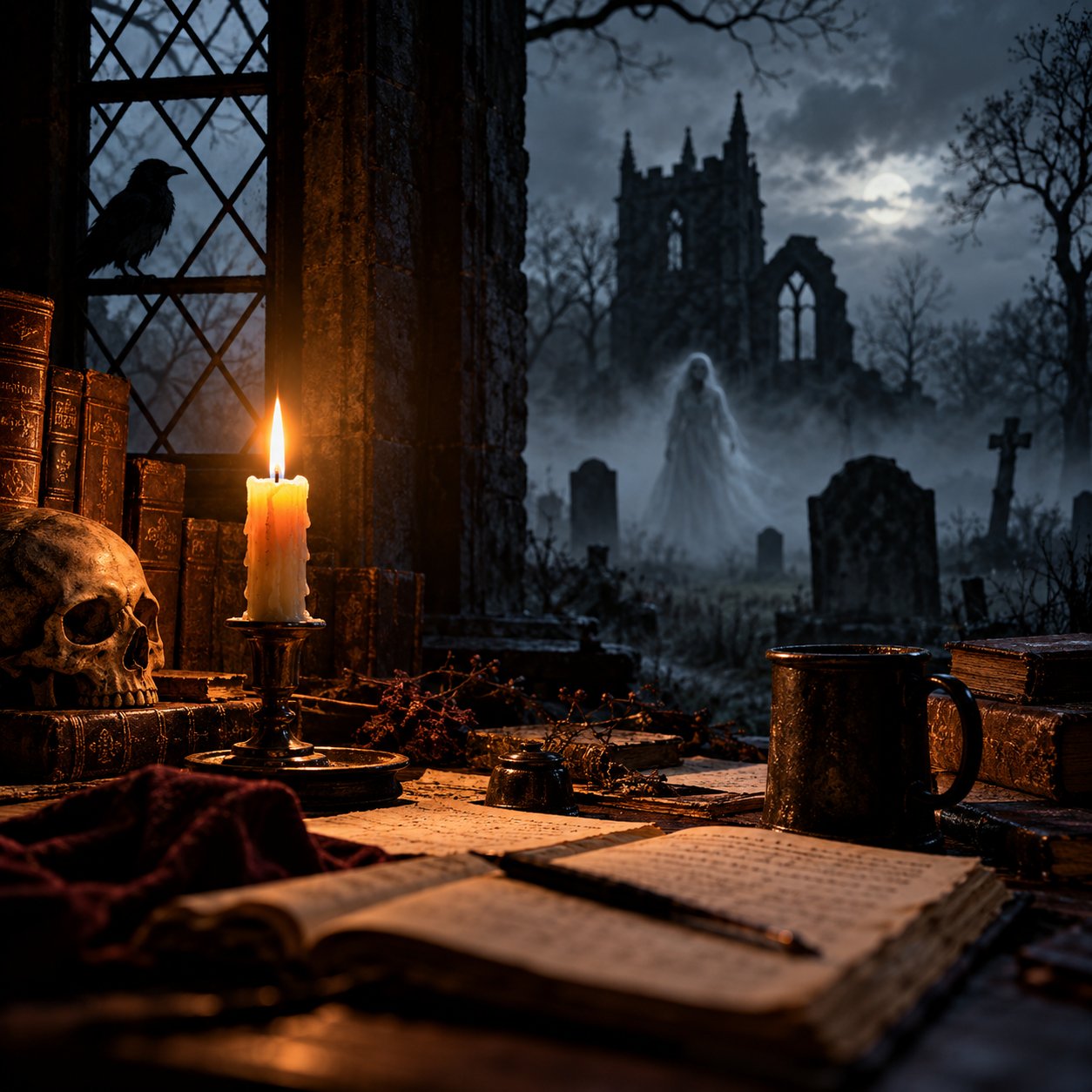
I present here five ghost stories, and every one of them works from this principle. They were not planned as a sequence. They ended up where they belong, each on whichever platform suited it. But they share an architecture, and the architecture begins with the same question. What does the ghost want, and what must the mortal learn?
The ghost is not a consequence
The instinct in most supernatural fiction is to treat the ghost as reactive. Someone disturbs a grave, reads a forbidden text, moves into the wrong house, and the haunting follows as punishment or warning. The mortal acts. The ghost responds. That framing turns the ghost into a mechanism and hands the story's engine to the living.
In The Uncounted, the dead of the Great Seattle Fire of 1889 reach through the floor of a hotel built over the ground where they burned. The official record said nobody died. Twenty-five city blocks were destroyed and the civic memory simply refused to hold the dead. So the dead hold themselves. They are not reacting to a disturbance. They have been there since the fire, waiting for a moment and a person fit to receive what they carry. The hotel guest does not trigger the haunting by arriving. She is chosen because the dead have decided that somebody should finally count them.
In “Afterward,” Edith Wharton wrote about a couple who move into an English country house rumoured to be haunted, and the ghost appears only after they have stopped expecting it. The wife only recognises the encounter as a haunting when the man who visited her husband turns out to have been dead for months. The ghost arrived on its own schedule. It came to collect what was owed, and it chose its moment with a patience the living could not have anticipated. Wharton wrote in her preface to Ghosts that a ghost must be “the ghost” and not merely “a ghost.” It must have specificity. It must have purpose. That precision is what separates the form from atmosphere dressed in a shroud and told to stand in the corner.
Counting Out pushes the principle further. Grace Pascoe waits twenty years before she begins. Four children murdered her during a counting game on Bodmin Moor and hid her body in a mine shaft. Two decades later Grace returns, and she uses the children's own rhyme as her instrument. Every death she delivers is shaped by what that person became in the years after the murder. Grace does not simply punish. She answers. The twenty-year delay is not hesitation. It is craft. She needed the four of them to finish becoming what they were going to become before she could respond to the full shape of what they did.
Not every lesson arrives as punishment
The word “lesson” sounds instructive, even prim. But the lessons ghosts deliver are rarely comfortable, and they are not always verdicts. Sometimes the ghost brings something the living could not have reached on their own.
In The Ghosts of Godstow Abbey, King Henry II and Rosamund Clifford appear to the Abbess Katherine Bulkeley on the night she receives Cranmer's letter telling her the abbey will be dissolved. They have not been disturbed, and nobody summoned them. They have recognised a moment that requires their particular knowledge, and they have chosen to offer it. Henry speaks about the difference between contest and eradication. Rosamund speaks about how stones remember quarrels long after the quarrellers are dust. These are ghosts who arrive as counsel. Katherine walks back to her chamber carrying a clarity that Cranmer's letter alone could never have provided.
Elizabeth Bowen's “The Demon Lover” works from a different angle but confirms the same principle. A woman returns to her shuttered London house during the Blitz and finds a letter from a soldier she promised herself to twenty-five years earlier, a soldier she believed dead. There is no malice in the letter. There is only the statement that he is coming to collect what was promised. The ghost does not teach or warn or punish. He arrives because an obligation was never discharged, and the story escalates around that single claim until the woman is taken. The lesson for the reader is about what promises cost when they outlive the person who made them, but the ghost himself has no interest in teaching. He has come for what is his. The ghost does not need to intend a lesson for the story to deliver one. The lesson can live in the gap between what the ghost wants and what the mortal understands.
The Farewell Chamber occupies yet another position. In the Yewdeep beneath the Durn Yew, a room built for farewells has begun accumulating the ghosts of people who promised to return but did not. The Yew keeps them because it does not know what else to do with a promise that was never honoured. A woman with wet hair and a missing arm. A young man with a wound at his throat that will not close. They do not speak, they watch. They stand behind the person who is about to leave. These ghosts are not vengeful. They are residue. They are what happens when words spoken with love bind the world that heard them and the speaker never comes back to collect what was left behind. Eventually a custodian must close the room, because even a place built for mercy reaches a limit. The lesson arrives with the sealing of the room. Some debts cannot be held open forever.
How much ghost the lesson needs
Here is where the real craft of the form lives. The amount of ghost you show, the way the haunting manifests, the pace and pressure of the supernatural are all determined by what the mortal is meant to learn. You do not write every ghost story the same way because not every lesson requires the same delivery.
Grace Pascoe in Counting Out needs to be seen and heard. She uses the rhyme because the rhyme was the instrument of her death, and turning it back upon her killers is justice and symmetry at once. The haunting is loud and theatrical because the crime was specific and the guilt has been distributed across four people who have each spent twenty years constructing a version of events that protects them. The ghost must crack every one of those constructions open. That requires volume and a little spectacle. It requires Grace to be present and unmistakable.
Robert Aickman refused all of this, of course. He called his fiction “strange stories” and stripped away the transaction I have been describing. His ghosts do not arrive with lessons, nor do they come to collect, counsel or punish. They make the ordinary world feel off-kilter and then leave the reader with no resolution. Aickman appreciated the power of withholding the purpose, and his best work trades on that brilliantly. But what he wrote is not what I mean by a ghost story. It is something adjacent. When you remove the lesson, the ghost becomes atmosphere rather than agent, and the story drifts from transaction into mood. That is a legitimate and often extraordinary form of fiction. It is not mine.
The Advancing is one ghost story I have written that deliberately tests the form's limits most severely. In 1885, in Lenox, Massachusetts, a girl named Judith watches her uncle murder her brother and then kill himself. The roads are snowed in. The ground is iron. The bodies remain in the house. The uncle's coffin stands in the parlour, and each night it moves. Not far. An inch, perhaps a little less. Judith's mother measures the distance with pencil marks on the floorboard. No ghost is ever seen or heard, and nothing is explained. There is only a coffin that advances, a mother who counts, and a girl who grows up measuring the distance between herself and everything around her.
The lesson does not need a face. The world moved while Judith slept, and she will never stop watching for it to move again. The form here is almost silent because the lesson is about the impossibility of safety, and anything louder would have given the reader somewhere to stand. A ghost that announced itself could be faced. A coffin that moves one inch per night cannot be faced, because there is nothing there to confront and nothing to bargain with. The restraint is not atmosphere for its own sake. It is the only delivery method the lesson permits.
What the dead decide
These five stories exist in different fictional worlds. One belongs to the Marchlands. One draws from real history. Three sit in no shared setting at all. The spread was not planned. They are simply the locations they ended up, each where it belongs.
What holds them together is the principle I keep returning to. The ghost is never a prop. The ghost is a figure with something to deliver, and the means of that delivery is the story. Whether that means a counting rhyme chanted until the chain of office chokes the wearer, or a medieval king and his mistress offering counsel across five centuries, or a cavern full of the abandoned dead, or a coffin moving one inch per night while a woman kneels in candlelight with a pencil, the method is always answerable to the message. A ghost story is not a story that happens to have a ghost in it. It is a story the ghost has decided to tell.
If you'd like to follow Jonathan B. Edvane, you can do so here.
Discussion