
Gothic fiction is the literature of things that should not still be present but are. A house that remembers what happened inside it. A document that records names belonging to the dead. An institution whose rules have become indistinguishable from punishment. A ship that returns from the sea floor with its engines still turning. The genre operates at the boundary between what the rational world insists is settled and what the story proves is not.
Unlike horror, which often works through immediate physical threat, gothic fiction tends to build its dread through accumulation. Something is wrong with the place, the record, the family, the inheritance. The protagonist discovers this wrongness gradually, and the discovery changes them in ways they did not expect and cannot reverse. The haunting is rarely sudden. It has been waiting.
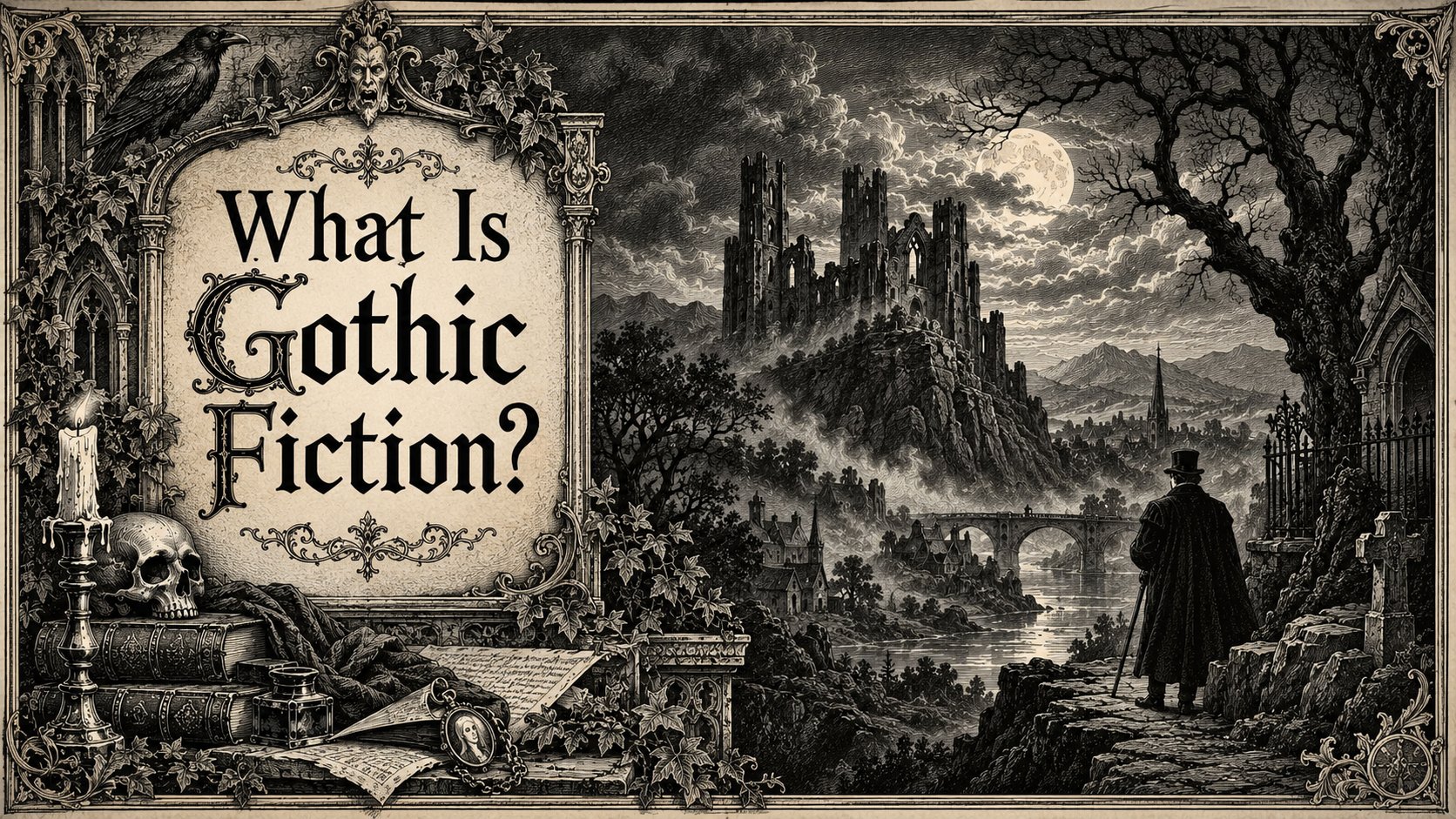
That patience is what separates the gothic from almost everything else. A horror story can begin with a scream. A thriller can open with a chase. Gothic fiction begins with a door that opens too easily, a letter that should not have arrived, or a silence where an answer ought to have been. The reader suspects the danger long before the character does, and that gap between suspicion and confirmation is where the genre lives.
Three inheritances
The genre inherits from three traditions, each of which gave us a different register of dread.
Ann Radcliffe, writing in the 1790s, established the gothic of atmosphere and suspense. In The Mysteries of Udolpho and The Italian, Radcliffe constructed settings so oppressive that the architecture itself became the antagonist. Corridors that seemed to lengthen. Rooms whose doors were locked from the wrong side. Landscapes whose beauty made their danger harder to believe. Her heroines were rational women caught inside irrational buildings, and the terror arose from the growing suspicion that the building knew more about them than they knew about it. Radcliffe also pioneered the explained supernatural, the suggestion that every haunting might have a material cause, though she understood that the explanation never quite erased the dread. The reader had already felt the fear, and no rational footnote could undo it.
Edgar Allan Poe moved the gothic inward. His contribution was the recognition that the most frightening building was the human mind. In stories like “The Fall of the House of Usher” and “The Tell-Tale Heart”, the boundary between the haunted place and the haunted narrator collapses until neither can be trusted. Poe understood that unreliable testimony was more disturbing than any spectre, because the reader could never be certain whether the narrator was describing what happened or constructing what they needed to believe. His narrators confess too much or too little. They explain themselves with a precision that becomes its own evidence of madness. Every sentence is a locked room.
Bram Stoker added the gothic of invasion. Dracula is assembled from letters, diary entries, newspaper cuttings and phonograph transcriptions, each of which claims to be factual and none of which can see the full picture. The horror enters through the documents themselves. The vampire crosses borders, corrupts bodies, and rewrites the rules of what the living may expect from the dead. Stoker grasped that the most effective gothic threat was one that used the machinery of modern life against itself. Trains, telegrams, typewriters and blood transfusions all appear in the novel, and the vampire is more comfortable with them than the men who invented them.
The fake document
The Apportionment of Slyne Birch takes the tradition Stoker pioneered and turns it inside out. Instead of assembling documents that try to contain a supernatural threat, I structured the story to present a supernatural threat that operates entirely through documents. A tithe surveyor arrives in a Victorian parish to map every field and account for every acre. The older records name a settlement the living have agreed to forget. The dead just want someone to finish their paperwork.
Henry George is a rational man doing rational work. Chains, bearings, field books, acreages reduced and checked. Yet the parish register records baptisms, marriages and burials from a place that was cleared of its inhabitants four hundred years earlier. Names appear in his own handwriting that he has no memory of writing. A previous surveyor, Blunden, began the same work twenty years before and fled before completing it. The story’s horror lies in what the record compels George to do. His hand is seized by the administrative logic of a system older than he is. “The centuries had collapsed into a single administrative present.” When George’s own name appears in the burial register, entered in his own hand, he understands that by completing the apportionment he has entered himself into the same account.
This is gothic fiction operating through bureaucratic machinery. I have replaced the haunted house with a haunted schedule. The locked room is a column of figures that will not stay crossed out. Radcliffe would have recognised the atmosphere. Poe would have recognised the compulsion. Stoker would have recognised the documents. But the horror belongs to the record itself, and when Copus burns the completed map, an identical copy appears in the parish chest. “The law recognised both.”
Gothic folklore
Mistress Grimshaw’s Purse draws from the older tradition of the cursed object, but frames it inside the social machinery of a Victorian parish. Mistress Agnes Grimshaw dispenses charity at the church door, where God might see it and, more importantly, where no neighbour could pretend he had not. The purse opens only for those who speak the appointed words. “I stand in want before this parish, and acknowledge Mistress Agnes Grimshaw as my benefactress.” Each coin is stamped with the recipient’s name.
Judith Cox, a widow facing eviction, submits to the ritual and saves her cottage, but the price of the payment goes on spending itself. Her named coins circulate through the parish, broadcasting her poverty from the baker’s till to the alehouse. “Her need had become coinage.” The gothic turn arrives when Judith understands that the purse recognises want in all its forms, not only hunger and debt. “Mistress Grimshaw had a want too, larger than rent and sharper than hunger.” She wanted bowed heads, grateful tongues, Sunday praise, and the pleasure of seeing honest people made small before her.
The supernatural justice that follows is swift and physical. Coins bearing Grimshaw’s own name flood the churchyard. The voices of the poor speak the appointed words back to her. The rector, who enabled every humiliation, delivers the story’s final line with the precision of a man who has perfected complicity. “I didn’t hear a thing.” This is gothic folklore because the cursed object carries a moral logic older than any church. The purse does not punish sin. It answers want with want, and the institution that blessed the arrangement looks away.
Gothic dystopia
I Spill It All is set in Streindarke, a civic state whose academy trains girls through systematic correction. The institution divides into upper halls, where young women are refined into administrative silence, and below-stairs service areas, where girls like the narrator, Regan, labour in debt. “A tray was to be an extension of the wrist, as that in turn was an extension of obedience.”
The gothic element this time is not supernatural. It is structural. The academy’s architecture, its damp walls, iron grates, laundry shafts and instruction tubes, functions exactly like Radcliffe’s oppressive castles, except that the imprisonment is administrative rather than physical. Girls are not locked in. They are corrected until even their stillness can be trusted. “Cruelty, after all, notices what it injures.” The Principal Matron, Daisy Wilde, speaks in euphemisms so polished that the violence beneath them has become invisible. The Field of Natural Consequence, the meadow behind the academy where no pupil is permitted, serves the same narrative purpose as the forbidden wing in a Radcliffe novel. It is the place where the institution’s control does not reach, and therefore the place where escape becomes imaginable.
Regan’s act of rebellion is not a grand gesture. She spills wine on the uniform of Angel-June Nair, a girl from the upper halls who has begun to see her. The spill is deliberate, precise and trained. Everything Miss Villein taught her about control is turned against the system that taught it. When Angel-June publicly acknowledges the act as communication rather than clumsiness, both girls are forced through the rear gate into the meadow, where they find Martha and a community of girls who have already escaped. “You spilled it, then.” The gothic dystopia does not end with the destruction of the institution. It ends with the discovery that someone has already been living outside it.
The ghost story
The Return of the SS Strumble is perhaps the most traditional of the four. Thomas Darling, a lighthouse keeper who survived the wreck of the SS Strumble in 1891, receives a sea-soaked stowaway during a storm. The man brings a warning. “Put out the light. Before she sees it.” The ship that went down eight years earlier is coming back.
The Strumble appears beyond the outer rocks with no crew, no answer to signals, and navigation lamps burning the wrong colour. Thomas guides her in because he is a keeper and that is what keepers do. Below decks he finds boots by the bunks, and pipes still warm. In the hold, brass machinery prints predictions on paper strips. “You think you are counting, then you are remembering, then you are obeying.” The stowaway’s warning about the ticking proves accurate in a way Thomas does not expect. The machines do not threaten him. They offer him knowledge of a future disaster and the chance to prevent it.
Thomas takes a small mechanism ashore. He sends letters. Years later, the predicted incident at Dogger Bank occurs, though with fewer deaths than the machine foresaw. The question the story leaves unanswered is whether Thomas altered the future or merely participated in a design he could not see. When the mechanism prints a new prediction, June 1914, he holds the paper over a flame but cannot bring himself to burn it. The story closes with him standing “between darkness and warning, with the future trembling in his hand.” I consider this to be a ghost story at its most genuinely gothic. The haunting does not end. It merely changes the terms on which the haunted man must continue living.
What gothic fiction keeps asking
The four stories above represent four distinct modes of gothic fiction, but they share a single preoccupation. In each case, the protagonist discovers that the world contains a system, a record, a machine, an institution, whose logic is older and more stubborn than anything human will can oppose. The surveyor completes the schedule because the schedule demands completion. The widow seizes the purse because the purse recognises true want. The servant spills the wine because obedience, turned against itself, becomes the only available rebellion. The keeper preserves the mechanism because the future, once known, cannot be unknown.
Gothic fiction does not ask whether the haunting is real. It asks what the haunting wants, and whether the haunted can survive giving it to them. That question was present in Radcliffe’s corridors, in Poe’s confessions, and in Stoker’s assembled documents, and it has not been answered yet. The genre endures because the question endures. There is always another locked room, another unfinished record, another institution whose rules have outlived their reason, and another ship on the horizon that should not be there.
If you'd like to follow Jonathan B. Edvane, you can do so here.
Discussion