
Every writer who works with history faces the same problem sooner or later. The source material is interesting. The records survive. A name appears in a pipe roll, a chronicle, a patent roll, a tithe schedule. Something happened, or someone existed, and the evidence is still there. The question is what to do with it.
The worst answer is to copy it. A writer who simply transcribes historical events into fictional prose has produced neither good history nor good fiction. The facts become a scaffold that the story leans on instead of standing by itself, and the reader can feel the research holding the narrative up like a man propping open a door he should have walked through. Umberto Eco understood this when he built The Name of the Rose around real Franciscan disputes and real fourteenth-century theology but let the murder plot carry the novel rather than the scholarship. The history informed everything. It governed nothing.
The better answer is harder to describe, because it changes depending on what the source is actually offering. Sometimes the record gives you a gap. Sometimes it gives you a system. Sometimes it gives you a name that already contains the story if you hold it to the light. The four stories discussed here each began with a real historical source and each found a different way through the same problem. None of them copies the history. All of them depend on it absolutely.
The gap in the record
Geoffrey of Monmouth knew something in the twelfth century that most historical novelists still struggle with. When he sat down to write Historia Regum Britanniae he had Bede, Gildas, Nennius, and a handful of Welsh genealogies in front of him. What he produced from those sources was Arthur, Merlin, Lear, Cymbeline, and a thousand years of invented British kings. Scholars have spent centuries arguing about whether Geoffrey believed his own inventions or simply understood that the gaps between his sources were large enough to build a world inside. Either way, the method was clear. He did not copy his sources. He read them until he found the silence, and then he filled it.
Hilary Mantel worked from the opposite direction but arrived at a similar place. Her Wolf Hall trilogy is built on a mountain of documentary evidence about Thomas Cromwell, a man who appears in hundreds of surviving records. Yet what makes the novels extraordinary is not what the records contain but what they leave out. Cromwell’s inner life, his domestic grief, his experience of walking through rooms where decisions were made that would reshape England. Mantel read every letter, every account, every witness statement she could find, and then she wrote the novel that lived in the spaces between them. The research was total. The fiction was everything the research could not reach.
The Second Commission begins from a real entry in the Patent Rolls of Richard III, dated 8 March 1485. A commission was issued appointing men to investigate the seizure of a merchant vessel belonging to Giliom Marcellis. The ship had been taken by a man called John Taillour. The entry names the commissioners. It records their authority. It says nothing about what they found when they went looking. That silence is the entire story.
The fiction sends Richard Taillour, John’s cousin (although this relationship is something I invented) and a yeoman of the crown, to carry out the investigation after the earlier commissioners vanish. He boards the Sint Marie and finds drowned men above the waterline. The ship is wrong in ways that no surviving record could explain, because the record stopped before the explanation began. John Taillour is still aboard, haunted by the men killed during Channel operations conducted on the King’s behalf. He spares Richard to carry a message back to the living. “The dead remember.”
The Patent Roll entry is real. The commission is real. The names are real. Everything that happens on the ship is fiction, but it is fiction that grows directly from the documented silence. The story does not contradict the record. It occupies the space where the record chose to say nothing, and it asks what might have been terrible enough to make the record stop.
The system turned against itself
M.R. James spent his professional life inside archives. He was Provost of King’s College, Cambridge, and later of Eton, a man who catalogued medieval manuscripts and read Latin the way other men read newspapers. When he wrote ghost stories he did not abandon that expertise. He weaponised it. Stories like “The Stalls of Barchester Cathedral” and “An Episode of Cathedral History” begin from the texture of real ecclesiastical record-keeping and real antiquarian research. The horror arrives not despite the scholarly apparatus but through it. A man reads an old document, follows its references, visits the place it describes, and finds that the careful machinery of institutional memory has preserved something that should have been allowed to die.
The Apportionment of Slyne Birch takes a similar approach but pushes it further. The historical source is not a single document but a system. The Tithe Commutation Act of 1836 sent surveyors across England to map every parish, measure every field, and record every landowner and occupier in schedules that still survive in county archives. The process was real. The administrative language was real. The forms, the measurements, the obsessive bureaucratic thoroughness of Victorian England applied to medieval landscapes was all documented and verifiable.
The fiction introduces Henry George, a tithe surveyor sent to a parish called Ashenford. The older records he consults name a settlement called Slyne Birch, cleared in the 1440s and never resettled. As George works through the schedule, dead names begin appearing in his own handwriting. The previous surveyor, a man called Blunden, fled before completing his work. George’s hand is seized by the administrative logic of the dead, and his own name appears in the burial register. The completed map, when burned by the rector, reappears in the parish chest.
The horror here is not that the dead return. It is that the dead return through the system designed to record the living. “The centuries had collapsed into a single administrative present.” The tithe schedule does not break. It simply extends its jurisdiction. “The law recognised both.” The fiction does not need to invent a supernatural mechanism from outside the historical source. The source itself, the relentless documenting impulse of the Victorian state applied to a medieval parish, provides the logic by which the haunting operates. The system works exactly as it was designed to work. It simply works on the wrong people.
Subtraction
Not every historical source offers a gap to fill or a system to turn. Sometimes the source is buried under so many layers of later invention that the fiction’s task is not addition but removal.
The Tayle of Robyn Hode begins with a real entry in the Yorkshire pipe rolls from 1225. A man called Robert Hod appears as a fugitive whose goods had been seized by the Crown. In 1936 the historian L.V.D. Owen identified the entry, and in the 1980s David Crook argued that Robert Hod was the same man as Robert of Wetherby, an outlaw pursued by Eustace of Lowdham, a royal officer who had previously served as deputy sheriff of Nottinghamshire and Derbyshire. The scholarly argument remains open. The story treats it as settled and asks what follows.
What follows is a process of deliberate subtraction on my part. There is no Sherwood Forest. No Sheriff of Nottingham. No Maid Marian. No Merry Men in Lincoln green. Every familiar element of the Robin Hood legend is stripped away, and what remains is a minor landholder with a legitimate grievance against a royal tax assessment who finds himself pushed into outlawry by a court that never quite answers the question he asks of it. The officer who delivers the demand shrugs and says “Under the king’s right.” Robert challenges the assessment at the county court and discovers that the machinery of law has no interest in whether the charge is lawful. It only asks whether it has been paid.
The legend grows around Robert without his consent. A handful of armed men becomes twenty in the retelling. Money quietly returned to debtors becomes treasure scattered among the poor. John, his steward, grows taller with every account. A miller called Midge who supplied information becomes the faithful companion. A religious brother called Tewkes who provided intelligence about ecclesiastical wealth becomes a fighting friar. Even Mariota, the widow of a merchant killed during one of Robert’s robberies, is transformed by the stories into a woman who loved him and waited for him beneath the greenwood. The legend does not emerge from what Robert did. It emerges from what other men chose to remember.
The fiction’s relationship with history here is the opposite of the first two stories. The Second Commission fills a gap. Slyne Birch extends a system. Robyn Hode removes the accretion of eight centuries of myth and asks what the pipe roll entry might have looked like before anyone started singing about it. The transformation from history into fantasy is shown from the other side. The reader watches the real man disappear into the legend that will eventually consume him, and the last line confirms it. “Robert of Wetherby disappeared from Yorkshire and from memory. Robyn Hode lingered.”
The name as engine
The Vanishing of Spearhafoc begins from one of the stranger entries in the Anglo-Saxon chronicles. Spearhafoc was a real eleventh-century monk and goldsmith, appointed Bishop of London by Edward the Confessor and then refused consecration by the Archbishop. He was commissioned to make a crown for Edward and given gold and jewels for the work. Then he vanished, taking the gold with him. The chronicles record the disappearance but not the destination.
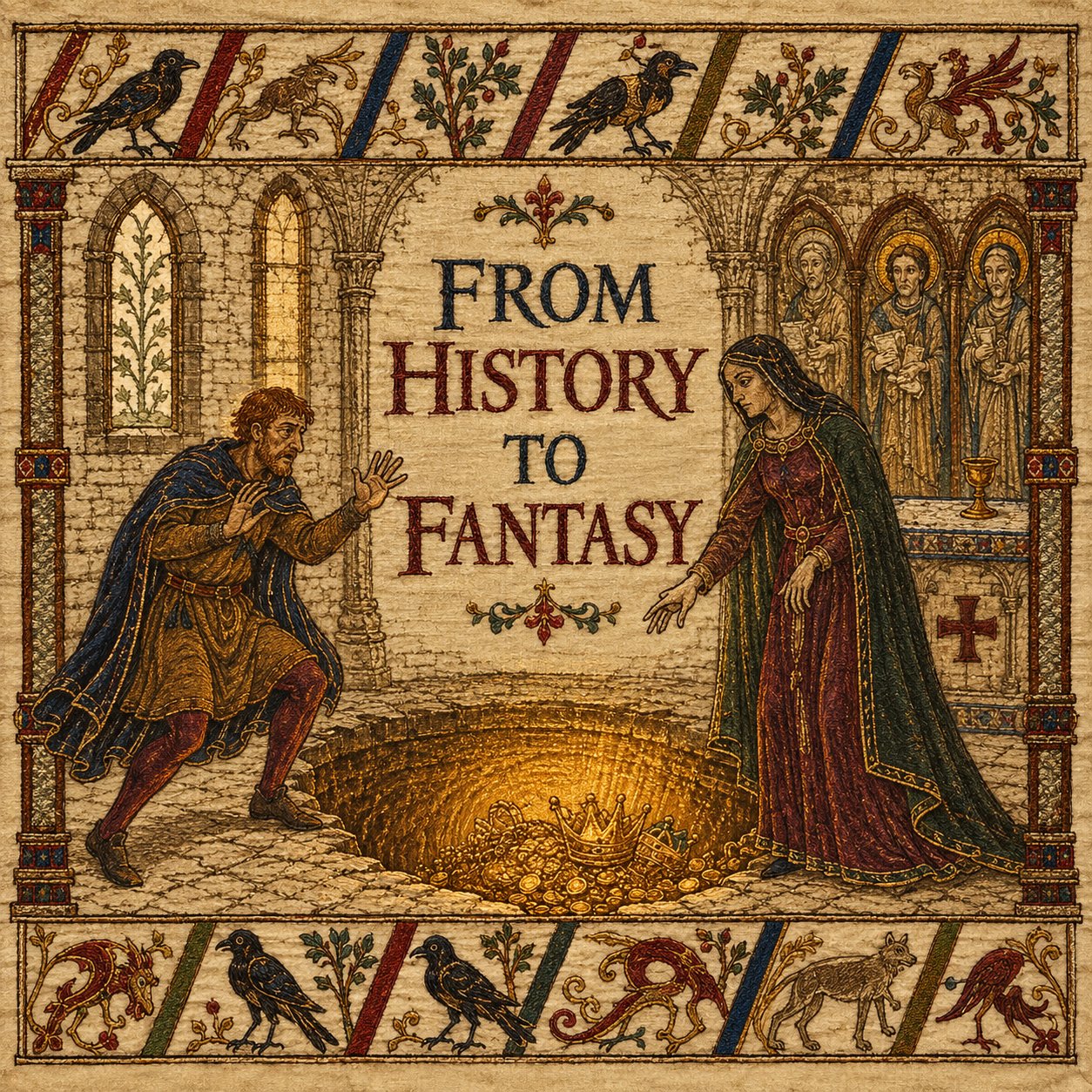
The fiction follows him west with the stolen treasure, through a landscape that grows older and stranger as he moves away from the court. He reaches a ruined chapel in Selwood Forest to rendezvous with the mysterious Jufreyna, a woman he first met at a foot-washing ceremony in Glastonbury. He asks her to make him vanish from England. She opens a slab beneath the altar, revealing a depth of yellow light that is not fire and not molten metal but something that has known gold since before kings hammered it thin. She takes the treasure and casts it into the depth. Then she turns to him and says “No road.” His bones narrow, his hands become hooks, his voice breaks into a shriek, and the chapel rises around his shrinking body until he is through the roof and over Selwood Forest, a sparrowhawk hunting the stolen brightness that has gone where no sparrowhawk can follow.
The name is the engine. Spearhafoc is Old English for sparrowhawk. The chronicles record a man who vanished. My story asks what it might mean if a man whose name was Sparrowhawk ceased to be a man. The transformation is not imposed from outside the historical source. It is already inside the name, waiting for a writer to take it seriously. Everything the story builds around the vanishing, Jufreyna, the ruined chapel, the yellow depth beneath the altar, the final metamorphosis, follows from the decision to treat the name as prophecy rather than coincidence.
This is perhaps the purest version of the process. The historical source offers a man, a disappearance, and a name. The fiction adds nothing that the name does not already imply. It simply refuses to treat the name as meaningless.
What the record offers
Four stories, four historical sources, four different methods of transformation. A gap in the Patent Rolls becomes a ship full of the drowned. A tithe schedule’s administrative logic becomes the mechanism by which the dead claim a living surveyor. Eight centuries of legend are stripped away to reveal the plausible man beneath. A monk’s Old English name becomes the instrument of his vanishing.
None of these stories copies history. None of them contradicts it either. The fiction lives in the relationship between what the record says and what it does not say, between what the system was designed to do and what it might do if its jurisdiction were extended, between what a name means and what a name might become.
The record is never the story. But the record, read carefully enough, will tell you where the story is hiding.
If you'd like to follow Jonathan B. Edvane, you can do so here.
Discussion