
The gothic tales I write very often begin with a document that does not add up. A parish register with names that should not be there. A civic report that claims nobody died. A purse that stamps the names of the poor onto coins. A brass mechanism that prints warnings about disasters that have not yet occurred. The supernatural arrives later, if it arrives at all, and when it does the horror has already happened. Something was left out of the official account, and what was left out has found its own way back in.
Four of my recent stories share this architecture, though I did not initially plan it exactly that way. Each one turns on a gap in some kind of record, and in each case the haunting is what was never properly acknowledged. I want to talk about why that works, and about why the official silence might be the most useful structural tool a writer of dark, gothic fiction has.
The Archive and the Absence
M.R. James understood the gothic power of documents better than anyone who has written in the form. His scholars, of which I am assuredly one, find horror inside manuscripts, catalogues, church inventories and mezzotints. The thing in the archive is waiting to be found, and the finding is the catastrophe. That principle has driven the English ghost story for more than a century, and it remains as sound now as it was when James first sat down to read “Canon Alberic’s Scrap-book” aloud to his Cambridge friends on Christmas Eve.
James was interested in what the record contains. The four stories I want to discuss are interested in what the record leaves out. The horror in each case lives in the space beside the document, in the silence that a community or an institution has chosen to maintain because the truth would be inconvenient. That silence is the engine. The supernatural, when it comes, is merely the sound the silence makes when it can no longer be restrained by the people or events it sits in.
What the City Chose Not to Count
“The Uncounted” is set in Seattle in 1897, eight years after the Great Fire that destroyed the city’s commercial district. The official record of that fire states that nobody died. People still repeat this as a point of civic pride, absolving the city for what I suspect was either poor record-keeping or deliberate omission.
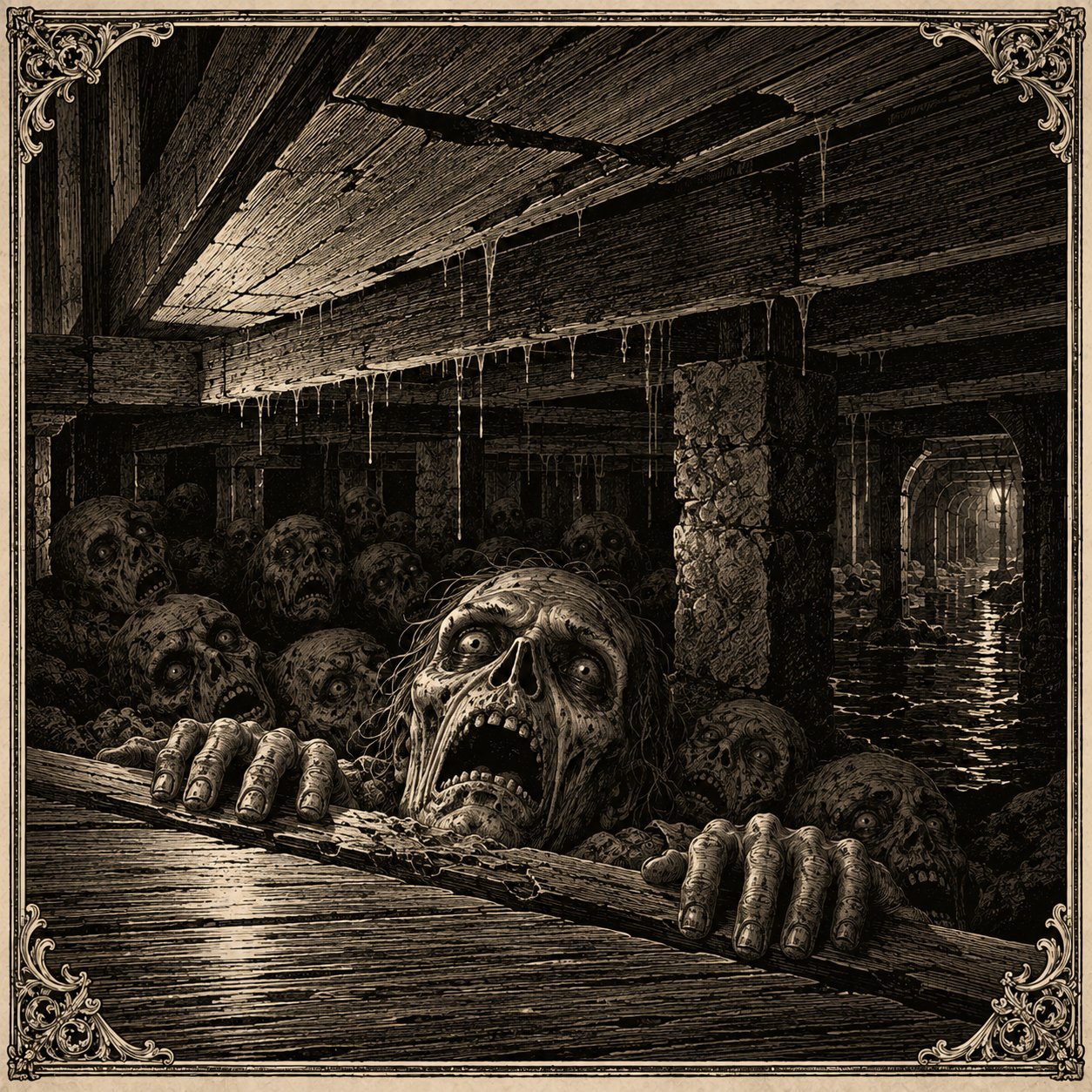
My narrator arrives in Pioneer Square and takes a room at the Elliott House, where tenants have been disappearing without explanation. Floors everywhere open. Faces appear beneath the boards. Pale, open-mouthed, unblinking. The residents are pulled through the floorboards into the darkness below, and nobody in authority comes to investigate because people like them, the dregs and the drifters, disappear every day. Anna Brown, who has watched the disappearances longer than the narrator, says it plainly. “They won’t come. Because people like this disappear every day. Nobody ever comes.”
The story ends with the line that carries its meaning. “The official record of the Great Seattle Fire says that not a single life was lost on June 6, 1889. People still repeat it as proof of good fortune, as though a city can be absolved by keeping poor records. I know better. There were dead beneath those streets, and I saw their faces. Somebody should have counted them.”
The dead beneath Seattle want something simpler than revenge. What drives them is need, and the need is to be acknowledged. The civic record said they did not exist, and so they pull the living down to join them, because if nobody will count the dead then the dead will count the living.
What the Parish Refused to Survey
“The Apportionment of Slyne Birch” works on the same principle but shifts it from the civic to the bureaucratic. Henry George, a tithe surveyor, arrives in Ashenford in 1843 to map the parish. He discovers references to a settlement called Slyne Birch that was supposedly cleared in the 1440s. When he raises it, Copus the rector tells him, “There is no need to put Slyne Birch upon the map.”
George goes to it anyway. What he finds is a gap. The settlement exists in every document he consults but has been left off every official map. Names appear in his field book in his own handwriting that he does not recall writing. The parish register contains centuries of entries from a place the authorities say is empty. A bell rings from the forest at nightfall, calling an office that has not been observed since the old forms were abandoned.
A previous surveyor, Blunden, abandoned the same work twenty years earlier. His unfinished schedule was found in the parish chest, breaking off halfway through a line. George does not abandon it. He finds himself unable to stop writing. The pen moves from column to column with a fluency that requires neither hesitation nor reference, entering names, acreages and holdings from a place he has barely measured. When his hand finally releases the pen, he has completed a document of a settlement that has been administratively dead for four centuries and is now, on paper, as detailed as any living parish.
The story’s final revelation is devastating in its quietness. “The dead had not summoned surveyors because they desired vengeance. They had been correcting an omission through whatever hand the living provided.”
The dead of Slyne Birch seek paperwork. Four centuries of administrative neglect has given them an appetite that is bureaucratic in its precision and gothic in its stubbornness.
What the Purse Made Public
“Mistress Grimshaw’s Purse” takes the principle in a different direction. The record here is a transaction. Every Sunday, Mistress Agnes Grimshaw stands beneath the church door with her black purse and waits for the poor to come to her. Before the clasp will open, each petitioner must say the appointed words clearly enough for the whole parish to hear. “I stand in want before this parish, and acknowledge Mistress Agnes Grimshaw as my benefactress.”
The purse is a ledger. Every coin it produces is stamped with the name of the person who needed it, and those coins circulate through the village so that the debtor’s shame passes from hand to hand. Judith Cox, who has survived three winters of widowhood without asking, understands the cost before she pays it. Her name had passed through St Barrow’s all day, changing hands more often than kindness ever had. Grimshaw gives in order to create a record of suffering. The giving is the point, and the point is power.
When Judith finally turns the purse against its owner, what pours out is the accumulated evidence. Names in silver. Voices repeating the formula. Then the black coins stamped with Grimshaw’s own name. They fill her mouth. She chokes on the record she built. The rector, who stood beside the purse every Sunday and smiled, claims to have heard nothing.
Shirley Jackson would have recognised this machinery. “The Lottery” is driven by the same structural silence. The community maintains a careful record of its own ritual, the box and the slips of paper and the names drawn in their proper order, while collectively refusing to acknowledge what the ritual actually does. The silence is maintained because maintaining it is easier than confronting what lies beneath. Gothic fiction understands that this kind of institutional quiet is a form of speech. It says that we know, and that we have decided to say nothing.
What the Machine Remembered Early
“The Return of the SS Strumble” inverts the pattern. Where the other three stories concern records of the past that were falsified or suppressed, the Strumble’s brass prediction machines produce a record of the future. Thomas Darling, a lighthouse keeper who survived the original wreck, watches the dead ship return to his light in a storm. In the hold he finds six polished mechanisms that print warnings on paper strips. A sea-soaked stowaway has already told him what they do. “They do not calculate. They listen ahead.”
The silence here belongs to the future. Nobody has yet failed to record the Dogger Bank incident or the continental catastrophe the machine’s later strips describe. Thomas stands at the edge of a gap that does not yet exist, with evidence in his hands that could prevent it. The question the story asks is whether he has the right to fill a silence that has not yet been chosen, and whether preventing one disaster might only clear the ground for something worse.
Thomas sends his warnings. Men live who might otherwise have died. Then the machine prints another strip, and the second prediction is larger than the first. “Royal blood. Sarajevo. Treaties awakened. Trains east and west. Europe entire.” The story ends with Thomas standing between darkness and warning, with the future trembling in his hand and every choice before him claiming to be mercy.
Daphne du Maurier indulged this kind of gothic uncertainty. In Rebecca the official record of a woman’s death, the inquest, the coroner’s verdict, the public story the household agrees upon, says one thing. The truth says another. The second Mrs de Winter lives her entire married life inside that gap, and the novel draws its power from the fact that closing the gap would be worse than leaving it open. Thomas Darling faces a similar impossible position.
The Principle
The most productive source of gothic unease, in my experience, is the silence that precedes the supernatural event. The dead beneath Seattle haunt the Elliott House because nobody counted them. The dead of Slyne Birch haunt the surveyor because nobody mapped them. Grimshaw’s purse turns against her because she built an economy of silence around other people’s suffering. The Strumble’s machines haunt Thomas because he holds the only record of something that has not happened yet, and saying nothing would be the easier choice.
The craft principle behind all of this took me four stories to see clearly, though it is simple enough to state. If you want to write a gothic tale that disturbs rather than merely frightens, begin with the record. Ask what was left out, and why, and who chose the omission. The ghost is just the omission standing up.
Every silence has a mouth. Given enough time, it opens.
If you'd like to follow Jonathan B. Edvane, you can do so here.
Discussion