Every piece of writing advice eventually becomes suspect. The person who said it turns out to be difficult, or dishonest, or worse. Neil Gaiman spent years telling writers that the only question a reader ever truly asks is "what happens next?" and that everything in a story exists to make that question impossible to put down. The advice was good. It remains good. That it came from someone whose behaviour away from the page has since been called into serious question does not undo the principle itself. I still use it. I use it in every story I write and every chapter I plan, and I am not going to pretend otherwise.
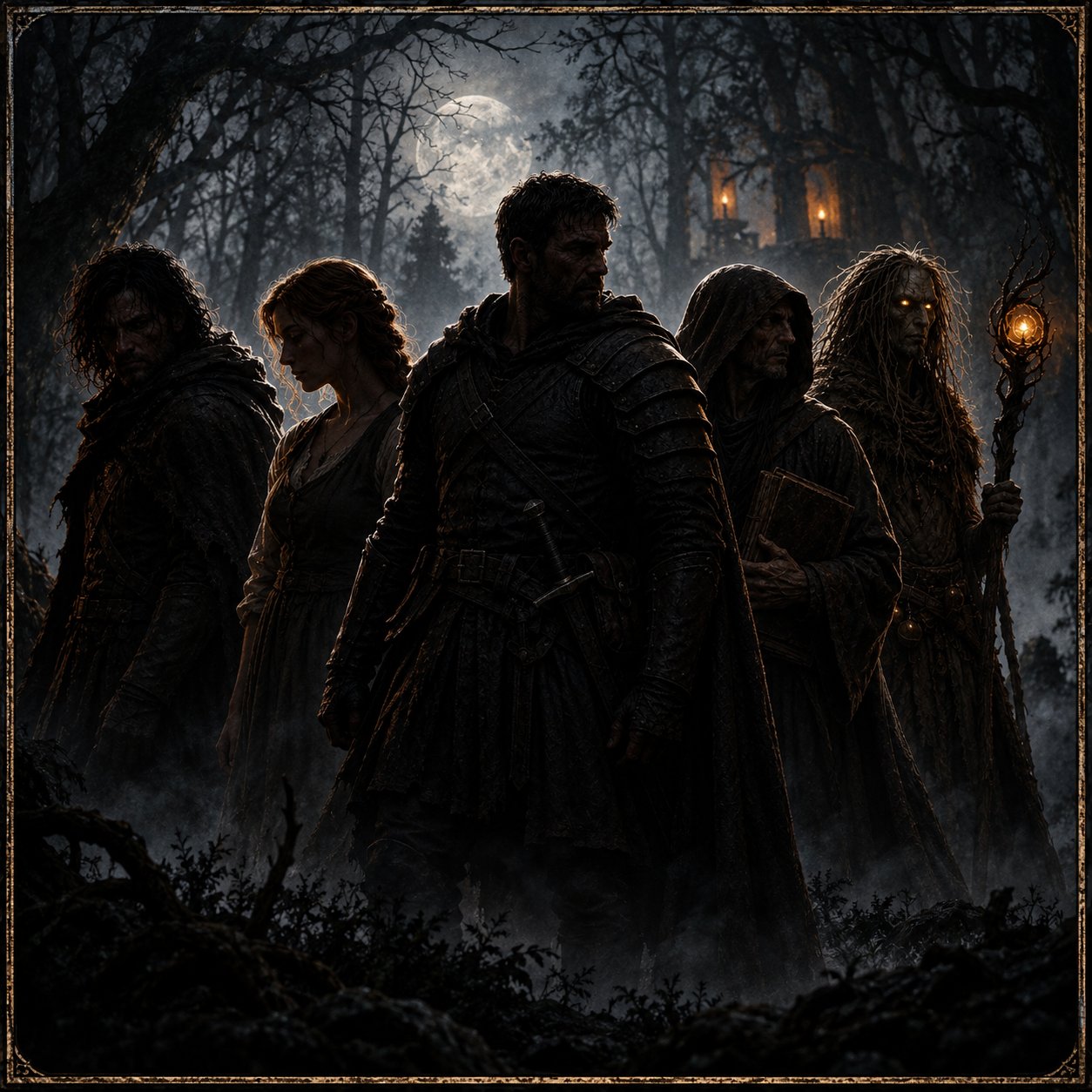
What I want to talk about here is how that principle shaped the way I introduced five characters who carry much of the story in my first novel, The Shivering Vale. None of them appear for the first time in the novel. Every one of them arrived first in a standalone short story, published freely as part of Tales from the Woldwood, months before the book was finished. That was deliberate. I wanted readers to have already met these people, already formed their own sense of who they were, and already be carrying an unanswered question about each of them before the novel asked anything at all.
The Method
Andrzej Sapkowski did something similar with the Witcher. The Last Wish and Sword of Destiny were short story collections published before the saga novels, and they worked as standalone fiction. You could read them without knowing a longer story was coming. But if you did read them, you arrived at the novels already invested. You knew Geralt. You had watched Yennefer make choices you could not quite forgive. You had seen Dandelion be brave and foolish in equal measure. The novels did not have to earn that investment from scratch. The stories had already done the work.
I am not comparing the scale of what I have written to the Witcher sequence. But the method is the same. Tales from the Woldwood is a free forty-story collection set in the Marchlands, and five of those stories exist specifically to introduce people the novel needs you to care about. Each story is complete on its own terms. Each one works without the novel. But each one also leaves a door open that only the novel walks through.
Edric
In Ale and Ashes, two former soldiers arrive in Ironreach looking for a fresh start. Edric Laine is one of them. His friend Arnulf Pike is the other. Pike finds work, finds purpose, begins to settle. Edric cannot. He is still carrying the war, and one night in a tavern he nearly kills a man who was harassing a waitress. The violence is disproportionate. It frightens everyone in the room, including Edric himself. He leaves Ironreach the next morning and heads home to Broch Heel. He knows he is not safe to be around people yet.
The story is about the aftermath of conflict, and it works as exactly that. But the question it leaves behind is pointed. Edric is a man who knows he is dangerous and does not know how to stop being dangerous. He walks away from the one person who understands him. Where does he go from there? The novel picks him up some time later, and it does not offer him an easy answer.
Alys
The Sister Who Went introduces Alys as a healer attending a dying noblewoman at Gefroy Castle. Lady Gefroy, in her final hours, tells Alys a story she has kept a secret. Her sister, Lady Jolis Frye, left everything behind. She walked away from her title, her marriage, her life, and journeyed to the Woldwood with a monk and two strange men. Lady Gefroy helped her go. She never saw her again.
Alys listens. She is skilled and professional, and the story she hears is not hers. But the Woldwood is mentioned with the kind of fear that suggests something more than forest, and Lady Gefroy warns of something that listens and remembers. The question left behind is not what happened to Jolis Frye. That is Lady Gefroy's question. The question is what Alys does with what she has heard, because a healer who walks into rooms where people are dying is a person who collects the things that others leave behind. The novel puts beneath her feet a path beyond the herbs and salves.
Wryke
Wryke is the strangest of the five introductions, because Wryke is not an ordinary person. The story takes place inside the Calteris Expanse, a living system built on principles of flexibility and load distribution. Wryke works within that system, monitors its structural health, and when the system begins to fail, and refuses to yield where it should, Wryke tries to intervene. The intervention is rejected. The system collapses. Wryke falls through a breach into the Yewdeep, the root-grown world beneath the Woldwood, and is accepted and employed by the Hollow Matron as a guardian of the sallow paths.
Mervyn Peake understood that the most compelling way to introduce a character is to show them complete in their own element before the story needs them. Steerpike in the kitchen, Flay in the corridors. You learn who they are from how they inhabit a space, not from what the plot asks them to do. Wryke works the same way. The Calteris Expanse is Wryke's element, and you understand Wryke entirely through the way that element fails. The question the story leaves is what Wryke becomes in a place that is growing like the Yewdeep. The Hollow Matron offers constraint rather than freedom, and Wryke accepts. The novel tests what that acceptance eventually means.
Drenn
The Ballad of Brenk Hill is probably the least conventional fantasy character introduction I have written. Drenn is a farmer. He works two strips of land. He fixes a neighbour's gate. He walks home to his wife Leonora and their children. The story follows a single ordinary day in close, careful detail, and everything about that day is honest and complete and enough.
Then fire appears on the horizon.
The sound comes like thunder, distant and climbing, and the story ends with a line that I still think is one of the truest things I have put on a page.
Lives can be honest, generous, and complete, and still be taken without warning or reason.
The question Drenn's story leaves is the hardest of the five, because it is not about what Drenn will choose. It is about whether choosing is even available to him. The novel puts him in a position where the answer to that matters enormously.
Matthis
The last of the five is Matthis, the librarian of Greyholt Abbey. In A Volume Set Aside, he finds an unmarked volume while cataloguing restricted materials. Six pages of script that looks less like writing and more like gestures. He recognises a possible connection to the First Language, where naming and action were once the same thing. He could study it. He could open something that might not close.
He puts the book back on the shelf.
That single act of deferral is Matthis entire introduction, and it tells you everything about him. He is careful and disciplined and afraid of exactly the right things. But the story ends with a suggestion that the deferral did not hold, that the truth called louder than his caution. The novel finds Matthis at the very moment where calling louder has become calling too loud to ignore.
Why It Matters
The conventional approach would have been to introduce all five of these people inside the novel itself. First chapter, second chapter, rotating viewpoints, each one getting their establishing scene before the plot begins to move. That is how most fantasy novels work, and it works well enough. But it asks the reader to do a lot of investment up front on trust, before they have any reason to care about these people beyond the fact that the author has chosen to follow them.
What I hope the short stories do is different. They let the reader arrive at the novel already caring. Already carrying a question about Edric that has been sitting unanswered for weeks or months. Already wondering what Alys will do with what she heard at Gefroy Castle. Already unsettled by what Wryke accepted in the Yewdeep. Already hoping that Drenn's decency will be enough, yet suspecting that it will not. Already impatient with Matthis for putting the book back.
That is the engine. A question, planted and left to grow.
What happens next? The novel is where you find out.
If you'd like to follow Jonathan B. Edvane, you can do so here.
Discussion