
Fantasy has a small vocabulary for women. There is the warrior in impractical armour, whose fighting ability is introduced in the same paragraph as her sweaty cleavage. There is the ethereal beloved, who exists to be worth saving. There is the scheming queen, whose ambition is presented as a corruption of femininity. And there is the sacrificial figure, whose death or suffering provides the emotional fuel for someone else's story.
These are not characters. They are positions in someone else's architecture.
The four women I want to discuss here, from four of my Tales from the Woldwood, are written in opposition to those defaults. It is not a political point. I just feel the defaults are bad craft. A woman whose purpose in the narrative is to be looked at, rescued, punished or mourned is a woman the writer has not yet thought about carefully enough. All characters deserve depth, however fair or voluptuous they appear.
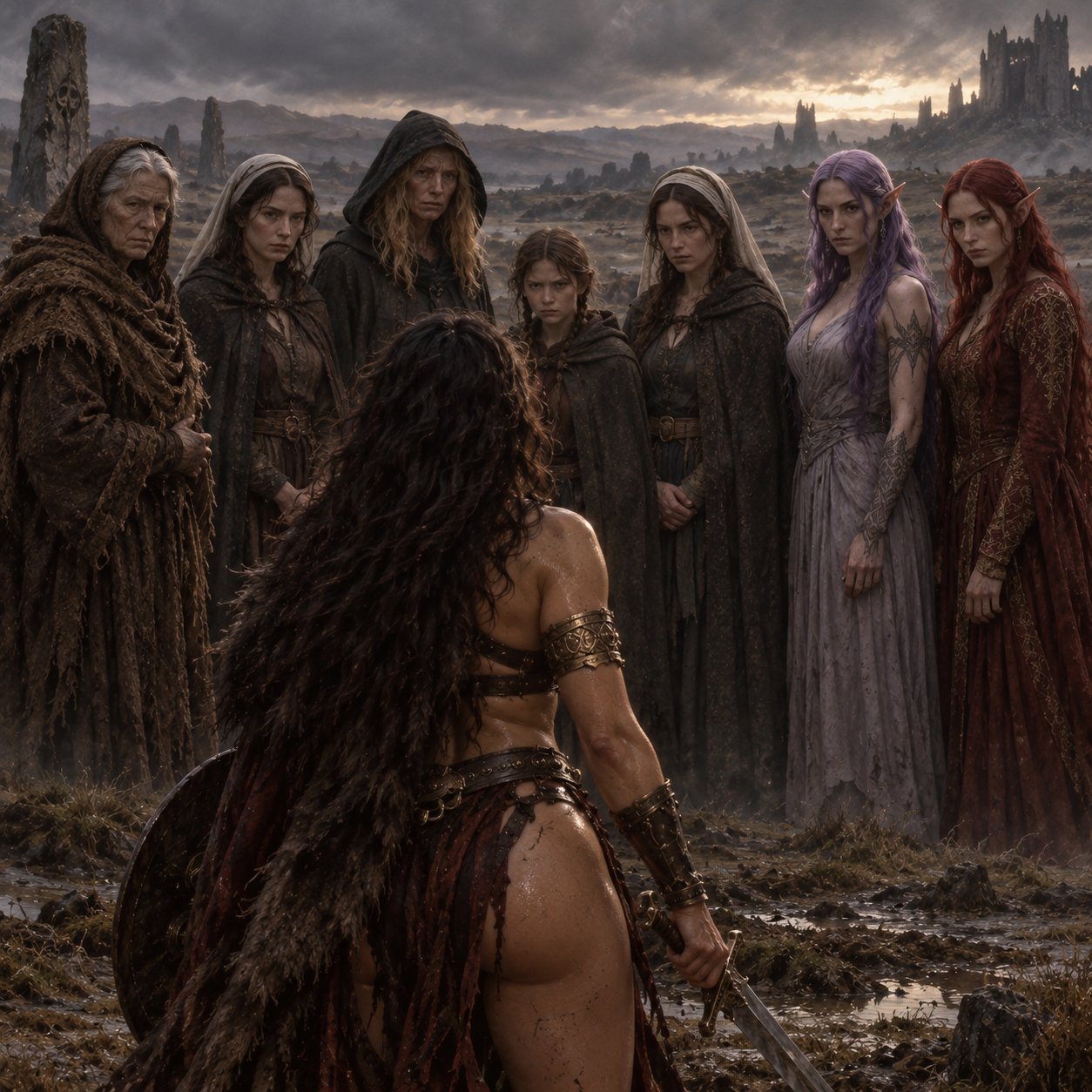
The woman defined by what she looks like
Robert E. Howard invented Red Sonja in chain mail that left nothing to the imagination, and the template has survived with remarkably little alteration. The woman warrior in modern fantasy may be stronger, better armoured and given a tragic backstory, but she is still, very often, presented through the camera of desire. Readers know what she looks like before they know what she wants.
Sarah J. Maas's heroines represent the contemporary version of this. They are powerful, they suffer, they fight, and they are described in terms that make clear the writer has never stopped thinking about how they appear to the men around them. The agency is real. The gaze has not moved.
Liora, in From Eelpond to Faelen's Watch, is never described through anyone's physical desire for her. I wrote what she learns, what she notices, what she decides, and what she risks. When Callen befriends her on the road, the danger is not sexual, despite her fears. It is institutional. He is scouting her for someone who sees her as a clean acquisition, a phrase that carries its own particular horror because it treats a person as inventory. Liora survives because she pays attention, not because she fights. She carves a single word into a tree and walks away, and that word is the most violent thing I wanted in the story.
The craft point is straightforward. A woman character who is defined by her decisions rather than her appearance does not need to reject femininity or perform toughness. She needs a writer willing to look at her the way she looks at the world.
I think the reason the gaze persists is that many fantasy writers have learned to write women by imitating other fantasy writers who wrote women badly. The template reproduces itself. Howard described women through male desire in the 1930s and the structural habit simply migrated from one generation of writers to the next, picking up modern vocabulary along the way. The most effective correction is not to write against the gaze deliberately. It is to forget it exists and describe the character from inside her own attention.
The woman who sacrifices for someone else's story
Tolkien's Arwen is beautiful, immortal and defined almost entirely by what she gives up so that Aragorn's story can reach its conclusion. Her sacrifice is real. It is also, from a craft perspective, not really hers. She surrenders immortality because the man she loves is mortal, and the weight of that loss belongs to the reader's understanding of what she has given rather than to anything she herself expresses about it. Arwen is what happens when a writer respects a woman enough to make her sacrifice meaningful but not enough to give her a voice inside it.
Ophelia is the earlier version. She is destroyed so that Hamlet's moral crisis can deepen. Her drowning is beautiful, famous, and entirely in service of someone else's reckoning.
Zaria, in Zaria's Choice, walks into the sea. But she does not do it for anyone. The bone wand has returned, the debt is hers, and the decision to settle it belongs to her alone. The girl who follows and watches from the breakwater does not understand what she is seeing. Zaria does not explain. The sacrifice is not softened by a witness who can translate it into something comfortable, and the girl will carry what she saw without being able to make it mean what she needs it to mean.
I wrote about Zaria once before, in an earlier Dark Hearth post on dark fantasy craft, because her story is useful for illustrating several principles at once. What matters here is specific. Her death is not in service of a man's arc. It is not in service of anyone's arc. It is the conclusion of a bargain she made years before the story opens, and the story's refusal to soften it with purpose is what I used to give it weight.
The sacrificial woman in fantasy almost always dies beautifully and meaningfully. Her death teaches the hero something. It motivates the quest. It proves the stakes are real. When a woman's death in fiction exists primarily so that a man can feel something, the writer has used her as furniture. Zaria's death teaches nobody anything. It settles a debt.
The woman who is allowed to be wrong
Lady Macbeth makes an ugly choice and is punished for it with madness. That is the traditional bargain. A woman in fiction may be morally compromised, but the story will extract payment in guilt, breakdown or destruction. The message is legible across centuries of literature. Women who make hard decisions will be broken by them.
Cersei Lannister is the modern inheritor. George R.R. Martin gave her genuine moral complexity, intelligence and a perspective the reader can inhabit, and then the narrative slowly codes her as a monster. She schemes, she drinks, she fails, and by the end the story has moved past any interest in her interior life. The complexity was provisional. The verdict was always coming.
Winn, in The Lie That Worked, makes a decision that harms an innocent person. She does it with full awareness of what it will cost, and she does it to protect someone else from something worse. The story does not punish her with madness or redeem her with a noble sacrifice. She made a choice that damaged someone who did not deserve it, and she continues to exist inside the consequences of that choice without achieving forgiveness or condemnation.
In all honesty, I found that harder to write than a heroine or a villain. A woman character who does something ugly and remains intelligible, who a reader can still see clearly without either excusing or condemning, required all of the resolve I could muster to resist the instinct toward a moral resolution. The story needed to remain still where most others might flinch.
Robin Hobb understood this with Malta Vestrit in the Liveship Traders. Malta begins as exactly the kind of woman fantasy usually dismisses. She is vain, materialistic, self-interested and impatient with everyone around her. Hobb refuses to punish her for any of it. Malta becomes formidable by discovering what those qualities are worth under real pressure. She grows dangerous without ever apologising for who she was at the start, and that refusal to make her earn the reader's approval through humility is one of the bravest things in modern fantasy writing.
The woman who speaks and is not forgiven for it
There is an old pattern in which women who open their mouths in the wrong room are either vindicated or destroyed. Joan of Arc burns. Antigone is entombed. The witch is hanged, drowned or exiled, and the story either makes her a martyr or makes her a warning. What the tradition rarely allows is the middle ground. The woman speaks, the room reacts, and she walks away carrying the cost without the story telling you whether she was right.
Cylaen, in The Court of Serafall, stands before a court that has found her misaligned. She does not accept the judgement. She fights with language, picks apart the reasoning, and exposes the fear underneath the procedure. The court does not reconsider. It does not see reason. It removes her. She is exiled, and she walks to the Durn Yew, and the story does not circle back to tell you she was vindicated or that the court regretted its decision.
What I hope the story tells you instead is what her twin, Saereth, felt while watching it happen. That is the craft decision that I chose to hold this one together. The reader experiences Cylaen's defiance from the perspective of someone who loves her and cannot help. The court is afraid. Cylaen is clear. Saereth is the one who breaks, because witnessing courage you cannot match and cannot protect is its own kind of damage.
Angela Carter never let a woman character become a lesson. In The Bloody Chamber, the women have appetite, will, sometimes monstrous expression, and Carter refused to smooth those qualities into either heroism or cautionary tale. She understood that a woman who frightens the reader and remains sympathetic is worth more to fiction than one who confirms what the reader already believes. That double vision, where the character is both admirable and unsettling at the same time, is the territory I wanted Cylaen to occupy.
What these four women share
None of them needs rescuing. None of them is defined by a man's perception of them. None of them is rewarded for being good or punished for being bad in the ways fiction has traditionally required.
What they share is cost. Liora pays in vigilance. Zaria pays in life. Winn pays in the knowledge of what she chose to do to someone who trusted her. Cylaen pays in exile. Every one of those costs is specific to the woman who carries it, shaped by her circumstances and her decisions rather than by what the plot requires of a female character.
That specificity is the craft argument. Writing women well in dark fantasy, or perhaps any genre, does not mean writing them tough, or noble, or fierce, or any of the other adjectives that have become shortcuts for taking women seriously. It means writing them with the same attention to consequence, compromise and cost that you would bring to any character whose decisions will impact the story.
Fantasy's defaults for women are old and lazy. A writer who reaches for the warrior princess, the sacrificial maiden, the ethereal beloved or the scheming queen has saved time by borrowing a tired archetype instead of building a person. She might do certain things reliably, but she will never surprise anyone. It will never cost the reader anything. And dark fantasy, if it is doing its job, should cost the reader something.
If you'd like to follow Jonathan B. Edvane, you can do so here.
Discussion