Fantasy has a monster issue, and it is not a shortage. There are plenty of them. The problem is that most of them exist only to be fought and defeated or destroyed. They arrive, threaten all and sundry, and the hero steps in to boss them out of town or out of existence. And the story? It moves on to the next confrontation. The monster is an obstacle. Its purpose is to test the protagonists, and once the test is passed, it has nothing left to offer.
I have never found that especially interesting. In four of the Marchlands stories, I have written creatures that could reasonably be called monstrous, and in none of them does the monster serve as something that must be overcome. They are lenses. Each one exists to show the reader something about the world, the character, or the story's moral landscape that could not be shown without them. They are not there to be fought, although they may be. They are there to be understood, or in some cases, to demonstrate that understanding might not be available.
In this post I discuss how each of them works, and why I think dark fantasy benefits from monsters that refuse to behave like villains.
The monster that needs you
In The Krivvian, Drenn Falkor steps through a gate into the realm of Krivv looking for solitude. What he finds is a jungle that watches him. The Krivvian are small, scaled, glistening with mucus, and equipped with hooked fingers and corrosive spit. They test him with escalating provocation. A bite on the neck. A corrosive glob on a trunk. A grin full of jagged teeth. They are physically repulsive. Most of the detail I gave to them, and Drenn's revulsion, clashing with his love for simpler creatures, hopefully comes across as genuine and sustained.
But the Krivvian are not quite hunting him. They are assessing him. When something in their realm shifts and they need to leave, they climb onto him. They hook into his pauldron, his belt, his cloak, anywhere that will grant them purchase. Drenn carries them out through the gate because he is the only thing that will move, and they chose him because he sat still when every instinct told him to draw his sword.
The monster here is the passenger rather than the antagonist. Drenn's test is not whether he can kill the Krivvian but whether he can bear them. The monstrous is entirely in the physical sensation, the mucus, the hooks, the rancid breath - and in the surrender of control that carrying them demands.
The monster that narrates
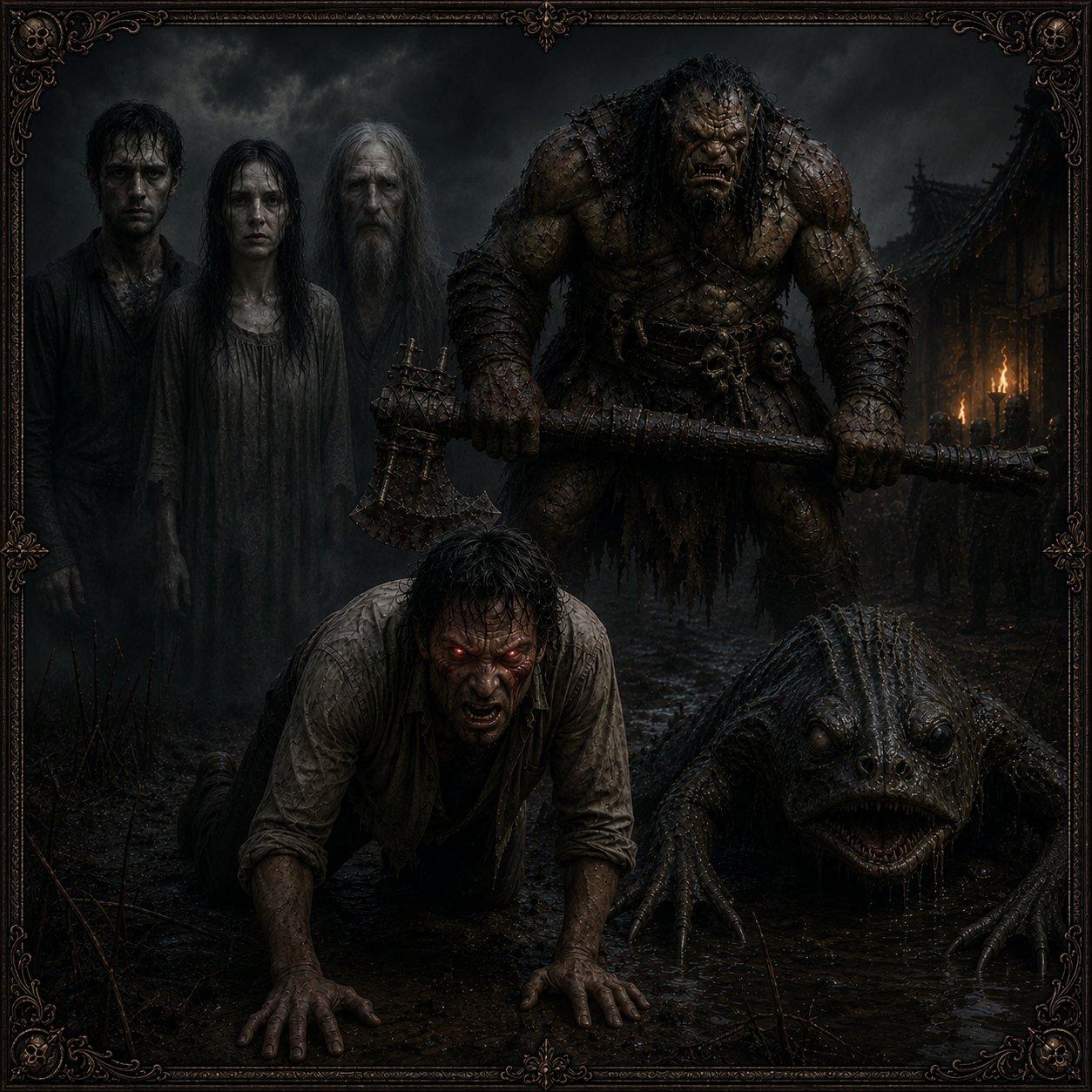
An Ogre Denied is written entirely from inside the monster. The ogre has no name. He has appetite, function, and a body built for breaking. He wins a fight, takes a two-handed axe, and crosses through a gate into the Shivering Vale to raid. The first few paragraphs are meant to sit the reader inside a mind that does not reflect or regret, and makes no distinction between violence and purpose.
Then the Shepherds of Aurivath arrive. They are hooded, featureless, and they drift rather than walk. They cannot be struck, cannot be reached, and do not pursue. They just appear, and the ogres around him are torn apart before his eyes. The ogre flees, hides, and survives. He wanders the Vale afterwards, eating the remains of his companions without moral hesitation. He searches for a gate that will not reappear. He strikes the landscape with his axe because striking is all he knows. The Vale does not care.
The Beowulf poet understood something about this territory that most fantasy forgets. Grendel is not only a threat to Heorot. He is an exile. He lives outside the hall, outside the light, outside the community that defines itself by what it excludes. The poem gives him lineage, descent from Cain, and a reason for his rage. He is monstrous because he has been thrust outside humanity and forced to listen to its joy from the darkness.
My ogre occupies similar ground, though from further inside. The reader spends the entire story in a mind that has no access to reflection, and the horror is that violence is all he is, and the Vale has made it meaningless. It rendered him irrelevant.
The monster that mirrors
What The City Permits contains a demon, but the demon is not the monster of the story. It possesses Lysander Bly, a dock-factor in the city of Lenth, and it tears him apart from the inside. The possession is physical and brutal. Bly's mouth splits, his ribs crack, his body is used as a vessel until it fails. The demon is articulate, politically aware, and interested in being recognised as part of the city's machinery. It tells Osric Dyer, the reeve sent to contain it, that Bly invited it with his debt.
The real monster is the city of Lenth itself. The merchants who commissioned the possession through intermediaries. The Aldermen who reduce the aftermath to fines and penance. The system that digests horror and calls the result order. Osric does not defeat the demon. He watches Kress, the licensed binder, collapse the host's body to destroy the thing inside it. Then he writes a report, requests executions, and receives a decision that prioritises trade over justice. He deems it the last straw, something he could have predicted and leaves the city. The demon did not break him. The city's response to it did.
Mary Shelley built the template for this. Her creature is not the villain of Frankenstein. He is the consequence of Victor's ambition and abandonment. He is articulate, capable of love, and driven to violence only after every attempt at connection is met with revulsion. The horror of the novel is not the creature's murders. It is Victor's refusal to take responsibility for what he made. The monster mirrors the maker, and the maker cannot bear to look.
The demon in Lenth works the same way. It mirrors the city's corruption back at the man whose job is to contain it, and the reflection is disgusting enough to make him walk away.
The monster that accumulates
The Farewell Chamber has no monster at all in the conventional sense. The Farewell Chamber is a room in the Yewdeep grown for partings. People come to say goodbye, and the room holds their words. The problem is that too many of those words were promises that were never kept, and the room has begun to retain the dead who made them. A woman with wet hair and a missing arm. A young man with a wound at his throat that does not bleed. They appear during farewells, standing behind the one who is about to leave, and they do not speak or move toward the living. They gather and remain.
Retta, the custodian, watches this happen and eventually recognises that the room has reached its limit. The Yew does not understand unfulfilled promises. It only knows that something was spoken and never completed, and it holds the residue because it has no mechanism for letting go. Retta closes the room. There is no supernatural battle or exorcism. He merely places his palms on the root-wall and tells it "enough."
The monstrous here is accumulation. The ghosts are not malicious. They are the weight of words that outlived the people who spoke them. The room became dangerous because something human happened in it too many times without resolution.
What the lens shows
China Miéville understood that monsters could be structural rather than dramatic. In Perdido Street Station, the slake-moths are terrifying, but they exist inside an ecology. The Remade are monstrous, but they are products of a political system that uses flesh as punishment. The creatures in his work are never simply enemies to be overcome. They are symptoms of the world they inhabit, and fighting them without addressing the root cause of their existence is futile. Miéville's monsters belong to their cities the way disease belongs to poverty. They are consequences.
That is closer to what I am attempting than any model built on heroes and villains. The Krivvian belong to Krivv. The demon belongs to Lenth's economy. The ghosts belong to the Yew's inability to forget. Even the ogre, displaced and irrelevant, belongs to a system of raiding that the Vale was not built to accommodate. None of them arrived from outside. None of them can be removed without removing the conditions that produced them.
When I write a monster, I am not asking you to fear it. I am asking you to look through it at something else. The fear, when it comes, should be directed at what the creature reveals about the world it inhabits and the people who share that world with it. That is what dark fantasy can do with monsters that other genres cannot. It can make them legible without making them safe, and it can refuse to let the reader off the hook by offering a clean kill at the end.
The Krivvian are still clinging to Drenn somewhere in the Yewdeep. The ogre is still walking the Vale with a broken axe. The demon is gone, but more will surely come, while Lenth's Aldermen are still voting. The Farewell Chamber is sealed, but the Yew will need to grow another room, because people will always make promises they cannot keep.
None of these problems have been solved, and that is the point.
If you'd like to follow Jonathan B. Edvane, you can do so here.
Discussion