The Story
Joining The Returned this week is The Uncounted, bringing with it a lesson I have already learned. I see this rejection as belonging to the same category as the IONTAS one. PNW Gothic is exactly the right register for my work, however it is there to serve a specific community of writers. I took a chance on it because I lived and worked in the Pacific North West for an extended period in the late nineties, when I resided in Seattle and Mount Vernon.
It is a polite form rejection, and one I had been expecting in all honesty. I wrote this one to fit the publication and again I find that to be a misguided technique. I still think it is a decent story, containing some of the most interesting historical facts that I ever dug up, and therefore I rest it in The Returned for you to judge. Do leave a comment.
The Rejection
Submitted to Pacific Northwest Gothic for their inaugural issue, in 2026.
Rejection · Pacific Northwest Gothic
Thank you so much for submitting your work to Pacific Northwest Gothic. We truly appreciate your interest in our journal and the trust you placed in us by sharing your work.
After careful consideration, we have decided to pass on your piece for this issue. Please know that this decision is not a reflection of the quality of your work. With so many strong submissions, we had to make some difficult choices.
We are unable to provide specific feedback on submissions or answer questions about our process. Submissions for our second issue will open up early next year, we hope you’ll consider submitting to us again in 2027.
— The PNW Gothic Team
Listen — Narrated Version
The Uncounted
I have wondered for years whether there is any wisdom in writing this down. I hardly believe it myself, and I was there. Memory changes things. Perhaps I saw less than I remember, or understood more than there was to understand. Yet I know what I heard, and I know what happened to Anna Brown. If I tell it, some will call me a liar and others a drunk. I would almost prefer either explanation. But silence has troubled me longer than disbelief ever could, and so here is the whole business.
* * *
I reached Seattle in the last week of November, back in 97, with rain dripping from every edge of me and enough money in my pocket to keep me off the street for maybe a month. I had come from Chicago because Seattle was far away, and at that point distance seemed the most important consideration.
Pioneer Square was mud, brick, steam and shouting. New buildings towered above streets that had themselves been lifted a full storey since the fire, so that old doorways and windows remained below ground while the city carried on over their heads. It was the craziest thing. In places, square glass prisms had been set into the pavement, and they caught the lights from the buried level. It felt like there was another Seattle beneath the one I was walking through. And maybe there was.
The Klondike had filled the streets with men buying picks, blankets, sledges and anything else a shopkeeper could persuade them they would need before reaching Alaska. Wagons blocked the crossings. Drunks spilled from saloons. Dogs howled.
I found the Elliott House by chance and stayed because the sign said rooms were twenty-five cents a night. The lobby smelled of tobacco and old wood. Clifton Miller sat behind the desk with a newspaper folded beside him and took my name without looking up. He knew my accent, though.
“Chicago?” he said.
I nodded.
He pushed a key across the counter. “Second floor. Better than the ground. This whole neighbourhood burned down eight years ago. This place went up after. Clean start for Seattle.” He glanced towards the windows. “Remarkable thing is nobody died. Not one person in the whole fire. Or so they say. I can’t see it.”
My room was small but dry, with a bed, washstand and one chair. I slept badly. Sometime after midnight I woke to sounds beneath the floorboards, faint scraping and muffled voices. I decided it must be the saloon below, or men moving through the underground passages and closed my eyes again.
* * *
Three nights later, I woke to a woman screaming on the floor below. In the Elliott, noise travelled easily and most of it meant nothing. Men came in drunk, doors were slammed, arguments started over money or cards or women and were forgotten by morning. This was different. The scream ended too suddenly, and what followed it was not the usual commotion. It was complete silence. Intrigued, I jumped out of bed and headed down there.
I found her in the first-floor corridor, pressed against the wall opposite her room and staring at the place where a length of skirting had been pulled away. I had seen her before in the lobby, though we had never spoken. She was a dark-haired woman, perhaps a few years younger than me, who gave the clear impression of being somebody used to managing without help. There was none of that composure in her now. She was shaking badly enough that when I asked if she was hurt, she only pointed towards the gap.
“There was a face,” she said. “Under there. Looking up at me.”
I crouched and put my eye close to the opening. At first I saw nothing except darkness, but after a few seconds I could make out the faint sheen of wet stone somewhere below. There were passages under that part of the city, and enough men slept or smoked or hid themselves down there that a face beneath a floor was not impossible. I told her so. “Some drunk found his way under the building, maybe. Or one of the opium men. There are plenty of them down there.”
She looked at me as though I had missed the point. “I’ve been here two months,” she said. “I know what the men underneath look like. This wasn’t one of them.”
Something about her conviction stopped me from offering another explanation. I asked what she had seen, and she said the face had been white as candle grease, its mouth hanging open, its eyes fixed on her without blinking. I caught the smell of liquor about her, but drink alone could not account for what I saw in her face.
She said her name was Anna Brown, and I walked her back to her room. Before going upstairs again, I glanced through the corridor window towards the street. Pioneer Square was almost dark, though the glass prisms set into the pavement still held their light, only brighter now. Yet I thought nothing of it.
* * *
Over the next few days Anna and I began talking. Sometimes it was in the lobby when Miller had gone into the back room, sometimes on the stairs, once over coffee in a place near Yesler where the windows sweated from the heat inside. She didn’t say much about herself and I returned the favour. There are people who ask questions because they are interested in you and people who ask because somebody else might want to know. Anna was neither. She seemed content to let some things remain unsaid until there was a reason to say them.
It was there, over that coffee, that she told me about Orville Johnson, who had occupied the room next to hers until a few weeks before I arrived. “You would have hated him,” she said. “Most people did. He kicked one of the dogs outside because it was lying across the step, and Miller once had to drag him out of the saloon for refusing to pay.” None of that had anything to do with what happened to him, she added. One morning his room was just empty. His boots were still beside the bed, his coat on the hook, his shaving things on the washstand. Miller said he must have left in a hurry. “Without his boots?” I asked. Anna looked at me over the rim of her cup. “That was what I said.”
After that I began paying more attention to the place. I noticed how often doors stood open on rooms I had thought were occupied, and how rarely anybody asked where a neighbour had gone. Seattle was full of people passing through, and the Elliott more than most places. A man could be there on Monday and halfway to Skagway by Thursday, or sleeping in an alley by Wednesday, and nobody thought it strange.
Then, one evening, Miller started his rounds.
He went along the ground floor knocking hard on doors and calling out what was owed. We could hear him from the lobby, grumbling about men who could find money for whiskey but not for a bed. After a while the knocking stopped. When he came back, his face had changed.
“There are three gone,” he said.
Anna straightened. “Gone how?”
“Just gone. Smith. Jasper Smith. Minnie Sullivan. And another fella.” He rubbed at his mouth. “Damn it, I can’t recall his name.”
We went with him. In Jasper Smith’s room the blankets were on the bed and his valise was under it, but the iron frame had been dragged nearly two feet sideways. In Minnie Sullivan’s room the boards near the wall bulged upward, as though something beneath them had put its back to the floor and pushed.
Miller stared at it for a long time. “I’ll fetch the police.”
Anna waited until he had gone back towards the lobby before saying, “They won’t come.”
I asked why not.
“Because people like this disappear every day. Nobody ever comes.”
* * *
That night I slept with my clothes on. I told myself it was because I meant to leave early in the morning, though I had packed nothing and didn’t know where I would go. The truth was that I no longer liked the thought of being caught barefoot in the Elliott House.
Sometime after midnight I heard Miller below me. At first it was only his voice, sharper than usual, carrying up through the floorboards as he called into one of the ground-floor rooms. I could not make out the words. Then came a crash, followed by a sound I had never heard from a man before and never want to hear again. It began as a shout and changed halfway through, as though whoever was making it had lost the proper use of his throat.
Then there was nothing. That silence again.
I was on the stairs and moving, and found Anna in the corridor below, wrapped in a coat over her nightdress, staring towards the room with the bowed floorboards.
“Miller went in there,” she said. “He said he wanted another look.”
The door was shut. I called his name and received no answer. When I tried the handle it would not move, so I put my shoulder against the wood. The frame gave on the second attempt.
The room was empty.
The window was closed and latched from inside. The bed stood where we had left it. More than that, the floorboards were flat. I crossed the room and stamped on them, then knelt and ran my hand across the place where they had bulged only hours earlier. The wood was hard and seamless.
There was no Miller. No broken board, no open trap, no place for a man to have gone. Only a smell.
Anna came as far as the doorway and stopped. “What is that stink?”
I knew smoke, wet cellars, slaughterhouses, coal yards and alleys after rain. This was none of them and somehow all of them together. Sealed away and then uncovered. I stood up. Anna looked at me, and whatever hesitation had been between us was gone.
“We need to leave,” I said.
She nodded once. “Now.”
There was nothing else to discuss.
* * *
I took the stairs two at a time and was back in my room before the smell of that room had left my clothes. Packing took less than a minute. I had arrived in Seattle with little enough and had acquired nothing worth delaying for. Shirt, razor, money, coat. I left the washbasin full and the bed unmade and did not look back when I closed the door.
Anna’s door stood open when I reached it, and for one foolish second the sight of the lamp burning inside made me think everything was still ordinary. She had her bag on the bed and was crossing towards the window, reaching for the coat hanging from the hook beside it.
Then her feet left the floor.
There was no jerk, no hand around her ankle, nothing I could describe afterwards and call the thing that took her. The boards beneath her just seemed to lose their hardness and become mud. Her shoes sank through them first, then her ankles.
“Anna.”
She turned towards me. Her bag slipped from her hand and struck the floor. I lunged for her, but by the time I got close she was down to her knees. I caught her wrist for an instant and felt her weight drag against me. She did not scream. She only looked at me, wide-eyed, and said my name once.
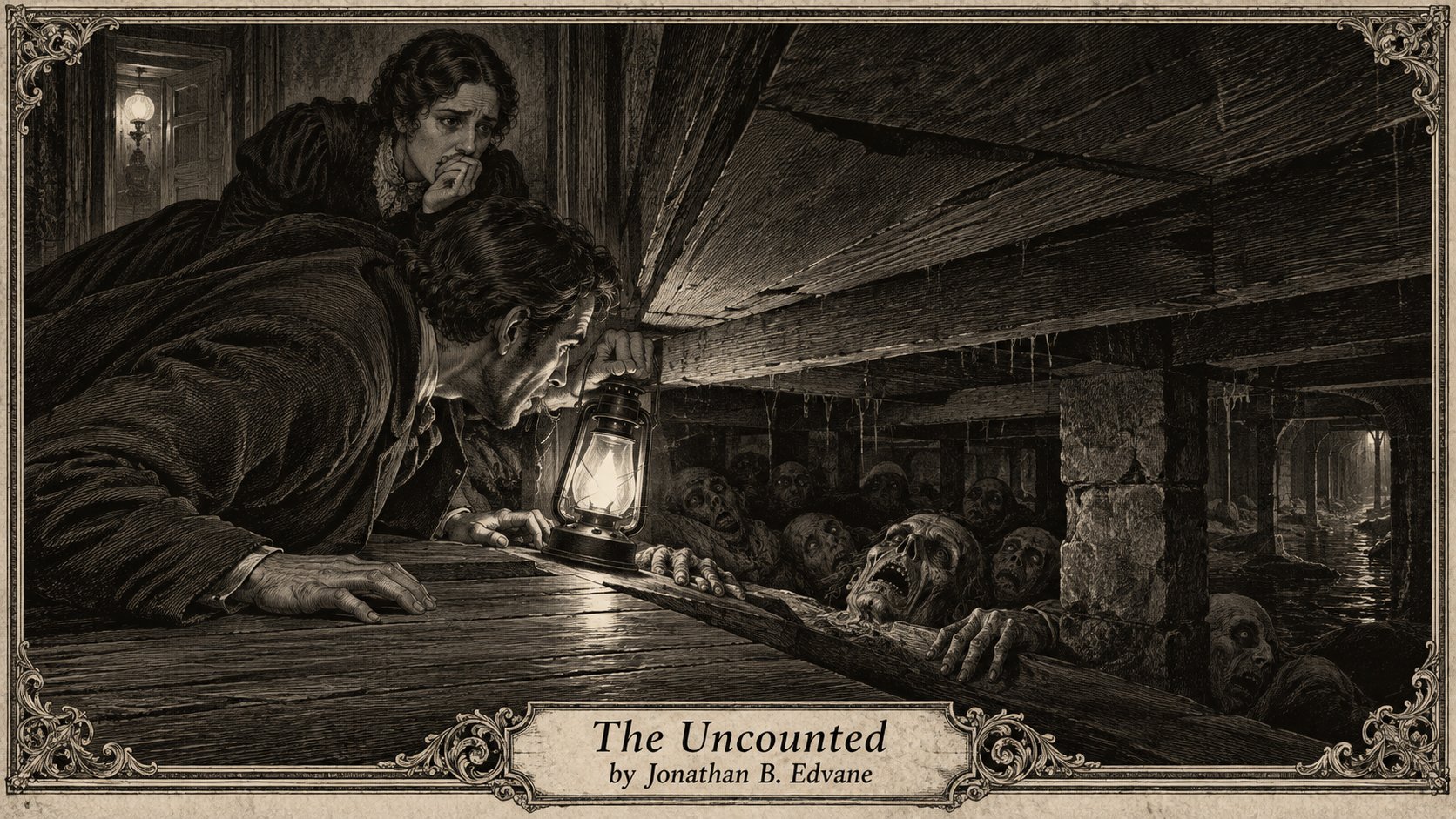
The floor opened wider around her, and I saw faces beneath it.
Not one. Many. Pale faces pressed close together in darkness, men and women, young and old, mouths hanging open as they looked upward. There was no anger and no hunger either. What I saw in those mouths was a desperate need. Vast and terrible.
Then Anna was gone.
The boards closed behind her without a crack. I dropped to my knees and struck them with both hands, shouting her name, but the floor was solid again. Her coat still hung beside the window. Her bag lay where she had dropped it. The lamp burned steadily on the table. For a moment I stayed there, staring at the place where she had been.
Then I ran.
I went down through the lobby, through the front door and out into the rain. I did not stop when I reached the street. I did not look back at the Elliott. And when the glass prisms shone beneath my feet, I kept my eyes ahead.
* * *
Where I went after Seattle does not matter much. I crossed the Sound, then went south, and before long I had learned again how to keep moving when a place began to know my name. I never went back to the Elliott House.
The official record of the Great Seattle Fire says that not a single life was lost on June 6, 1889. People still repeat it as proof of good fortune, as though a city can be absolved by keeping poor records.
I know better. There were dead beneath those streets, and I saw their faces. Somebody should have counted them.
Discussion