The Story
She Never Came Home was another early story I wrote for the theme of a publication, namely issue two of FOLKLORE by IONTAS Magazine. This is an Irish-led, Belfast-based writing community and they said they were keen on Irish voices. She Never Came Home is an English writer telling a story about Magdalene Laundries. That is one of the most painful chapters in Irish social history, and it is still raw.
Holly Evans may have looked at the name Jonathan B. Edvane, seen no Irish connection, and felt uncomfortable giving that particular story to an outsider when she had fifty Irish writers in a pile of over five hundred. My connection to Ireland is only slightly tenuous, since my father was Irish, from the south. She would not say that in a form rejection, but with five hundred submissions to choose from, it is an easy pass to make.
My own issue with it is the length. I adapted the piece to bring it under a thousand words when it would have been more interesting as something longer. I have no plan to extend it, so it rests here in The Returned.
The Rejection
Submitted to IONTAS Magazine for FOLKLORE, issue two, in 2026.
Rejection · IONTAS Magazine
Dear fellow creative,
Thank you for submitting to our second quarterly magazine, FOLKLORE. Unfortunately, your work has not been selected for this edition.
We really appreciate you sharing your work with us, your trust with IONTAS does not go unappreciated.
We received almost 500 submissions for FOLKLORE, and we can only include 50. A lot of fine work had to be turned down so we hope that this does not discourage you. We hope to see more work from you in our future issues.
Thank you for creating in a society that values instantaneous results over intentional choice.
Go raibh maith agat,
— Holly Evans, Editor-in-Chief, IONTAS Magazine
Listen — Narrated Version
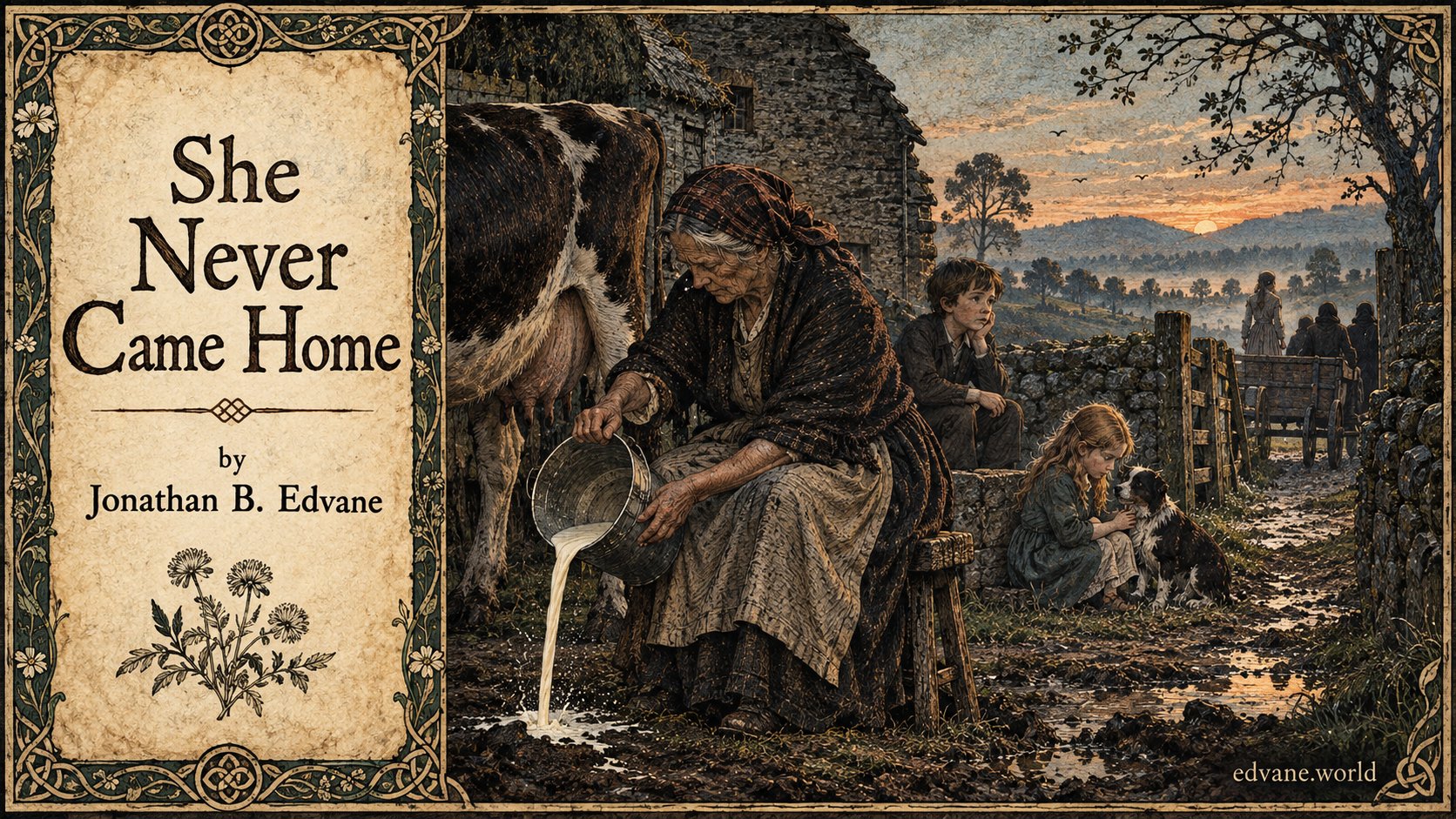
She Never Came Home
The morning was only beginning to colour the yard when Nana Kelly drew the stool beneath the cow and set the pail between her feet. Michael stood close enough to hear the milk strike the tin, while Áine crouched by the wall, pulling at the wet grass and telling the dog something only he could hear.
Nana milked in silence until a pale froth gathered. Then she tipped the first of it onto the earth.
Michael frowned. “Why did you do that?”
“Do what?”
“Waste it.”
She looked down at the dark patch soaking into the dust, then across at Áine, who had begun plaiting grass between her fingers. She set the pail aside and wiped her hand on her apron.
“Come here to me.”
She lifted him onto the low wall, choosing her words while the yard held still.
“When I was a wee thing,” Nana said, “I was an O’Hara then, and only five years old. Bridget was my sister. Sixteen she was, and fair enough to have every boy in the parish looking twice.”
Michael glanced towards Áine, but Nana went on.
“Owen Gilmartin was the worst of them. He knew well what the first milk was for. Everyone did. The beastings belonged to the earth and the Aos Sí, and you did not put them to your own mouth.”
Bridget had laughed when he dared her. The naive sound of it, and Owen leaning against the wall with the look of a lad certain she would follow. Bridget lifted the pail and drank, watching him over the rim.
“She wanted to show him she was not afraid,” Nana said.
“And was she?”
Nana looked down at her hands.
“She was sixteen, and he knew better.”
“It was the next morning the butter failed,” Nana said. She remembered Ma at the dash, working it until her arms shook, then starting over. “Three days she tried, maybe four, and still the cream would not break.”
Bridget was kept from the work after that. Nana remembered her standing by the door while Ma laboured, saying nothing beneath the looks cast her way.
Then the milk changed. “Pink it was at first, only a little, but by the week’s end it came the colour of ruby port.” Nana had seen that herself. She had seen Ma cross herself over the pail and carry it outside. What she had not understood was why the neighbours stopped calling, or why people passing on the road turned their faces from the O’Hara house.
The calf was found dead soon afterwards, stiff in the grass and without a mark upon it. It was the calf of the cow whose beastings Bridget had drunk, and that was enough.
“Maybe the cow was sick. Maybe the cream was wrong. Calves die.” Those explanations came years later, when nobody had any use for them.
By then the whisper had changed. Bridget had been seen with Owen Gilmartin. The girl was wayward. There was something wrong in her. “They scarce spoke of the milk after that,” Nana said. “It had done its work. They had their story, and Bridget was the one made to pay for it.”
“Father Flanagan came,” Nana said. “I remember him in the doorway, with Sister O’Beirne and Sister Brennan behind him. What was said before they took her, I cannot tell you. Nobody spoke to me.”
She remembered Bridget being brought from the kitchen, though brought was too gentle a word for it. One nun held each arm while Bridget twisted between them, calling for Ma, then for Nana. The sound of her voice had stayed when so much else had gone.
“I caught hold of her skirt,” Nana said, and her fingers closed upon the edge of her apron as they had closed upon the cloth that day. Bridget reached back, bending towards her, but Ma seized Nana around the waist and dragged her away. She had kicked and bitten and screamed until Ma held her so tightly she could scarcely breathe.
Father Flanagan touched no one. He stood aside and watched the nuns take Bridget across the yard to the waiting cart.
“That was the last of her I ever saw.”
No letter came. No neighbour brought word. Ma never spoke Bridget’s name again, and after a while Nana learned that asking only made the silence harder. She watched Michael carefully, measuring what seven years could bear.
Nana rose from the wall and brushed the dust from her apron. For a moment she said nothing. Then she looked past Michael to where Áine was still crouched in the grass, whispering into the dog’s ear.
“You see that wee sister of yours?” she said. “You want to keep seeing her here, where she belongs?”
Michael followed her eyes toward Áine.
“Then you mind her. You keep her close, and any boy comes around giving her the glad eye, you send him on his way. Do you hear me?”
He nodded, though he understood only the stern tone of her voice.
Nana lifted the pail and went back to the cow. She had brought the custom with her from the O’Hara place when she married into the Kelly farm, and every first pour since had gone into the earth. Whether it was owed to the Aos Sí or to Bridget, she could no longer have said. The two had grown together over the years until belief and grief were the same thing.
She settled once more on the stool and resumed milking. The damp patch darkened the ground beside her feet.
It was the one thing she could still do for the sister who had never come home.
Discussion