
Contemporary fantasy has grown comfortable with a particular version of the witch story. The witch is misunderstood. She is a healer, persecuted by fearful men. The reader knows whose side to take from the opening paragraph and never has cause to question that allegiance.
This is a useful story. It also has very little to do with folklore.
The older traditions were not interested in protecting the reader. They understood that the woman who healed your child and the woman you feared in the lane might be the same person, and that neither version of her cancelled the other. Dark folklore begins where that discomfort is allowed to stand.
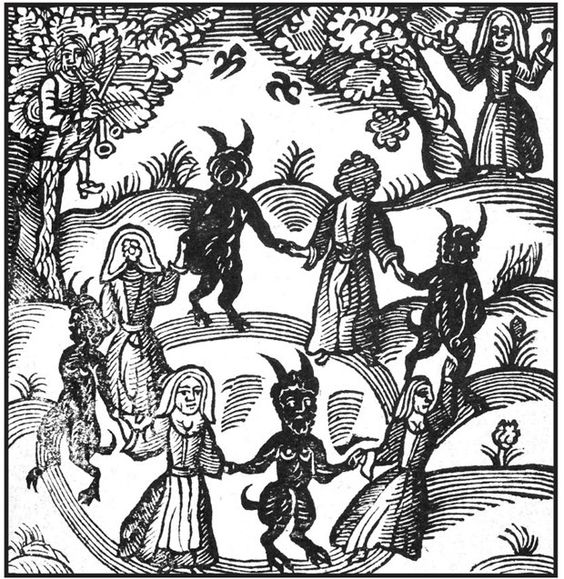
The Broomfield Witch is a first-person memorandum from a woman called Jess Harwood, who returns to her dead mother's house in an Essex village after the mother was burned at the stake. She finds the remnants of a healing practice. She takes it up. The parish comes back to her door in secret, needing what it once condemned. She discovers a supernatural artefact hidden behind a chimney brick and uses it to save a dying man. What follows is a story about what happens when the power to heal and the power to harm turn out to live in the same hand, and what that costs everyone near it.
The story belongs to a tradition of dark folklore and folk horror that runs through Angela Carter, Shirley Jackson, and Andrew Michael Hurley. What connects them, across decades and across differences of style, is a shared refusal. The reader will not be shielded from the story's full weight.
The witch who won't be saved
Angela Carter's great contribution to the witch story was her refusal to swap one simplicity for another. In The Bloody Chamber, her fairy-tale women have appetite and will, sometimes monstrous in expression. They are complicated where the originals were flat, and Carter never softened that complexity by turning them into heroines who happen to wear black.
Jess Harwood begins in a position I anticipated the reader to instinctively want to defend. A daughter returning to her dead mother's house. A woman taking up healing in a parish that destroyed the last woman to do the same. Sympathy settles on her early and without effort, and it's a trap. Because when Jess acts, it is with calm and forethought, it crosses a boundary her mother never crossed, and it does not ask the reader's forgiveness for it.
Writing a witch with that kind of agency asks more of the craft than writing a victim or a villain. The character must remain intelligible in her own terms while becoming genuinely frightening in the reader's. If the reader stops understanding Jess, the story collapses into simple horror. If the reader never stops agreeing with her, it sinks into revenge fantasy. Dark folklore occupies the narrow ground between those failures, the space where sympathy and dread sit together in the same sentence and neither one gives way.
I wrote about folklore's gentler possibilities in an earlier post, using Bramlick the Brownie to explore how charm and warmth can serve as a reader's entry point into a stranger world. The Broomfield Witch works the opposite side of the same territory. The question underneath both posts is the same. How much of folklore's original weight are you willing to let your fiction carry?
The hearth, not the battlefield
Epic fantasy tends to build its dread through scale. Dark folklore builds through proximity. The frightening thing is already in the house.
Andrew Michael Hurley writes in this territory with uncommon discipline. In Starve Acre, the horror grows from a family home where a dead child's belongings are still in place and something has been dug up from the field behind the house that should have stayed buried. Hurley never yells at you, though. The dread accumulates through domestic objects that seem to remember something the characters have not yet grasped. That restraint tells the reader something essential about the kind of story they are in. No quest will carry them toward the danger. The danger sits where they sit.
The Broomfield Witch stakes everything on the same principle. The Eye of the Dracan is an Anglo-Saxon relic, hidden behind a chimney brick. The mother's rules are written on slips of folded paper. Visitors arrive at dusk and leave before anyone can mark them. Every object in the story could sit on a real mantelpiece in a real Essex cottage, and that ordinariness is what gives the supernatural its impact. When Jess describes blood coming "fresh and eager" from a wound, you believe her because you have already believed the willow bark, the three-legged stool, the strip of linen stiff where it had once been wet.
Folklore that frightens keeps its feet on the hearthstone. The further the strangeness travels from the kitchen table, the less it costs the reader to accept and the less it costs them to remember.
Sylvia Townsend Warner understood this a hundred years ago. In Lolly Willowes, a woman's pact with the Devil is told with the same domestic precision other writers might bring to a story about keeping house. Warner proved that the witch story needed no Gothic machinery at all. A woman who had stopped apologising was sufficient.
The confession that tells the truth and lies at the same time
Shirley Jackson built We Have Always Lived in the Castle around a narrator who admits to terrible things in a voice so calm that the reader keeps trusting her long past the point of safety. Merricat Blackwood describes poisoning her family with the same steady attention she brings to burying objects in the garden. There is no guilt in her account because she does not experience guilt. And because the reader is locked inside her perspective, the absence becomes invisible for whole chapters.
Jess Harwood's memorandum is intended to work on the same principle, though pushed further. She tells you what she did and what it cost. She does not conceal the details. What she does instead is more dangerous. She shows you the parish that burned her mother and then came back to the same door when pain compelled them, and the priest who arrived in compassion and returned with force. She lets you construct the case for her actions inside your own head while she watches from behind the prose. By the time you reach the killing, I hoped some part of you may have already agreed with her. That recognition, that you have been managed by a voice you chose to trust, is the thing I want readers to feel in this story.
First-person narration in dark folklore removes the last barrier between reader and character. There is no external voice to pull you back to safety. You are inside the logic. If I have done the work right, you will not notice when you crossed from sympathy into something closer to complicity until the story is finished and you are left sitting with what you allowed yourself to feel.
Where dark folklore keeps its power
Before fairy tales were softened for nurseries, they were warnings. Before witch stories became allegories of persecution, they were something harder and stranger. The oldest traditions understood that the figure in the wood might also be the one you needed, and that needing her would never make her safe.
That understanding has not disappeared. It survives in Carter's shape-shifting brides, in Hurley's unearthed remains, in Jackson's calm and devastating narrators. It survives wherever a writer chooses to let folklore keep its original weight rather than trimming it into reassurance.
I wrote The Broomfield Witch inside that commitment. Whether it delivers is for the reader to judge. The tradition it belongs to is old enough and wide enough to welcome anyone willing to stop shielding the page from what the story already knows.
The Broomfield Witch can be read in full at Edvane Stories.
If you'd like to follow Jonathan B. Edvane, you can do so here.
Discussion