Writers often use folklore as a catalogue. They take a creature, a name, a few regional traits, and drop it into a fantasy world. The result may be recognisable. It will rarely feel rooted.
The problem is that folklore is not a stock cupboard of creatures. It is a way of thinking about the world. A brownie is not interesting merely because it is a small household spirit with a hat and a fondness for order. The useful question is not about what it looks like, but what kind of life, fear, duty, bargain and moral arrangement does a brownie imply? What does its existence say about the people who needed to believe in it?
Bramlick the Brownie, the eleventh story in the Tales from the Woldwood sequence, takes that question seriously. And because it does, it produces something that I hope reads as genuinely folkloric rather than merely folklore-flavoured.
Begin with what the figure does, not what it is called
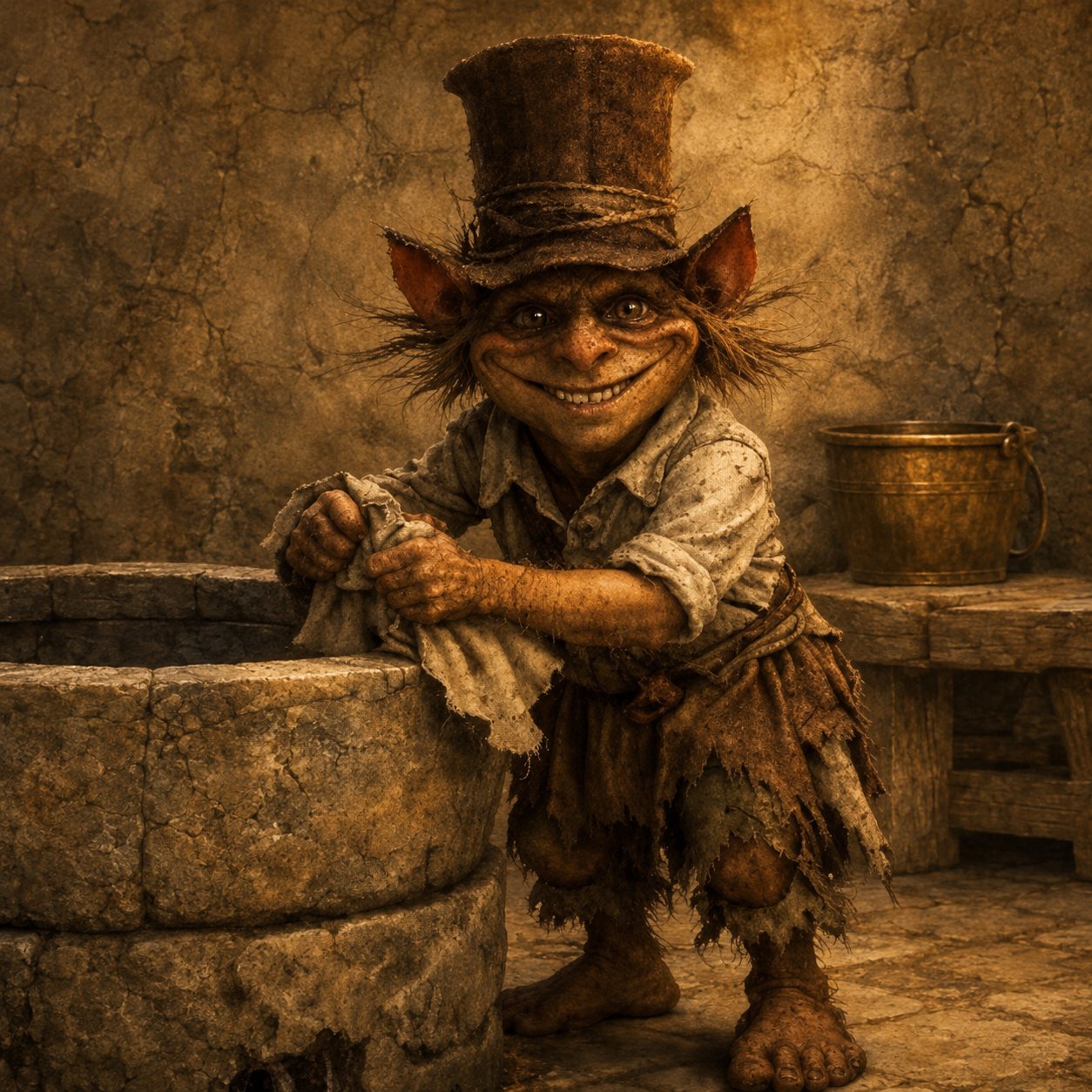
The lazy version of adapting a brownie would be to describe Bramlick as quaint, mischievous or charmingly domestic and leave it there. Small creature. Hidden chores. Hearth-magic. The kind of thing that works in a children's picture book and nowhere else.
The story instead asks what kind of creature would build a life around readiness.
Bramlick tends basins, garments, pegs, drains and warmth. He knows the chamber through its practical needs. He notices the frost line because he knows every inch of the floor. He repairs a hem where a traveller tore it with a careless boot. He scrapes dried blood from a basin pedestal so old it has almost become part of the grain. He is not there to perform folklore for the reader. He is there because things need doing, and things need doing before the people who need them arrive.
The distinction is important. Traditional brownie lore turns on exactly this: the unseen helper who anticipates rather than reacts, who keeps a place ready without being asked and without being thanked. Bramlick honours that tradition completely. But the story understands it at the level of function over costume.
When adapting folklore, begin with what the figure does in human imagination, not simply what it is called.
Move the folklore into a new system
Bramlick is recognisably a brownie, but he is not in a farmhouse or cottage. He is in the Yewdeep, tending a chamber used by travellers before they pass through a gate to other realms. The same gate that brought him there. This relocation is what hopefully makes the adaptation feel original rather than borrowed.
The old idea remains. The unseen helper. The quiet domestic worker. The creature who keeps a place ready without being acknowledged. But the context transforms the meaning of the work. Warm water, dry garments and firm pegs are not household comforts here. They are survival infrastructure. The difference between a traveller who leaves the chamber prepared and one who leaves unprepared may be the difference between living and not.
Bramlick understands this. He watches hands shake. He watches hands steady. He watches people look toward the sealed door beyond the landing with the heavy silence of those who have already decided they will not return. He cannot change what waits for them. He can only ensure they leave as ready as the room can make them.
That shift, from domestic service to something closer to last rites, gives the folklore a weight it cannot carry in a farmhouse setting. The adaptation works because the world it has been moved into demands more of it.
Do not merely import folklore. Make it answer to the rules and pressures of your own world.
Keep the old rule, but change its emotional meaning
Brownie folklore often turns on visibility. The brownie hides. To be seen, or worse, to be rewarded with clothing or payment, breaks the arrangement and drives the creature away. The folk logic is precise. The brownie's usefulness depends on its invisibility, and recognition destroys the compact.
Bramlick carries this rule intact, but the story gives it a psychological depth the original tradition never needed to supply.
He does not hide simply because that is what brownies do. He fears being seen because to be seen is to be brought into someone's story, and Bramlick has not slipped into the Yewdeep to become a character in anyone else's tale. Behind that instinct is a specific history. His realm was at war. The Redcaps and Hobgoblins had fought over anything they could think of, and Bramlick had learned that war did not care whether a creature wanted a part in it. If the Redcaps had won, the outcome was clear. He would be owned, bound to a task chosen for him and beaten into obedience.
So the old folkloric rule of invisibility is no longer merely quaint. It is the practical wisdom of a creature who has seen what happens to those who get noticed by the wrong kind of power. The folklore pattern is the same. The emotional reason behind it is entirely new.
Alan Garner's work is useful to think about here. In The Weirdstone of Brisingamen and The Moon of Gomrath, folklore operates as a clear and identifiable force embedded in specific land. The old powers are present because the place requires them, and they carry the impact of genuine belief rather than literary reference. Garner convinced me that folklore is strongest when it is tied to somewhere real, somewhere that still holds the pressure of the old rules upon it. Bramlick works by the same logic. He belongs to the Yewdeep because this specific place needs exactly what he is, not just because brownies belong in fantasy settings.
The best adaptations keep the old pattern but give it a new emotional reason.
Let folklore carry social meaning
This story is not only about a brownie. It is about labour that people depend on and do not notice.
The travellers assume the chamber is simply ready. They move through it thinking only of themselves, assuming it exists because it always has, perhaps believing it grew from the roots complete and perfect, needing nothing. Bramlick observes this. Their assumption is his shelter.
When a traveller finally says aloud that someone keeps this place and that it is always ready, Bramlick is satisfied. He has not been seen, but the truth has been spoken. The traveller will forget the thought as soon as his journey begins. But the words matter to Bramlick because they are accurate. The readiness is made. It does not make itself.
Mary Norton's The Borrowers understands this kind of invisible economy. The Borrowers sustain themselves through the unnoticed borrowing of household items, living in the gaps of a world that would dismiss them as impossibly small if it ever looked properly. That novel showed me what it means to live in the margins of a system that barely knows you exist, and to make that life meaningful anyway. Bramlick touches some of the same moral territory, though in a darker register. His smallness is not a deficiency. It is the exact condition that allows him to do what he does.
Folklore becomes powerful when the creature reveals a human arrangement. Who serves, who benefits, who notices, and who forgets.
Let the darkness sit underneath the warmth
There is a version of this story that would be genuinely cosy. Small creature in a hat. Hidden domestic magic. Quiet satisfaction in work well done. A reader arriving for that version will find enough of it to stay comfortable.
But it is worth being clear about what the cosiness is doing. The warmth of the chamber, the satisfaction of the clean basin and the straightened peg, the quiet pleasure Bramlick takes in a room that is always ready, these things are real in the story. They are not ironic. Bramlick's contentment is genuine.
What sits underneath that contentment is darker. He chose this life because the alternative might mean ownership, bound service and violence. The travellers he watches over are heading into a crossing that will kill some of them. The gate they pass through hates them. The cold is trying to get into the room, although Bramlick doesn't know why. The world outside the chamber is not warm, and Bramlick knows it better than any of the travellers do.
Susanna Clarke manages this balance consistently in Jonathan Strange and Mr Norrell. The fairy world in that novel has surface charm, wit and glamour, and underneath it something that is socially and morally unsettling in ways that accumulate slowly. The folklore is never merely decorative. It carries the older logic of a power that does not share human values, and that patience, that willingness to let the charm sit at the front while the darker logic works quietly underneath, is what gives the novel its particular atmosphere.
I wanted Bramlick to work in a similar way. The story is available as warmth. It is also available as something colder, if the reader stays long enough to ask what the chamber is for and why the people passing through it look at the journey ahead of them having already decided they will not return.
Dark folkloric fantasy works when the old charm remains visible, but the cost underneath it is hard-edged.
Let smallness be the point, not the obstacle
A modern version of this story might push toward liberation. Bramlick should leave. He should seek recognition. He should demand a place in a larger story.
The story does something more interesting. His freedom is not escape for its own sake. It is the ability to choose where he is useful and remain there unclaimed. He thinks about the Heart Hollow, about creatures who might call him friend, about paths beyond the Yewdeep entirely. He considers all of it, then looks around the chamber. The basins steam evenly. The racks stand straight. The floor is clean, the pegs firm, the drain clear.
Then footsteps approach, and the room is ready.
That ending is not resignation. It is a specific kind of contentment that the brownie tradition has always carried: the satisfaction of work that matters, done well, without needing applause. The story lets that satisfaction be real without making it naive. Bramlick knows exactly what he has escaped. His choice to stay is made with full knowledge of the alternative.
A folkloric creature does not need to be enlarged into a hero to become interesting. Sometimes the point is the scale of attention, and the depth of it.
What this offers the writer
Folklore is not a shortcut to atmosphere. Used carelessly, it produces exactly the weightless, decorative fantasy that a hundred other books have already produced.
Used carefully, it does something no invented creature can quite manage. A brownie is not just a small helpful spirit. It is the residue of every household that believed in hidden labour, unspoken arrangement, the danger of the wrong kind of notice, the thin line between usefulness and ownership. That history is available to the writer who looks for it.
Bramlick works because the story did not borrow a brownie. It understood one. It asked what kind of world would produce this creature, what fears and habits and moral arrangements the figure implies, and then it built a place that needed exactly those things.
The Yewdeep needed a brownie. Not a generic fantasy creature. Not a magical helper with charming mannerisms. A small, cautious, practical being who chose routine over escape and quietly decided to stay, because the work was real and the freedom was his and the room was always ready when the next traveller arrived.
That is what adapting folklore actually means.
Bramlick the Brownie is part of Tales from the Woldwood, a series of standalone dark fantasy stories set in the world of the Marchlands. Read it on Substack.
If you'd like to follow Jonathan B. Edvane, you can do so here.
Discussion