
I did not set out to build a world.
I set out to write one story inspired by one song, the way a person might set a single afternoon aside for a single small task. The song was "Dark Entries" by Bauhaus, because what it gave me was not a plot but mainly a feeling, the sense of something furtive being made official, a transaction dressed as a confession. I needed somewhere for that feeling to live, so I invented a city called Streindarke, yes that is an anagram of Dark Entries, gave it a Hall of Concordance where love was registered like property, and let a tired clerk named Albrecht Baus stamp seals onto other people's devotion while his own collapsed in private. I finished the story. I assumed I was finished with the city too.
I was wrong, and the way I was wrong is the actual subject of this post.
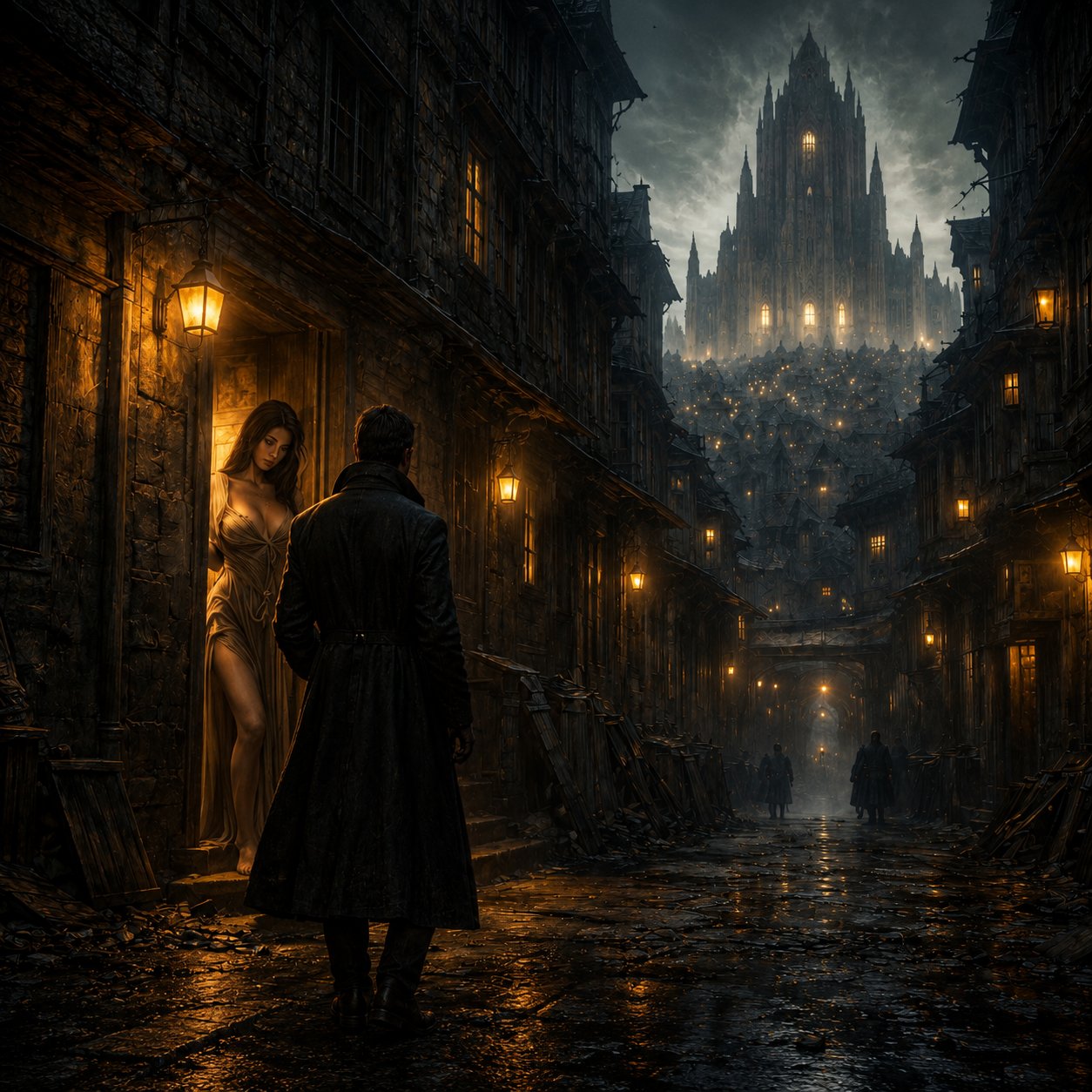
A setting that refused to stay used
Most advice about worldbuilding assumes intention. As I have written before, in the VVD Post, for me it is about creating pressure, and Streindarke has it in spades. You decide you are building a world, and then you build it, mapping borders and governments and histories before you let a single character walk through any of it. That approach works for plenty of writers. It has never been mine, and Streindarke is the clearest proof I have that it doesn't need to be.
What happened instead was smaller and stranger. I hadn't looked far for a second song to write against. It was always going to be The Cure's "One Hundred Years," a song built around a colder, more municipal kind of bleakness than Bauhaus's furtive theatre. The natural thing would have been to invent a different place for it. Instead, I found myself returning to Streindarke, because the place had already proven to me that it could hold more than one kind of darkness. A Hall of Concordance that corrects love can sit in the same city as a mortuary that corrects death. The logic was the same machine wearing two different uniforms.
That is the test I would now offer any writer wondering whether a setting wants to become a world rather than stay a backdrop. Backdrops serve one story and then go quiet. A world keeps generating pressure after you've left it. Streindarke kept doing that. By the third story, a fourth had already suggested itself, and at no point did I sit down with a map or a constitution. I sat down with a song and let the city tell me which department of itself it wanted to show me next.
Songs as seeds, not scripts
The part of this sequence I most want other writers to notice is what each song actually contributed, because it was never a plot.
"Dark Entries" gave His Pretentious Love a structure built on concealment dressed as paperwork, the sense of something being recorded that should have stayed unspoken. I did not adapt the song's narrative, because the song barely has one in any literal sense. I took its central image, the secret rendered official, and asked what a city would have to believe about love before it built an entire civic department to manage it. Albrecht's seals, his Codex, his "go in concordance," none of that comes from the lyric. It comes from chasing the lyric's implication as far as a bureaucracy could carry it.
"One Hundred Years" works on Under a Yellow Moon the same way. The song carries a particular flavour of exhausted, watchful bleakness, and what I borrowed was the colour of that watchfulness, which became literal in the story as an actual yellow moon hanging over the city, "less to illuminate than to hold it under observation." Rhett Bormis, the mortician who refuses to cosmetically correct Charlotte's murdered body for public viewing, owes nothing to the song's specific images. He owes it a mood, the particular weariness of a man who has run out of room to keep lying. The moon does the rest of the work, watching rather than revealing, which is exactly the register the song lives in.
Siouxsie and the Banshees' "The Staircase (Mystery)" gave the clearest gift of the four, because the title alone amounted almost to an instruction. Arrange the Symmetry needed a staircase that behaved like a trap, and so Ballion, the secret police officer sent to investigate a vanished nobleman, climbs a spiral stair that loops back on itself, shows her the wrong hallway in a mirror, and delivers her at last to the room where her own death waits, arranged by the man she came to find. None of that staircase exists in the song. What exists in the song is the suggestion that a mystery might be navigable, and might have a logic a person could climb toward and understand. I built a staircase literal enough to punish that hope.
"In the Meadow" by All About Eve gave I Spill It All its one ungoverned space. Streindarke can correct love, death, and rebellion, but it cannot fully correct a field. The Academy's "Field of Natural Consequence" sits behind black railings, observed but not entered, the one place in the entire sequence where the city's logic of legibility breaks down into something older and less catalogued. It is worth saying, briefly, that this is the moment in the whole sequence that edges nearest a Lovecraftian register, not in tentacled excess but in the sense of a darkness that the institution cannot file, categorise, or correct, because it predates the institution's authority to do so. Streindarke is otherwise a thoroughly legible nightmare. The meadow is the one place it admits there are things it cannot read.
In each case, the song supplied an image, a mood, or a single suggestive phrase, and the story's job was never to illustrate that material. It was to let Streindarke's own logic metabolise it into something the city would actually produce. That is the difference between adaptation and seeding. Adaptation asks what happens next in someone else's story. Seeding asks what your world would grow if you planted this one feeling in its soil.
What four desks build that one desk cannot
No single Streindarke story shows you the whole city. Each one sits behind a different desk. Albrecht processes love. Rhett processes death. Ballion processes suspicion, until the city processes her instead. Regan, the servant girl at the bottom of I Spill It All, processes nothing, because she is herself the thing being processed, a debt inherited from vanished parents and worked off in scrubbed stairs and pressed cuffs.
Kafka, I concede, is an unavoidable reference point for this kind of fiction, and I would rather meet the charge directly than dodge around it. What Kafka understood, and what Streindarke borrows from him without apology, is that bureaucracy can absorb a person so completely that the person's interior life becomes irrelevant to the machine processing them. Albrecht's Codex doesn't care that his own love is corrupt. Ballion's credentials don't protect her once the city decides her usefulness has ended. The individual case file survives. The individual rarely does.
Where Streindarke deliberately departs from Kafka, and where I think the comparison becomes more interesting than a simple debt, is in its register of cruelty as something the city considers actively benevolent rather than absurd. Kafka's institutions are often opaque even to themselves, a logic nobody quite controls. Streindarke's institutions know exactly what they are doing and consider it an improvement. That is closer to Kazuo Ishiguro's Never Let Me Go, where an entire system of institutional harm runs on a calm, settled confidence that this is simply how things are best arranged. The Academy in I Spill It All, with its Field of Natural Consequence and its quiet conversion of grief into administrative debt, owes more to that Ishiguro register than to Kafka's bewildering corridors. Nobody at the Academy is confused about what they are doing to Regan. They have agreed, collectively and without much discussion, that it is correct.
That distinction matters because it is what four stories can do that one cannot. A single Streindarke story shows you one face of the machine and lets you wonder whether the rest of the city might be kinder. Four stories, told from four different positions inside the same apparatus, close that possibility off entirely. By the time Regan watches the Field of Natural Consequence finally turn its appetite on someone other than the girls below stairs, the reader already knows, from Albrecht and Rhett and Ballion, that Streindarke has no kinder face waiting in some department we haven't visited yet. The machine is the same machine everywhere. That epistemic closure is the thing repetition buys that a single story, however good, cannot.
What I'd tell a writer hesitating over their own accidental world
If you have ever invented a place for one story and felt, afterwards, a small reluctance to let it go, that reluctance is worth listening to. Not every setting earns a second visit. Most shouldn't get one, and forcing a world to expand past its first use is its own kind of failure, the padded sequel nobody asked for. But some settings have more pressure in them than their first story used, and you will often only discover how much by giving them a second assignment and watching what they do with it.
Streindarke was never planned as a series. It became one because a Hall of Concordance and a mortuary and a spiral staircase and a forbidden meadow all turned out to be rooms in the same building, and I only found that out by opening more doors. The songs gave me four different feelings to chase. The city is what was already waiting on the other side of all four doors, patient, administrative, and entirely willing to be visited again. And, I promise you, it will be. Somebody will eventually have a chance to be king.
Further reading on The Dark Hearth. What Is Gothic Fiction?
If you'd like to follow Jonathan B. Edvane, you can do so here.
Discussion