
There is a problem at the heart of every novel that builds its world from scratch. The reader needs to know things before they can fully appreciate the events. They need to understand what certain names mean, why certain places carry dread, what history sits beneath the present action. But the moment a novel stops to explain all of that, it stops being a novel and becomes a lecture. The reader's interest, which is a fragile and temporary thing, drains away while the author fills in the world they should have trusted the story to reveal.
I finished The Durn Yew: Book One, The Shivering Vale before I published a single story in the Marchlands. The novel is complete. The world was fundamentally formed. And I knew, looking at it, that a reader coming to it cold would have to accept a great deal on trust, because there was no space in the novel's architecture to stop and earn it.
The forty stories of Tales from the Woldwood are my answer to that problem. Not a prologue. Not appendices. Not a glossary. Forty pieces of standalone fiction, each one complete in itself, that between them introduce the people, places, histories and systems of the Marchlands without once revealing what the novel is about.
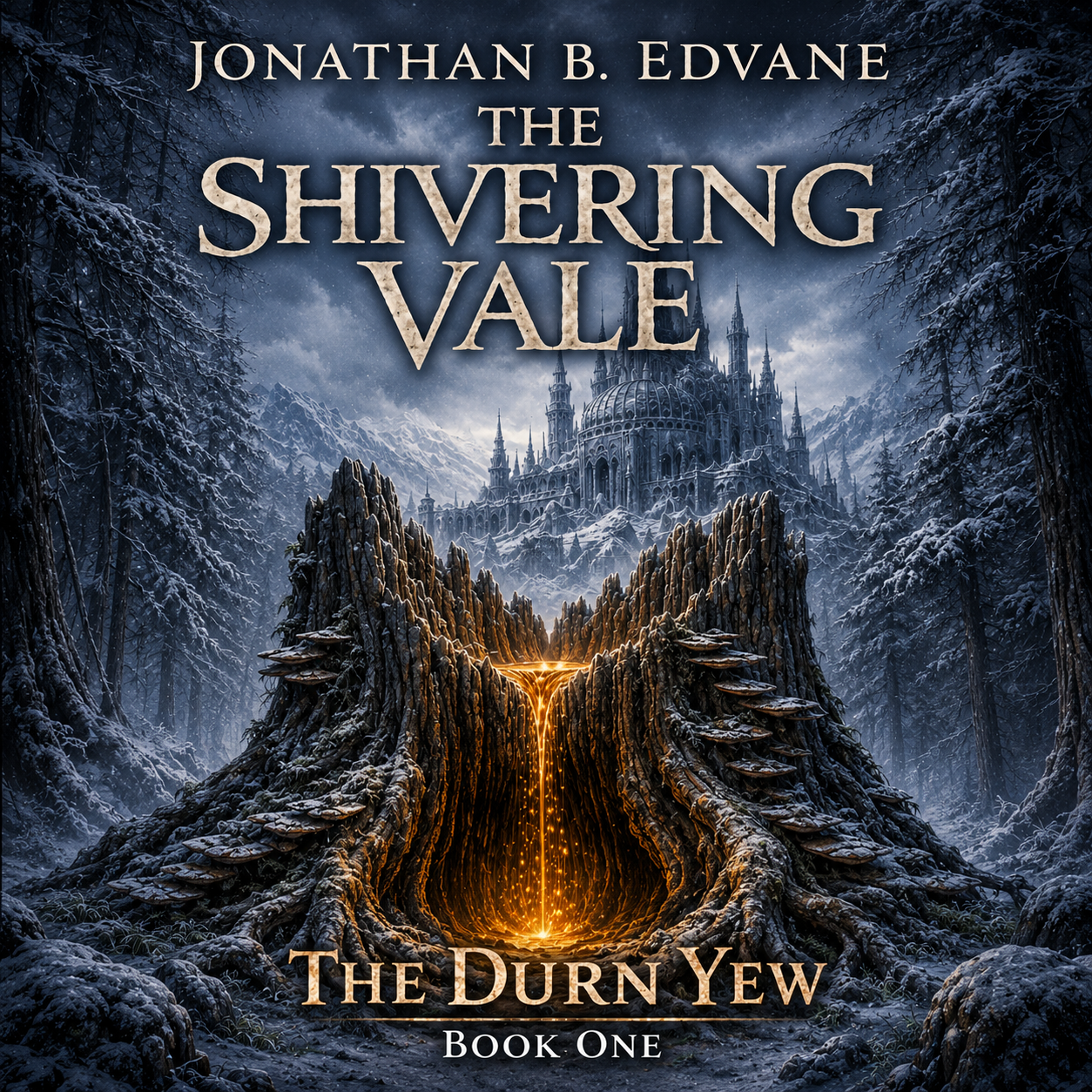
The problem with lore in a novel
The Marchlands is a secondary world with its own history, its own magic systems, its own geography and political architecture. The novel assumes the reader inside it. It does not stop to explain what a Verdicrence wand-naming ceremony means, or why certain standing stones carry unease wherever they appear, or what kind of man arrives at the novel's opening carrying a war inside him that the story never fully describes. These things are present. They do their work. But a reader who already understands the texture of the world they are moving through feels that work differently from a reader who is still assembling the basic picture. Once I accepted that premise, I knew this was the right way to go. It could be satisfying from either perspective.
The traditional solution is to put the explanations in the novel, shaped as naturally as possible. A character asks a question another character answers. A scene is set in a location that permits description. A memory surfaces at a convenient moment. These techniques work, up to a point, and every writer of secondary world fiction uses them. But they all require the novel to carry meaning that is not strictly the novel's own, and the weight of it always shows. The reader feels it as slowness, tangential detail, or the author's heavy hand too visible on the page.
My decision was to remove that problem from the novel entirely and distribute it across forty stories that have no obligation to serve the novel's plot at all. Each story exists on its own terms. Each one has its own protagonist, its own stakes, its own emotional logic. The lore they carry is incidental to their surface, which is exactly the point. A reader who encounters the standing stones through Pethwick's fireside yarn, or who understands wand-naming through the disaster in Trofius's stone house, arrives at the novel already calibrated. They do not need to be told. They remember. And the reader who comes to the novel cold, having never met Pethwick or stood in Trofius's stone house, is not left behind. The novel does not depend on the stories. It rewards those who read them, whether beforehand or afterward.
Three stories, three kinds of work
The forty stories do not all work in the same way, and it would be wrong to suggest there was a rigid system behind them. But looking back, they divide broadly into three functions, and three examples show those functions more clearly than any description of them could.
It's Kinder If You Don't Struggle is told in three parts, each following a different traveller who encounters Pethwick, an old road-trader with a story about standing stones that he has told so many times the details have shifted, though his dread has never changed. The stones themselves are never explained. Their connection to anything larger is not clearly stated. What the story delivers is an accumulated folk dread, the sense of something old and deliberate at the margins of the world, which a careful reader will find quietly confirmed when they open the novel. Pethwick himself is mentioned in passing in the novel, not as a character of consequence, but as a name a reader of the stories will recognise. That recognition is its own small reward, the kind that comes from having paid attention.
Ale and Ashes does something different. It follows two men walking away from a war, one of them Edric Laine, who is the novel's central figure. The story gives Edric a history the novel never has occasion to deliver directly. It shows the war's effect in his hands and his silences, the way he nearly kills a man in a tavern over something that has nothing to do with the man and everything to do with what Edric has seen. It shows his friendship with Arnulf Pike, who appears early in the novel, and makes that friendship legible in a way the novel's pace does not permit. A reader who comes to the novel having read Ale and Ashes understands something about Edric that the novel does not explain, because it does not need to. The story has already done it.
Elrinaris works at the level of system. The novel contains a wand-naming ceremony that the reader must accept at face value, because the novel has neither the space nor the structural reason to establish the full history and danger of what is happening. Elrinaris does that work in advance. The story centres on an apprentice and her master, a wand shell that responds with fire rather than growth, and the slow, uncomfortable discovery of what the shell actually is and what name it carries. A reader who knows this story arrives at the novel's ceremony with a different understanding of what is at stake. And for those who follow the full six-book arc, Elrinaris itself is not finished with the Marchlands yet.
The architecture of six books
The decision to write forty stories before publishing the novel was not only a craft decision. It was a structural one, and it was made for the whole series rather than just the first book.
The Durn Yew is a six-book sequence. Each book is its own year-long project. The first forty stories of Tales from the Woldwood serve the first book, and later become The Annals of the Shivering Vale. The five books that follow will each have their own constellation of standalone fiction, stories that do the same work for their respective novels that the Woldwood sequence does for The Shivering Vale. The lore that cannot live inside the novel without stopping it, hopefully finds its home in the fiction that runs alongside it, and readers who follow both strands will always know more than the novel requires them to know. I never wanted that surplus knowledge to be wasted, though. My intention is that it accumulates into the kind of intimacy with the world that keeps readers inside a long series.
There is also something else the forty stories do that is worth pointing to. They make it possible to talk about the novel before the novel exists in a reader's hands. Before starting this process I decided to publish independently and all available advice stresses the importance of it. A writer who publishes standalone fiction in a world is already in conversation with an audience about that world, already building the familiarity that a novel launch depends on, without ever having to say here is a book, please buy it. The stories are the conversation. The novel arrives, eventually, into a room that I hope has already been warmed.
This is not a marketing strategy dressed as craft. The stories have to stand on their own or they do nothing. A reader who comes to Pethwick's fireside for the first time and finds him unconvincing will not carry that encounter into the novel with them, because they will not go any further. The lore only reaches the novel if the fiction earns it. Which means the forty stories are not a prologue to the Marchlands. They are the Marchlands, arriving in pieces, year by year, asking only that the reader keep showing up.
Further reading on The Dark Hearth. What Is Dark Fantasy?
If you'd like to follow Jonathan B. Edvane, you can do so here.
Discussion