The Marchlands has no map. Forty stories, a six-book novel sequence in progress, and not a single diagram of where anything sits in relation to anything else. No compass rose. No dotted trail. No legend explaining what the little tree symbols mean. I did not lose the map. I never drew one.
This will bother some readers, and it will certainly bother some writers. The fantasy map has become so firmly embedded in the genre that most people never stop to ask what it is actually for. It arrives on the first page or the last, it names a few mountain ranges and a forest, it puts the Dark Lord’s fortress in the top right corner, and the reader is expected to consult it like a motorist checking the route before setting off. The assumption is that full immersion in a secondary world requires this one single artifact, delivered right at the outset, before the first sentence of the first chapter has done any work at all.
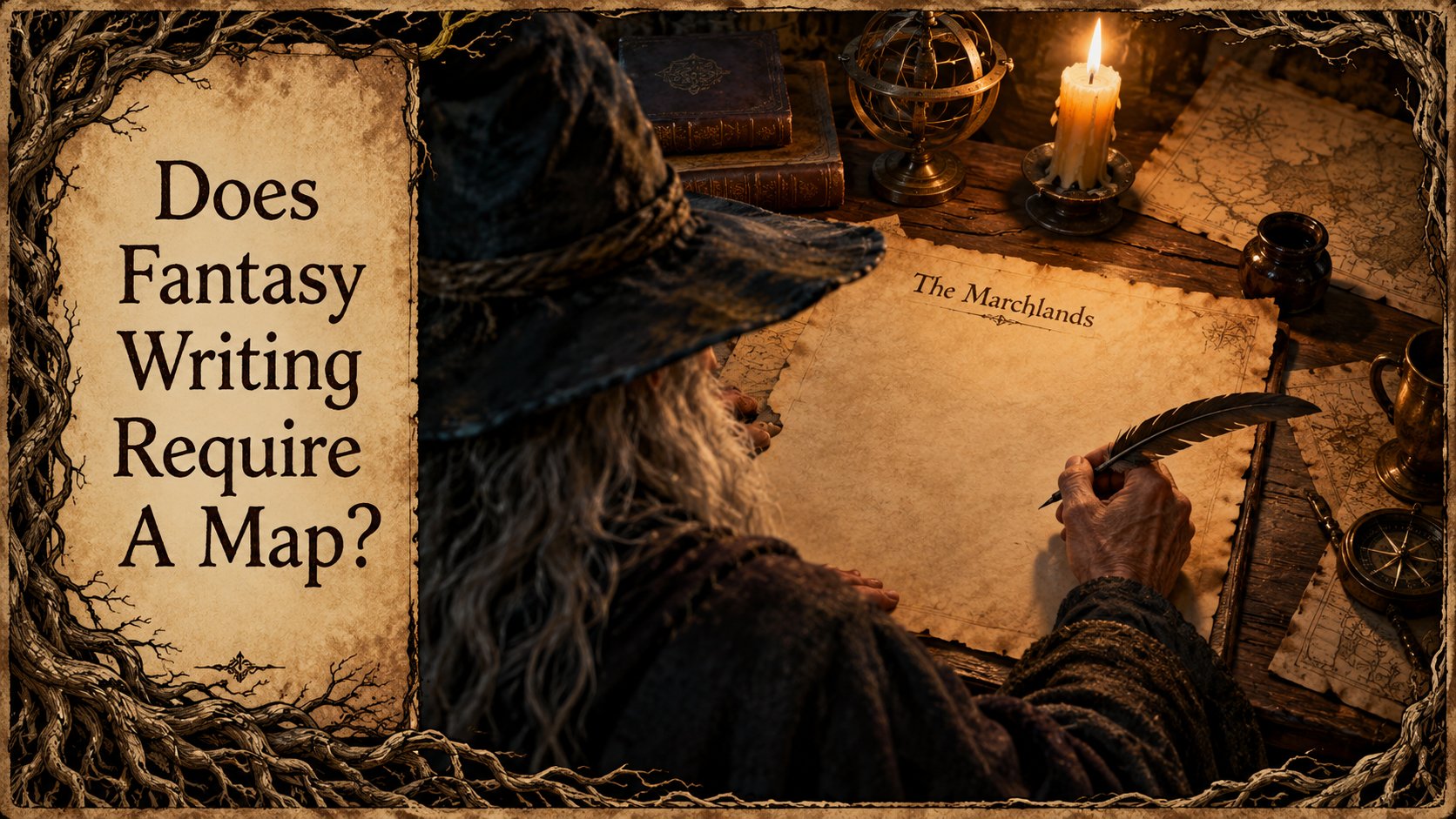
I assumed the same thing when I started. Everybody else had one, so I would need one too. The problem arrived almost immediately.
The map wants answers you do not have
I was building the Marchlands through the writing itself. The world was not a settled place that I then described. It was taking shape as each story demanded new locations, new distances, new relationships between one settlement and another. I had no fixed idea of how many continents there were, how far the sea was from the interior, whether a particular forest bordered a particular river. I was discovering all of this through the fiction, and the fiction was moving faster than any diagram could follow.
A map demands that you commit to the geography before you need it. It asks you to decide, right now, whether the mountains are to the north or the west, whether the port city faces east, whether the desert is three days’ ride or thirty. And once you have drawn those answers into position, every story that follows must honour them. The map becomes a constraint before it becomes a tool.
For a writer who plans everything in advance, that might not be a difficulty. For a writer who discovers the world through the act of writing it, the map is a trap. It forces premature commitments about the shape of a world that has not yet told you what shape it needs to be. I was locking myself into geography that might need to change by the third story, the tenth, the thirtieth. Every line I drew was a promise I might not be able to keep.
What worldbuilding actually needs to do
The moment I stopped trying to draw the map was the moment I started thinking properly about what worldbuilding is for. And the answer, for me, turned out to be very simple. Worldbuilding exists to make the reader trust that the world extends beyond the edges of the story they are reading. It does not need to prove that trust by showing them everything. It needs to imply it.
The Marchlands has a currency system. It has linguistic structures visible in the way people speak and name things. It has a dead monarchical system and a living tension between the authority of common law and the presence of magic that common law cannot govern. It has historical threats that echo forward into the present of the stories. None of this is filed in an appendix, or committed to a spreadsheet. All of it lives inside the fiction, embedded in the forty Tales from the Woldwood, surfacing where the story needs it and staying silent where it does not.
Trust the reader. Writers say this all the time and then hand the reader a map, a glossary, a pronunciation guide, and a family tree before the first chapter. I am more interested in the dark space. The things unsaid. The questions left behind by a story that has moved on. Worldbuilding to granular, exhaustive detail, laying every system out for inspection the way Brandon Sanderson does, is a legitimate choice but it is not the only one, and for my kind of fiction it would be a catastrophic one. The darkness I write depends on withholding. A map is the opposite of withholding. It lays everything out before the reader has earned any of it.
A world that resists the diagram
There is a structural reason why the Marchlands resists mapping, and it goes beyond my preference for discovery over planning. The novels turn on the Groaning Gate, a threshold through which other realms tether themselves, temporarily, to the Marchlands. These tether realms appear, they become part of the world for a time, and then they are gone. The Shivering Vale in the first novel, Altheryon in the second. Each one is a place large enough to deserve its own geography, its own distances, its own sense of scale. And each one vanishes when the tether breaks.
A map of the Marchlands would need to be redrawn after every novel. The geography of the entire world is not stable in the way that a map requires geography to be stable. Drawing a definitive diagram of the Marchlands at any point in the sequence would be like mapping the weather. Accurate for an afternoon, useless by evening.
This is not an accident. The instability of the world is the story. The tether realms are not decorative. They are the mechanism through which the central conflict operates. A map would flatten that mechanism into something fixed, something the reader could consult and feel oriented within, and orientation is precisely what the Marchlands is designed to deny.
Where the map earns its keep, and where it does not
Mervyn Peake never drew a map of Gormenghast. The castle is vast, contradictory, and unmappable by design. The reader’s disorientation inside it is part of the experience. You are not meant to know which corridor leads where, or how far Flay has walked to reach the rooftops, or whether the kitchens are above or below the Hall of the Bright Carvings. The architecture exists at the scale of feeling, not measurement. Peake understood that the building would lose something essential the moment it became a floor plan.
Ursula Le Guin, whose Earthsea novels do include a map, wrote separately about the importance of the unmapped place in fantasy, the territory beyond the edge of the chart where the story has not yet unfolded. The map, she suggested, can close down that territory too early. It can tell the reader that the world ends here, at this coastline, and nothing lies beyond it. The unmapped place holds possibility. The mapped place has already been settled.
Joe Abercrombie resisted maps for years. He wanted readers “nailed to the text, chewing their fingernails to find out what happens next” rather than constantly flipping to the fly-leaf to check distances. His early First Law novels had none. Then in The Heroes he included five, each showing the same valley on a different day of a single battle. The maps were not guides to a world. They were instruments of a story. Abercrombie did not add maps because the genre expected them. He added them when the fiction required them, and only for as long as the fiction required them. Nicholas Rossis explored this and several other authors’ positions in a useful 2016 essay on the question, and the pattern he found is telling. The writers who resist maps tend to be the ones whose prose does the heaviest lifting.
Tolkien is the reason the convention exists, and it is worth remembering that his map was an academic exercise as much as a storytelling device. He was a philologist who built Middle-earth the way a scholar builds a reconstruction of a lost civilisation. The map was part of that scholarly apparatus. It belonged to his method. But the genre took his method and turned it into a rule, and the rule went unquestioned for so long that most writers now treat it as a prerequisite rather than a choice.
It is a choice. And the right answer depends on what the map is being asked to do. If your world is stable, if your geography is fixed, if the reader’s journey through the landscape is a meaningful part of the narrative, then a map serves the story. If your world is unstable, if discovery is the point, if the darkness lives in what is withheld rather than what is displayed, then the map is not a tool. It is a spoiler.
The map can wait
I will probably publish a map of the Marchlands one day. When the novels are finished and the world has settled into its final shape, someone can draw the thing. I might even run a contest for it. But the map will come at the end, as a record of what was found, not at the beginning, as a blueprint for what was planned. The stories came first. The world grew out of them. The map, if it arrives, will be a souvenir of a journey that was never meant to be guided.
Nobody has ever asked me where the map is. Forty stories, thousands of reads, and not a single person has said they needed a diagram to follow the fiction. The writing did the work. The worldbuilding, buried in the stories where it belongs, gave them enough to trust that the place was real and enough darkness to suspect that it was larger than they could see.
That is what I wanted. A world that resists the confidence of a diagram. A world without a map.
If you'd like to follow Jonathan B. Edvane, you can do so here.
Discussion