
There is a feeling that sits beneath horror and fear. It is not the moment a thing appears. It is the long corridor before the door. It is the knowledge that something is wrong, held in the body before the mind catches up, and it does not need a monster or a murder to work. It needs only a reader who has been taught, without quite realising it, to expect something terrible.
That feeling is dread. And it is an engine I return to frequently.
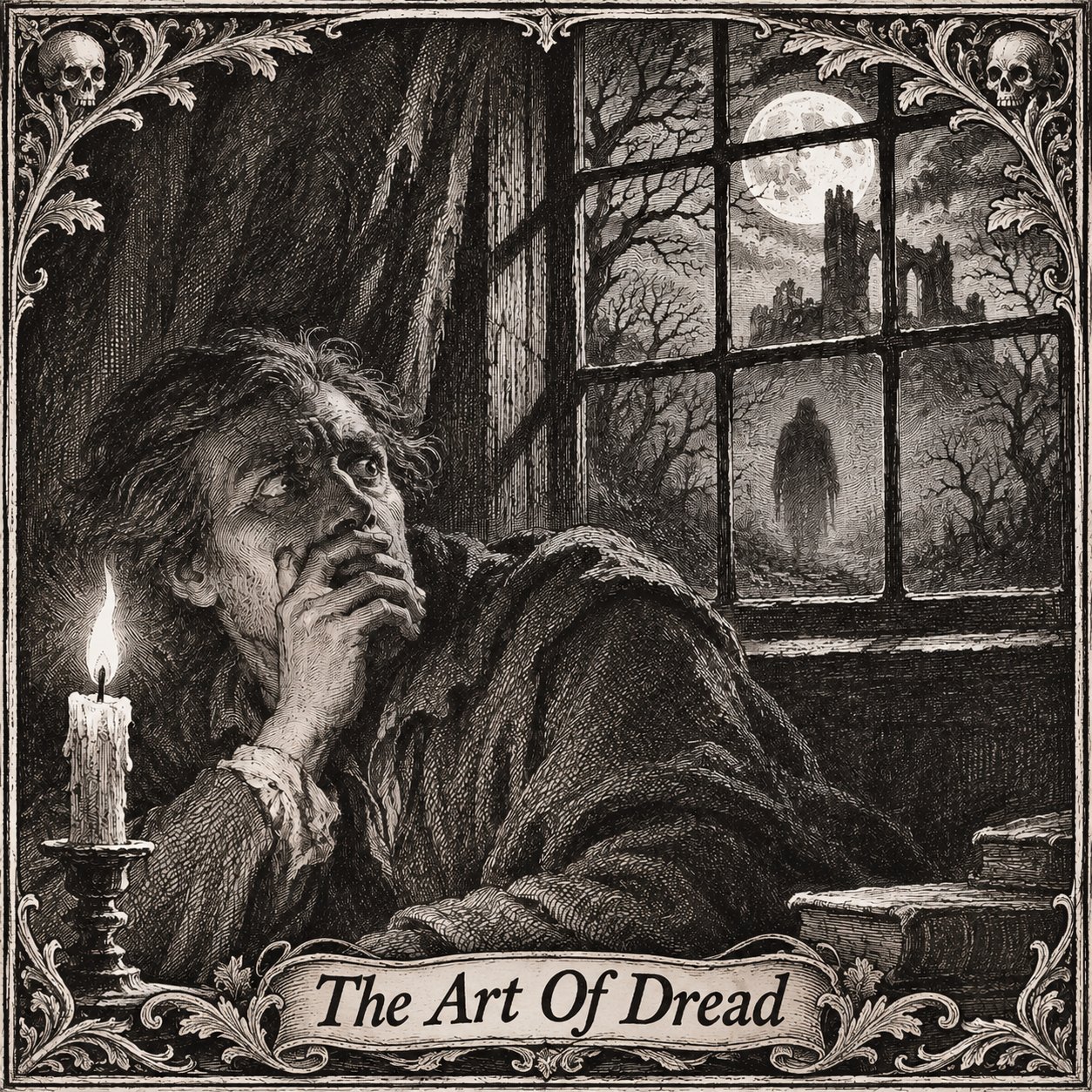
What dread is not
Fear is reactive. Something happens and the body flinches. Horror is revelatory. Things are seen and the mind recoils. Both depend on the moment of contact, the point where the threat becomes visible or the violence lands. They are powerful and necessary, and plenty of good fiction runs on them. But dread is a different instrument entirely.
Dread is anticipatory. It lives in the space before the event, and its power comes from the possibility that the event may never arrive at all. A story that generates dread successfully holds its reader in a sustained state of uncomfortable limbo. It conveys a growing certainty that the ground has shifted, the rules have changed, and the consequences have not yet arrived. The reader feels the weight of what is coming without being told what it is, yet sometimes the thing never comes and the dread is the point.
This is not suspense in the thriller sense, the ticking clock or the hidden bomb. Suspense asks “what will happen next?” Dread asks “what has already happened that I have not yet realised or understood?”
The empty hotel room
M.R. James gets my nod for knowing this better than almost anyone who has written in English. In Oh, Whistle, and I’ll Come to You, My Lad, the famous bedsheet scene at the end is horror. It is the reveal, the contact, the moment the thing shows itself. But the story earns that moment through twenty pages of dread that do all the real work.
Parkins walks along the beach and sees a figure in the distance that seems to be running toward him, though it should not be there. He returns to his hotel room and finds the bedclothes disturbed on a bed nobody has slept in. He hears sounds in the night. None of these events is frightening in itself. A distant figure might be anyone. Bedsheets might have been moved by a maid. Sounds in the night are sounds in the night. James gives the reader every opportunity to rationalise, and the reader takes each one gratefully, and the dread grows precisely because each rational explanation feels less sufficient than the last.
What James does is remove the floor one board at a time. He never tells you what is underneath. He lets you feel the give.
The house that wants you
Shirley Jackson’s The Haunting of Hill House runs on a different mechanism but arrives at the same condition. Eleanor Vance is not threatened by a ghost. She is enclosed by a house that reshapes her relationship to herself, and the dread comes from the reader understanding, long before Eleanor does, that she is not going to leave.
Jackson achieves this through architecture and social pressure rather than through landscape and absence. The doors that close on their own, the cold spot in the hallway, the writing on the wall, all of these are standard haunted house furniture. What makes them dreadful rather than merely eerie is the context Jackson wraps around them. Eleanor has nowhere else to go. She has no life to return to. The house offers her a belonging she has never had, and the reader watches her accept it with the slow certainty that the belonging is a trap. The famous opening paragraph, with its assertion that whatever walked in Hill House walked alone, is not a description of the supernatural. It is a description of dread. Something is wrong with the house, and that alone precedes any event.
The distinction is important for a writer. Fear requires an event. Horror requires a reveal. Dread requires a condition, a state the reader inhabits alongside the character, and the longer that condition persists without resolution, the more powerful it becomes.
The fairy tale already knows
Angela Carter’s The Bloody Chamber does something else again. The dread in that story is structural. The reader knows the shape of the Bluebeard tale before the narrator does, and every step the young bride takes toward the forbidden room is a step the reader has already taken in the mind. Carter does not hide the destination. She furnishes the corridor.
The wedding gifts, the husband’s previous wives, the key that will not come clean, all of these are given to the reader as markers on a path whose end is already known. The narrator’s voice, young and impressed and half-aware of her own danger, makes the dread worse because her pleasure in the castle and its luxuries is the reader’s discomfort. She is delighted by things that should alarm her, and the gap between her delight and the reader’s recognition is where the dread lives.
This is the fairy tale mechanism at work. Fairy tales do not trade in surprise. They trade in inevitability, and inevitability is one of dread’s oldest instruments. The reader knows the bride will open the door. The reader knows what she will find. The story’s power comes not from the discovery but from the approach, the long walk through a beautiful house toward a room full of blood.
The room that remembers
I have been writing around dread for years, though I did not always call it that. In The Farewell Chamber, I wanted to build a space where the rules were announced early and then tested to breaking point. The chamber is a room of parting, a place where people say goodbye, and it has a rule. Promises made inside it are heard by the room itself. The dread does not come from the ghosts who appear. It comes from the reader learning, gradually, that every vow spoken in that chamber is a summons. The word “I’ll come back” is not a comfort. It is an incantation. And the room is listening.
What I was reaching for was a dread built on language. Every time a character opens their mouth to promise something, the reader flinches, because he has learned what promises do in this place. The ghosts are the consequence, but the mechanism is the speaking. The room does not care about intentions. It cares about words.
The floor that swallows
The Uncounted works a different way. It is set in a rooming house in Seattle in 1897, in a district where the streets were raised a full storey after the Great Fire, burying the old doorways beneath the new pavement. People disappear from the house. The narrator offers rational explanations for each one. A man left town. A drunk wandered off. A woman moved on. The reader accepts these explanations because the setting makes them plausible. This is a transient place full of transient people, and disappearance is normal here.
The dread accumulates because each explanation is slightly less convincing than the last, and the narrator knows it. The floorboards bulge and then are smooth again. A scream stops too suddenly. A silence fills the space where a person was. The buried city beneath the streets is implied but never described, and the faces that eventually appear under the floorboards are the story’s one moment of horror. Everything before that moment is dread, built on the ordinary made unreliable, on the steady erosion of every reason not to be afraid.
The candle is a clock
Teeg is among the most purely dread-driven things I have written. A man sits in a cave with a single candle, talking to the flame, narrating his own past as the light dies. There is no present-tense threat. There is no monster. There is only a voice in the dark, a light that is going out, and a growing suspicion that the people who sent him here knew what would happen.
The candle is a clock, and the reader counts its remaining life alongside Teeg. Each time the flame dims, Teeg flinches toward it and says “Steady” or “Not yet,” and the reader feels the same contraction. But the deeper dread is not the candle. It is the slow reinterpretation of memory. Every story Teeg tells about his past changes slightly in the telling, and the reader begins to see a pattern that Teeg himself refuses to see. His lover knew things she should not have known. His friend knew the route too well. The mystic’s warning was too specific. None of this is proof. All of it is dread, the growing certainty that the ground shifted long before Teeg noticed, and that the darkness waiting at the end of the candle is not an accident.
The final line is a voice from the dark asking “Who’s there?” and it reframes everything that came before it. But the story does not depend on that line. The dread has been running since the first paragraph. The voice simply confirms what the reader already suspected.
What dread asks of a writer
If fear is a flinch and horror is a reveal, dread is a commitment. It asks the writer to sustain a condition rather than deliver an event, and it punishes impatience. A story that reaches for its shock too early loses the dread it was building. Dread lives in the gap between what the reader suspects and what the story confirms, and the wider that gap, the more powerful the feeling.
The practical demands are specific. Pace must slow without stalling. Information must be withheld without the withholding feeling arbitrary. The reader must be given enough to build their own picture of what is wrong, but never so much that the picture is complete. Sound and silence matter more than spectacle. The physical world, the dripping water, the floorboard, the candle flame, must carry weight that dialogue and action cannot.
And the writer must trust the reader. Dread is a collaborative act. The reader brings their own fears into the silence the writer has made, and what they imagine there will always be worse than anything the writer could show. The art of dread is the art of making space for that imagination to work, and then having the discipline not to fill it.
If you'd like to follow Jonathan B. Edvane, you can do so here.
Discussion