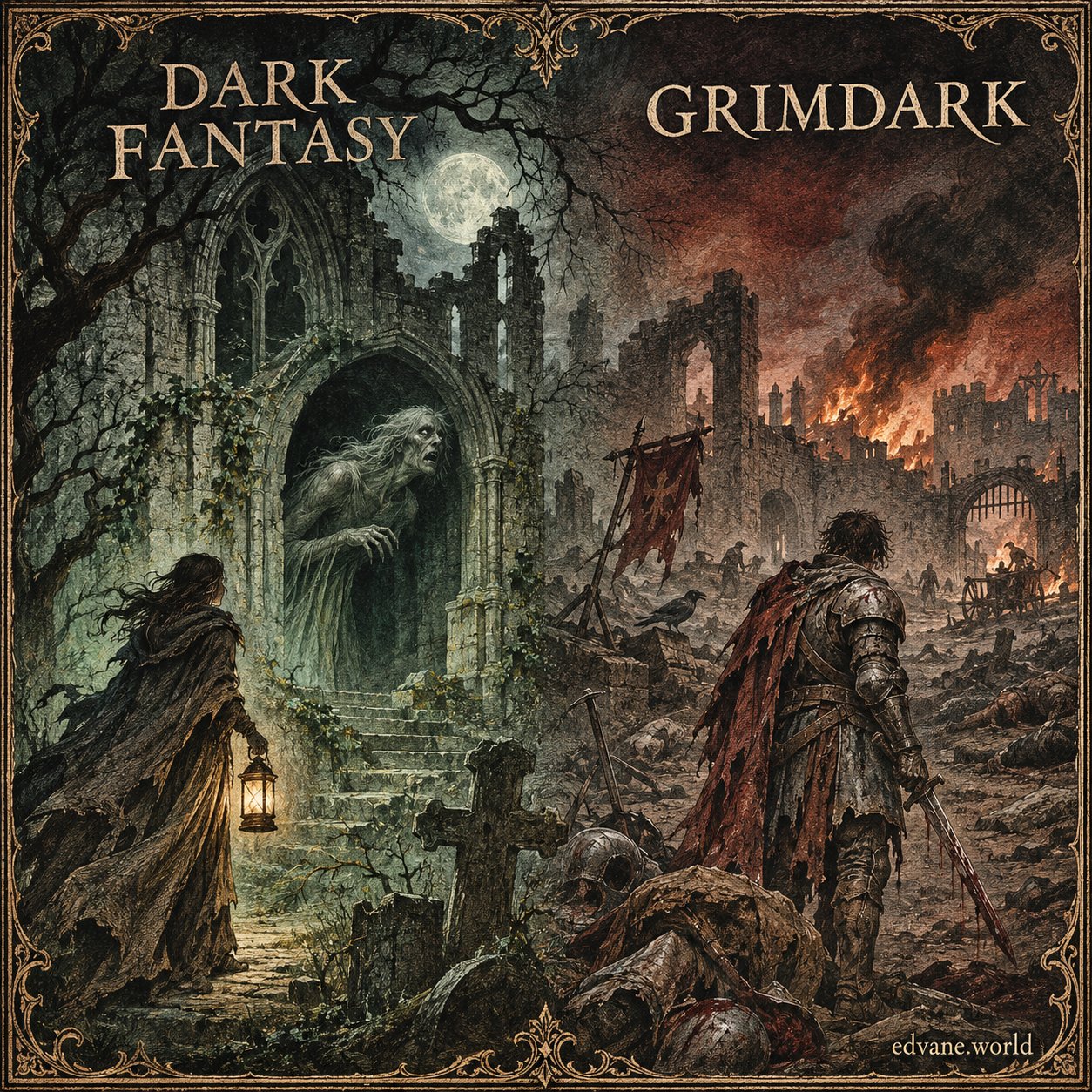
Grimdark and dark fantasy are genre terms often used as though they mean the same thing. They do not. They share a surface, a willingness to put difficult, violent and uncomfortable material in front of the reader, but beneath that surface they are doing fundamentally different work. Treating them as interchangeable imposes a cost on both traditions. It promises a reader one experience and delivers another. It flattens two distinct ways of thinking about darkness in fiction into a single mood, and the mood it settles on is usually grimdark’s, the louder of the two.
This is not a complaint about grimdark. At its best it is extraordinary fiction. But it is not what I write, and the difference is not a matter of degree. It is a difference in what darkness is for.
What grimdark does
Grimdark is fundamentally cynical about power. It assumes that the structures people build, the courts, armies, faiths and alliances, reward the worst in those who operate them. Moral language in grimdark is a weapon. Characters who speak about honour or justice are either naive or lying, and the narrative will eventually prove it. The pleasure of reading it is found in having comfortable fictions stripped away, and watching the machinery behind the throne.
Glen Cook established the tradition decades before anyone coined the term. The Black Company, published in 1984, was military fantasy written like a veteran’s memoir, flat and procedural and unsentimental, and Cook did it so early that the genre had to catch up with him.
Joe Abercrombie is the writer who went all the way. The First Law trilogy is grimdark working at full capacity. Its characters are vain, damaged, self-serving and often very funny about it. Abercrombie writes fight scenes that are chaotic, painful and unglamorous, and he writes political scenes that run on the same engine. The subversion of heroic fantasy is built into the structure of every book. The Chosen One is a fraud. The noble warrior is a torturer. The wise mentor has his own agenda and it is not kind. The craft behind it is formidable, and the cynicism earns its keep because Abercrombie never lets it become a pose. His characters are not performing darkness for the reader. They are living in a world where darkness is how things work.
That is what grimdark does. It takes the conventions of heroic and epic fantasy and holds them up to a light that reveals the politics underneath. It asks what a feudal society would actually feel like for the people living in it, and the answer it arrives at is devoid of hope and pretty bleak.
What dark fantasy does instead
Dark fantasy is not a response to heroic fantasy. It does not define itself against Tolkien, Eddings or Brooks. Its roots are older and stranger, running through gothic fiction, folk horror and supernatural folklore into territory that was never part of the genre argument at all. Where grimdark is cynical, dark fantasy is serious. Where grimdark strips away illusions, dark fantasy builds atmosphere. And where grimdark locates its darkness in what people do to each other, dark fantasy locates it in the world itself.
The darkness in dark fantasy is structural. It is in the land, the weather, the calendar, the architecture, the things that were there before any character arrived and will still be there after every character has gone. Human beings move through it and are marked by it, sometimes destroyed by it, but they did not create it and they cannot dismantle it. This is not nihilism, though. Nihilism says nothing has meaning. Dark fantasy says the world has meaning and some of that meaning is frightening.
Mervyn Peake was deliberate about this. Gormenghast is not dark because Steerpike is a villain. Steerpike is a product of Gormenghast, not the other way around. The castle’s rituals, its corridors that lead nowhere, its ceremonies whose purposes have been forgotten but whose observance is absolute, are the source of the oppression. Remove Steerpike and the castle is still suffocating. The darkness is architectural. It was there before any of the characters were born and it will outlast all of them, and that is what makes it dark fantasy rather than a story that happens to have a dark antagonist.
There is a scene in The Axe, the Hut and the Woodsman where Tarrold, a woodsman living at the edge of Wyndeborne Heights, watches a cold line advance through the forest. He does not know what it is. The junior magister who visited him earlier that day did not explain it. Nobody in the story explains it. The cold arrives, the trees go still, and Tarrold runs. He freezes to death on the path. There is no villain, institutional corruption, or cynical revelation about the nature of power. Something moved through the world and a man died because he was in its way.
A grimdark novel could not do that. Grimdark needs human agency, human failure, human compromise. Take those away and the engine stops. Dark fantasy’s engine runs on something else entirely. It runs on the feeling that the world has been around much longer than you, and was not built with your survival in mind.
The writer who does both
George R.R. Martin is the reason the two terms get confused, because A Song of Ice and Fire is doing both at once. The political machinery of Westeros is pure grimdark. The Red Wedding, Littlefinger’s scheming, Cersei’s corrosion of every alliance she touches, all of it runs on the same cynicism about power that drives Abercrombie and Cook. Readers who call Martin grimdark are not wrong. Half the books justify the label completely.
But the other half does not. Winter is coming, and winter is not a political metaphor. The Others are ancient, impersonal and indifferent to the game of thrones. The Long Night is not a consequence of human failure. It is something built into the world, something that was there before the Iron Throne existed and will still be there if every house in Westeros burns itself to nothing. The deepest threat in those books is not Cersei or Littlefinger or Ramsay Bolton. It is the cold itself, and the cold does not care who sits on the throne.
That is why Martin is the author readers reach for when they cannot tell the two modes apart. He is writing both, and the tension between them is part of what makes the books extraordinary. The tragedy of Westeros is that its people are so consumed by the grimdark game of power that they cannot see the dark fantasy bearing down on them from the north.
The boundary, and why it is worth marking
The two modes are easiest to tell apart when dark fantasy is at its quietest and grimdark is at its loudest. Nobody would confuse The Axe, the Hut and the Woodsman with The First Law. The difficulty comes at the boundary, where a story has grimdark’s violence and bleakness but dark fantasy’s architecture underneath.
An Ogre Denied sits on that boundary. The violence is graphic. The ogre kills a rival in a ring fight, eats his dead companions after a raid goes wrong, and wanders a landscape that offers him nothing. A reader skimming the surface would call it grimdark without thinking twice. But the darkness is not human. The ogre is not betrayed by allies, corrupted by institutions or making pragmatic moral compromises. The creatures who destroy the raiding party are impersonal, unkillable and entirely indifferent. The Shivering Vale’s geography repeats, trapping him in a place where everything he is, his strength, his axe, his instinct to hunt, have no purchase. He is not defeated. He is rendered irrelevant.
That distinction, between defeat and irrelevance, is the distance between the two modes. Grimdark defeats its characters. It puts them in a world that punishes their virtues and rewards their worst instincts, and the reader watches them adapt or break. Dark fantasy does something more unsettling. It places characters in a world that does not care about their instincts at all, good or bad, and the horror is the indifference.
Why this is not a ranking
Grimdark at its best is doing something genuinely difficult. Writing a convincing moral cynic who remains readable across six hundred pages is hard. Writing political intrigue that never simplifies into good and evil is hard. Abercrombie does both and makes it look effortless, which is a sign of how much craft is underneath. Cook did it far earlier, and with even less decoration.
But the two traditions ask different things of the reader and different things of the writer, and a reader who wants one will often be disappointed by the other. Someone who picks up a dark fantasy novel expecting Abercrombie’s gallows wit and political cynicism will find something slower, stranger and less interested in subversion. Someone who picks up a grimdark novel expecting atmospheric dread and folkloric unease will find something faster and angrier, and more concerned with what people do under pressure. Neither response is wrong. The problem is the label, or rather the absence of a clear line between the labels.
So here is the line. Grimdark asks what people are really like when the world stops pretending. Dark fantasy asks what the world is really like when people stop being the point.
If you'd like to follow Jonathan B. Edvane, you can do so here.
Discussion