Three fantasy achievements defined the genre for a generation, and I loved all of them using the present tense advisedly.
Tolkien built a mythology so extensive that it became the grammar of every world that followed. The depth of it still astonishes me. Languages, genealogies, an entire cosmology constructed with the patience of a scholar and the ambition of a poet. Nothing in fantasy before or since has been assembled with that kind of devotion, and nothing has shaped the expectations of readers so profoundly.
Rowling wrote seven books that taught an entire generation to read and showed them that children’s fiction could hold real darkness without flinching from it. The plotting across those seven volumes is extraordinary. She planted things in the first book that did not flower until the seventh, and she did it while writing prose accessible enough for a ten-year-old and layered enough to reward an adult rereading it twenty years later.
Martin proved something different. He proved that fantasy could be political, bloody, morally serious and structurally unpredictable, and he did it with prose good enough to make literary fiction envious. The Red Wedding is one of the great scenes in modern fiction because it earns its horror through hundreds of pages of political consequence. He made readers care about the mechanics of power in a way that fantasy had rarely attempted and had never sustained across that many pages.
I have read them all more than once. I am not here to diminish what any of them built. I am here to say that it is finished, and that the refusal to accept this is doing something corrosive to the genre they helped define.
The franchise that will not lie down
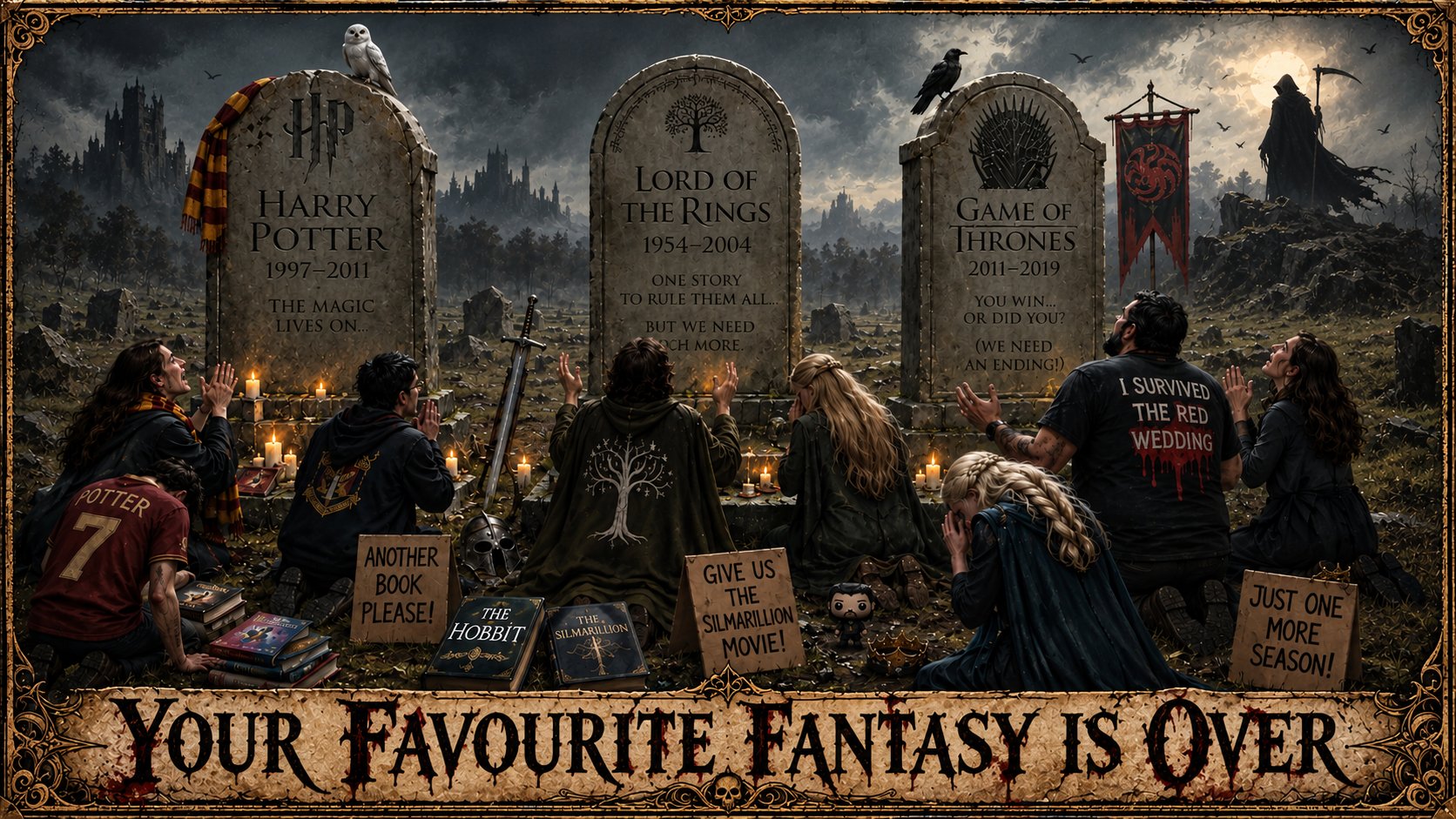
The Lord of the Rings was published between 1954 and 1955. Tolkien died in 1973. His son Christopher spent the next forty-five years editing and publishing his father’s manuscripts with a care and devotion that amounted to a second life’s work. Christopher died in 2020. Since then Middle-earth has become a licensing operation. Amazon spent a quarter of a billion dollars on The Rings of Power. Peter Jackson has been circling First Age films. The War of the Rohirrim arrived as an animated feature. None of this is building on Tolkien. It is standing on his grave and refusing to leave.
Harry Potter ended with Deathly Hallows in 2007. What followed was not all bad. The Fantastic Beasts films told new stories in the same world, and I enjoyed them for exactly that reason. They were not retellings. They were attempts to find new ground, and even where they stumbled commercially they at least had the courage to try something that was not simply Harry Potter again. But then came a stage play, theme parks, video games, a merchandise operation that could supply a small country, and finally the thing that troubles me most. HBO are now remaking the original story as a television series, book by book, with Rowling playing an active role in creative development. Not a new story. The same one. Rowling wrote one of the great fantasy stories of her century. She finished it. And then the machine decided that finishing was not enough.
A Song of Ice and Fire is different because it was never completed, and what happened in its absence is the clearest warning of what the franchise model does to a story. Martin published A Dance with Dragons in 2011. Fifteen years later The Winds of Winter has not appeared. In 2022 he told Stephen Colbert he was perhaps seventy-five per cent done. Since then the silence has continued, broken only by occasional blog posts confirming that progress is being made.
Meanwhile HBO finished the story for him, and the result was a catastrophe. Season Eight of Game of Thrones was a travesty because the showrunners were asked to land a story that only its author understood well enough to land. The political threads that Martin had woven across thousands of pages were collapsed into a handful of episodes. Character arcs built over years were resolved in minutes. The audience felt it immediately. When a writer hands their endings to other hands, what arrives is not an ending. It is a guess dressed in expensive production design.
And now there is a prequel series, and the franchise continues to grow sideways while the central work remains unfinished. At a certain point the honest assessment is that the book may never arrive. That is not a criticism of Martin’s ability or his commitment. It is an observation about what happens when a living franchise becomes more commercially valuable than a finished novel.
What the genre loses
Every pound spent adapting Tolkien is a pound not spent on something the audience has never seen. Every hour a reader spends waiting for Martin is an hour they could have spent discovering a writer who has already finished something brilliant and is waiting for anyone to notice. Every television executive who greenlit the Harry Potter remake chose a known property over a risk, and in doing so narrowed the corridor through which new fantasy can reach a wide audience.
This is not an abstract complaint. Fantasy literature is extraordinarily rich at the moment. Writers are doing things with the form that would have been unimaginable thirty years ago. But the commercial structures that bring fantasy to the largest audiences are locked in a cycle of return. They go back to the same wells because the wells are proven, and the audience learns to expect the familiar. A reader raised on adaptations of Tolkien learns to want more Tolkien. A viewer raised on Westeros learns to want more Westeros. The appetite for the new is not suppressed deliberately. It is simply never given room to grow.
The ones who let go
Not everyone kneels at the grave. Robin Hobb wrote sixteen books in the Realm of the Elderlings across more than twenty years. She began with Assassin’s Apprentice in 1995 and ended with Assassin’s Fate in 2017. She told a story that spanned generations, closed every door she had opened, and walked away. Readers wanted more. The world she had built could have sustained more. She understood that “could” is not the same as “should” and she let the work stand as what it was.
Terry Pratchett went further. Forty-one Discworld novels over thirty-two years, and when he died in 2015 he left instructions that his hard drive containing ten unfinished novels should be destroyed. It was. A vintage steamroller named Lord Jericho crushed the drive at the Great Dorset Steam Fair in 2017, and his daughter Rhianna has honoured his wishes ever since. There have been no ghostwritten sequels and no franchise extensions. Nobody has tried to squeeze another book from a voice that can no longer speak. Pratchett seemingly understood that the silence after the last word is part of the work.
The long silence
Patrick Rothfuss published The Name of the Wind in 2007 and The Wise Man’s Fear in 2011. The third book, The Doors of Stone, has not appeared. Rothfuss has spoken about this candidly. He has said that his early promises of a book a year were the words of someone who did not yet understand what he was making. “I was an idiot,” he said. He finished a full draft before the first book was even published, but he has rewritten it so extensively that the original no longer describes what the book became.
There is a reading of Rothfuss’s silence that treats it as failure. Another reading, and the one I find more persuasive, is that he understood something the franchises refuse to grasp. A story is not obliged to arrive on schedule. A writer is not a content pipeline. And if the choice is between a book that satisfies the machine and a silence that protects the work, the silence is the braver act. Rothfuss has not turned The Kingkiller Chronicle into a television series, a theme park or a cinematic universe. He has simply not finished, and in not finishing he has refused to let the work become anything other than what it is.
I am not saying he owes nobody an ending. I am saying that his refusal to provide one on demand is more honest than a book-by-book television remake of a story that was already told or a First Age blockbuster produced by committee.
Everything ends
The originals were extraordinary. That is not in question. But a genre that spends its energy looking backward will eventually forget how to look anywhere else. There are writers out there right now who are building worlds the audience has never seen, who owe nothing to Westeros or Hogwarts or the Shire, and who deserve the space that endless adaptation refuses to make for them.
Let the shelves hold what they hold. Let the adaptations stop and the prequels end and the expanded universes close. Your favourite fantasy is over. That is not a tragedy. It is the precondition for the next one.
If you'd like to follow Jonathan B. Edvane, you can do so here.
Discussion