
There is a particular kind of worldbuilding that feels like work but is really just hiding. You tell yourself you are building the world, and in a sense you are, but you have wandered into a room that the reader will never visit and you are rearranging the furniture in it. Currency is one of those rooms. So are calendars, and weights and measures, and the exact succession of kings three hundred years before the story opens. Each one invites you to build a whole system, and each one can quietly eat weeks of writing time, or more, while the actual novel sits unfinished. Let’s not even think about languages.
I want to talk about currency in particular, because it caught me, and because the way out of it taught me something I now apply to all of these time-traps.
Why money is so tempting to build
When you invent a world, money looks like a problem that has to be solved before anyone can buy a loaf of bread. It feels foundational. So you start asking questions. What are the coins called? What are they worth against each other? Who mints them, where are they minted and under what authority? Is the economy on a metal standard or something stranger? Before long you have a page of exchange rates and a short essay on monetary policy, and none of it is a story.
The trap is that all of this can be genuinely interesting. Real medieval currency was a mess of local strikes, debased coins and units of account that nobody ever actually minted. A single gold coin was so large a sum that an ordinary person might go years without handling one. There is a rich seam here for a writer who wants to mine it. The danger is mistaking the seam for the book.
When the system becomes the point
Brandon Sanderson is the writer most often held up for building systems that hold together under pressure, and his currency in The Stormlight Archive is a fair example of how far that can go. The money of Roshar is the sphere, a gemstone set inside a glass bead. There are ten kinds of gem and three sizes of each, which gives thirty distinct units before you have bought anything. The gems are ranked in value tiers according to how useful they are for the world’s magic, so an emerald is worth fifty times a diamond of the same size. The spheres also glow, because the same gems store the magical light that powers the setting, which means a coin can be charged or spent out, and a dark coin is harder to trust. People give them nicknames by colour. Whole scenes turn on whether a character’s money is still lit.
It is an impressive piece of design and it does real work in those books, because the currency and the magic and the weather are the same system seen from different angles. But notice what it asks of the reader. To follow the economy of Roshar you have to hold thirty units, five value tiers and a charged-or-spent distinction in your head, and the writer has to spend pages teaching you. Sanderson can afford that because his readers come for exactly this kind of machinery, and because his books are long enough to carry the lessons. Most of us cannot, and should not try. With due respect to Mr Sanderson, if your currency needs a tutorial, you have built a game economy and attached a novel to it.
When the system disappears
Go the other way and you find Tolkien, who built more of his world than anyone and showed almost none of its money. You can read The Lord of the Rings and come away with maps, genealogies, languages and songs, and never once be taught an exchange rate. The clearest glimpse is Barliman Butterbur at Bree, dealing in silver pennies, and Bill Ferny selling a broken-down pony for far more than it is worth. That is nearly the whole of it. The hobbits clearly use money, the economy clearly functions, and Tolkien never stops the story to prove it to you. He trusted that a silver penny changing hands tells the reader everything the scene requires, which is that these people live in a world where goods have prices and prices get haggled.
That trust is the thing worth stealing. The reader does not need to know your monetary system. The reader needs to believe your characters live in a world where money is real, and those are very different requirements. A single coin, described well and handled with the right amount of care or contempt, does more than a page of denominations ever will.
What I actually did
My own currency is about as simple as it gets. Gold, silver and copper, in that order of worth, which any reader will understand before you have finished the sentence. In the Marchlands the gold coins are crowns, the silver are shims, and the copper are curns. I will happily concede that the three-metal ladder is a philosophical remnant of too many hours spent hoarding gold, silver and copper in World of Warcraft. When a structure is lodged that deep in your head it is not worth fighting. It is worth using, because it means the reader already knows how it works and you never have to teach it.
But simple does not mean empty, and here is where the real decision was made. I did not want the novel to stop and explain any of this. A chapter that pauses to establish how money is struck and marked and trusted is a chapter where nothing happens, however elegant the detail. So I took the whole subject out of the novel and gave it to a short story instead. By the end of it, a reader can hopefully see that curns are used by the common folk, shims by anyone doing well or working hard, and crowns for those with stolen or inherited wealth.
Seeding it somewhere else
The story is The Mint at Fressalt Hoo, and its entire job, underneath the plot, is to lay the foundations of Marchlands money so that the novel never has to. A northern lord, Edwald Ferchar, rides into a harbour town with a saddlebag of raw gold and silver, wanting three boats, and the shipwright will not take unmarked metal for a sum that size. The down-payment has to be struck into local coin, crowns and shims, at the town mint. So we follow him to the mint and watch it happen.
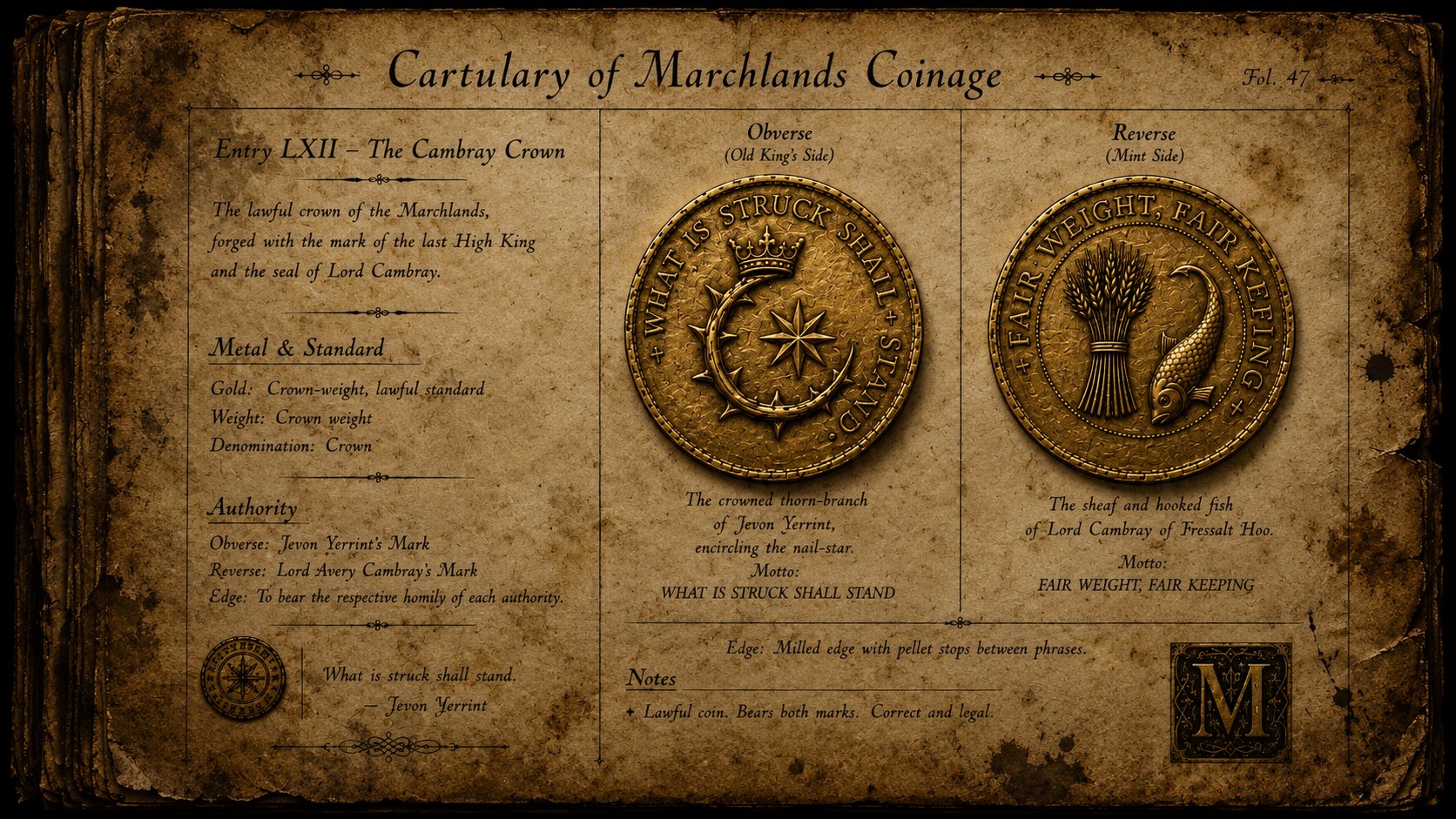
It is not entirely invented, though. English medieval history contains accounts of rich merchants visiting moneyers with their gold and receiving legitimately struck currency. I leaned into that idea for this purpose. Everything the reader will ever need to know about how this world handles money is in that scene, carried by a man who resents every moment of it. The mint tests the metal before it will touch it, because a stamp binds the local lord’s name to the coin and the mark has to be right. It keeps a portion of the gold as a fee, the shaving, which Edwald hears as a polite word for theft. Each crown carries two marks, the current lord’s sheaf and hooked fish on one face and the dead king’s sigil on the other, because old law demands the king’s mark on gold no matter who does the striking. By the time Edwald walks out with his box of coin, the reader has learned that money here is struck at a local mint, marked with a lord’s authority, tested before it is trusted, and shaved for a fee in the striking, and all through one man’s bad temper.
None of that has to appear in the novel. When a character in the book pays for something in crowns, the ground is already laid. A reader who has met the mint understands what a crown is and whose face is on it and what it cost to make. A reader who has not still loses nothing, because the coin behaves exactly as a coin should and the story carries on. The worldbuilding is there for anyone who wants it and invisible to anyone who does not, which is the only state worth aiming for in this writer’s opinion.
The real lesson
Currency was never the point. The point is that the things most likely to swallow writing time are the things the reader needs least on the page, and the answer is almost never to cut them and almost always to move them. Build the system if building it helps you believe in the world. Then find a smaller, lower-stakes place to show the three or four details that actually matter, and let the novel inherit the trust without paying for it.
I found the short story format perfect for this. So is a letter, a ledger, a scene in a tale nobody thinks of as important. You do the heavy work once, somewhere the pace can afford it, and every book that comes afterwards gets to spend a coin without first explaining the mint.
If you'd like to follow Jonathan B. Edvane, you can do so here.
Discussion