The Story
Entered in The London Magazine Short Story Prize. This was always going to be hard. It is a respected literary publication and my hopes were not high for it as a genre fiction piece.
On reflection, I can see why it did not land. It has been several months and, reading it again, the sub-plot is a little opaque to me. So much so that I cannot remember how I expected readers to join the dots of Gedge’s day. If I feel like that as the author, then I can hardly expect judges to find it accessible. I think it stands up as a rather morbid gothic piece, but falls short.
For me it was a good exercise, another for the rejection pile and no regrets. Do leave a comment.
The Rejection
Entered in The London Magazine Short Story Prize. This was the only submission of the story.
Rejected · The London Magazine
Dear Jonathan,
Thank you for taking the time to submit your work to our competition. Unfortunately, on this occasion your submission was not selected as a winner. We thank you for the time and effort you have put into your work, and wish you the best of luck in all your future creative endeavours.
Best wishes,
The London Magazine
thelondonmagazine.org
Listen — Narrated Version
The Highgate Mute
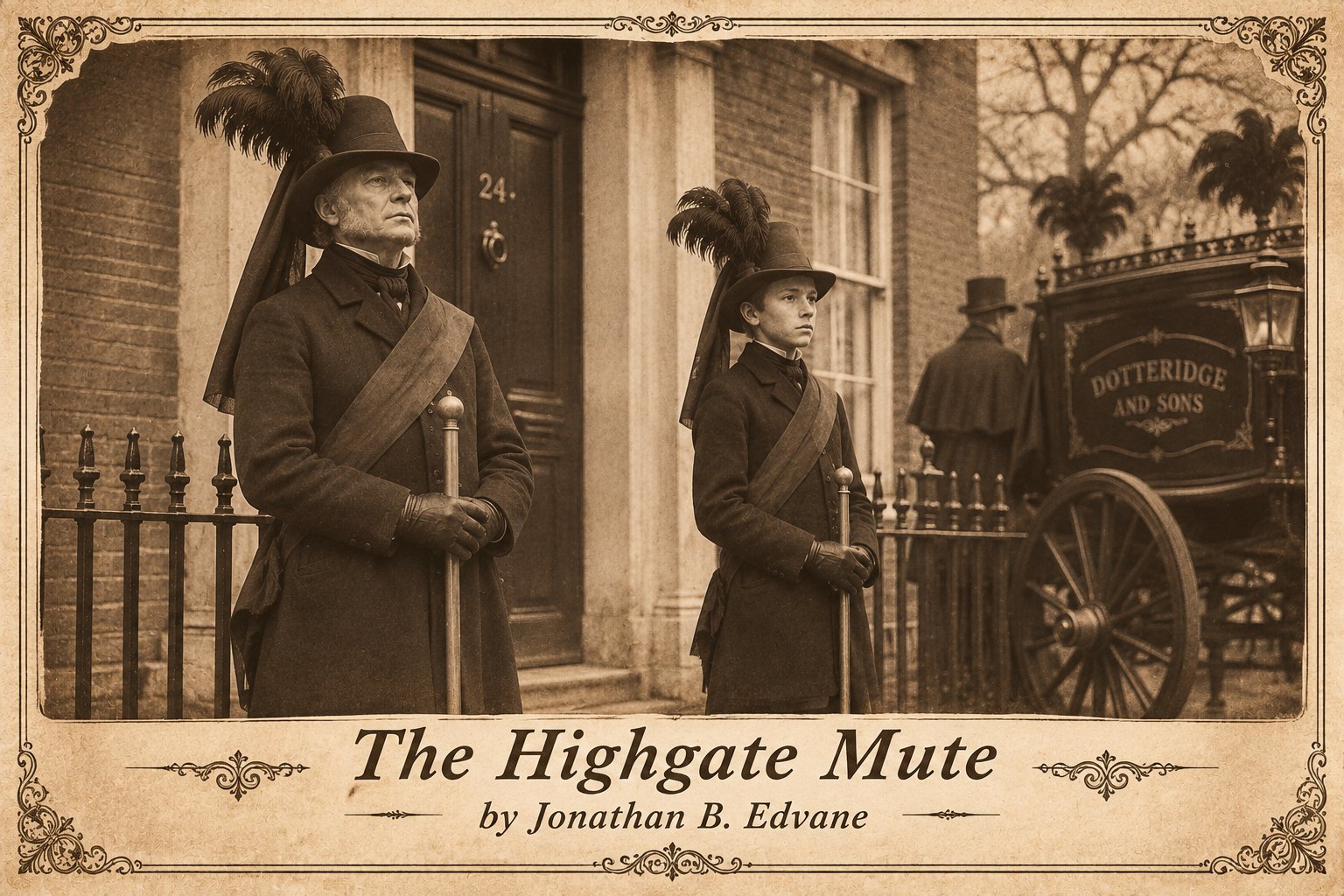
The ostrich plumes hanging from the lines stirred nervously whenever the stove drew. They had been dipped the evening before and were drying badly in the November damp. Amos Gedge moved among the smell of dye and feathers, separating the stuck vanes and leaving untouched what would settle of itself. Mounting boards were stacked against one wall, and his two staves rested in the corner.
Noah watched from beside the bench while Gedge finished dressing.
Three funerals in one day meant haste was necessary. Gedge buttoned his coat, settled the sash across his chest and then took up the beaver hat with its long fall of crape. He adjusted it before the small looking-glass above the basin. It had to sit properly. A mute who looked careless made the whole funeral look cheap.
“Come here.”
Noah obeyed. At fourteen he had begun to lengthen without yet filling out, and the borrowed coat was a little loose on him. Gedge straightened the collar, drew the sash flatter across the boy’s chest and fixed the crape where it had twisted at the back of the hat.
“You’ll grow into it.”
Gedge took the shorter staff from the corner and placed it in his hand, but Noah held it too high.
“Lower.”
He lowered it.
“Not like a broom. Let the weight rest.”
The boy adjusted his grip until Gedge was satisfied. He had seen men hired by the day slouch against their staff in the rain, take gin at every door and arrive at the grave with their sorrow rolling visibly in their stomachs. That was not the trade as Gedge understood it. There was dignity in stillness, if a man had the discipline for it, and more respect in silence than in half the words spoken over coffins.
He set Noah’s hat straight one final time. “You stand. You watch. You do not speak.”
Noah nodded.
Gedge took up his own staff, and together they went out into the dark.
By eight o’clock they were standing outside a plain brick house off the Highgate Road, one on either side of the door, their staves upright and their faces composed into sombre, solemn, rigid grief. The required expression. Noah was very still. Too still, Gedge thought. The boy seemed to be holding his shoulders as though waiting for a blow. Without turning his head, Gedge said, “For heaven’s sake, breathe.” Noah did, and some of the strain left him.
The coffin came out at half past the hour, borne by four men from Dotteridge and Sons. Walter Dotteridge, neat in black, followed it to the pavement, checking the bearers, the horses, and the spacing of the procession. He gave Gedge the smallest nod, and Gedge returned it. His own plumes stood above the hearse, not his finest work but respectable. The black ostrich feathers were dressed fully enough to disguise the repair of two older vanes. Behind them waited three mourning coaches.
The deceased, John Safferey, had been a copying clerk. This much Gedge had learned from Dotteridge, though the mourners themselves could have told him the same. They were largely clerks and office men, soberly dressed, punctual, and uncomfortable in the cold. No widow leaned upon an arm, and no mother wept into a handkerchief. They had come only because Safferey had worked beside them. While they waited for the procession to form, two of them spoke, appearing reluctant to discuss the matter. Gedge heard them clearly. Safferey had kept a copy of a will he had been told to destroy. The name mentioned was Alderton. One of them said it was unlike Safferey to have involved himself, and the other said nothing.
The featherman moved off, carrying the plume board before him. Gedge and Noah followed, then came the hearse and the coaches behind it. At the first turn, Noah shortened his stride to match his uncle’s and momentarily lost the rhythm. Gedge glanced across, and the boy corrected himself. They proceeded at a walking pace as faces turned towards them, then away. A funeral was a spectacle enough to be noticed, but rarely chosen for remembrance.
The grave lay on one of the less fashionable paths, below the grander monuments and far enough from the Egyptian Avenue that its columns were visible only in glimpses between the trees. Safferey’s burial was not mean, but neither had anyone paid to make it impressive. Gedge and Noah stood at the foot of the grave while the clergyman read his lines. The ground was firm, and the cold worked through boot-soles within minutes. Gedge had learned years ago to let it come. A mute who shifted his feet at the graveside drew the eye, and drawing the eye was the one failure the trade did not forgive. He was not there to be noticed. He was there to furnish the occasion with an appearance of gravity, just as his plumes furnished the hearse with an appearance of expense. The boy held his staff properly now, though he winced when the first shovelful of earth struck the coffin. That sound was always worse than anyone expected.
Gedge did not move.
The clergyman closed his book. Hats were replaced. Men coughed, feet shifted, and departures commenced. The clerks dispersed quickly. They had done what was expected, and now they had offices to return to and work that would not wait for the dead. Within minutes the graveside was empty but for the sexton and his boy watching the turned earth settling.
As they left the path, Noah said, “Nobody seemed sorry.”
Gedge adjusted the boy’s grip on the staff before answering. “Nor need you.”
Noah frowned.
“You are not here to judge grief,” Gedge said. He thought of what the clerks had said among themselves, and let it pass. “Keep the crape clear of the ground.”
The boy obeyed.
* * *
By early afternoon the day had not brightened. A weak grey light lay over the wider streets below the village, catching on the carriage glass and the black polish of the hearse waiting before a tall house with iron railings. This was a better funeral. The horses were matched, the harness clean, the coffin properly furnished, and his best plumes stood above the hearse in a dense black crown. Four to each horse as well, every one of them his own work. Walter Dotteridge was there again, only this time with two assistants.
“Mind yourself here,” Gedge told Noah as they took their places. “They’ll be looking.”
Noah glanced towards the house. “At us?”
“At everything.”
The dead woman was Mrs Summerton, housekeeper to the Alderton family, a name now familiar to Gedge. She had served them for many years, which explained the expense. A household of standing could not bury an old servant cheaply without inviting disparagement. When the door opened, the family emerged in ordered black. There was no confusion of grief, no one needing support, no child being coaxed into place. Each mourner seemed to know precisely where to stand. Gedge would ordinarily have approved of it. Proper mourning, like proper funeral work, required discipline. Yet the arrangement troubled him.
The mistress came first, veiled and upright. Two grown daughters followed. A younger man, perhaps a son, stood back to allow them passage. Servants gathered at the rear, and among them a young girl stood apart, white-faced, her hands clasped tightly together. The master of the house was absent. Gedge looked towards the door, expecting him to appear, but it closed behind the last servant.
The featherman raised the plume board and moved off. Gedge and Noah followed. The boy walked better this time. He had found the pace during the morning’s procession, and his stride matched Gedge’s now without needing correction. They passed through streets where the houses were tall and well-kept, the steps scrubbed, the boot-scrapers polished. Curtains moved in two of the upper windows. Gedge kept his face forward. A funeral procession was a performance, and like all performances it was made for an audience it would never acknowledge.
Mrs Summerton’s grave had been prepared in a better quarter of the cemetery, where the paths were gravelled, and the newer monuments stood clean and pristine. A mason had left two wooden markers beside the plot, and Gedge assumed a stone had already been commissioned.
The family gathered opposite him in a close group as the clergyman began. They mourned well. The mistress stood with her veil drawn and her hands folded. One daughter held a handkerchief. The younger man who had followed them from the house kept his eyes on the coffin throughout. None of the family broke down, whispered, looked awkward or reached for another’s hand. Their sorrow appeared properly rehearsed. Only the white-faced girl among the servants stood outside the arrangement, her grief ungoverned and unwelcome.
Gedge knew better than anyone that grief had its forms. He made part of his living from them. There was nothing shameful in ceremony where feeling failed. Still, he found himself thinking of the closed door and the husband who had never appeared. Behind the family, two of the servants spoke in voices that were not meant to carry. One said that Mrs Summerton had told the girl something about the master’s affairs, and that the girl had been foolish enough to repeat it. The other looked towards the white-faced girl and said nothing.
Gedge stood very still. He had heard the Alderton name twice now, once from clerks who did not know he was listening and once from servants who did not care. The will, the housekeeper, the absent husband, the frightened girl. He arranged none of it into a coherent shape. He just held it, as he held the staff, because holding things without remark was what he had become accustomed to.
When the clergyman reached the committal, Noah moved. A light pull came at Gedge’s sleeve. Gedge kept his eyes forward. When it came again, he turned them just far enough for the boy to understand, and Noah let go. The coffin was lowered. Gedge bowed.
They had passed through the cemetery gates before Noah spoke. “Uncle.”
Gedge walked on.
“That girl. Among the servants.”
“What of her?”
“She was frightened.”
Gedge remembered the things he had heard the servants say. “You must learn not to concern yourself with everything your eyes happen upon, nephew.”
“But...”
“Discretion is part of our work.”
The words came harder than he intended, and Gedge regretted his tone. All his working life he had stood at doors, next to coffins, behind grieving families, and understood that the privilege of the mute was to be overlooked. Men lowered their voices for servants and strangers. They did not lower them for furniture. Twice that day he had stood close enough to hear what was not meant for him, and twice he had let it settle without a word. He had just told the boy to do the same.
Noah had not yet learned to look away.
* * *
By the time they reached the third house, the afternoon was fading into evening. This time there was scarcely a funeral to speak of.
George Rubwright had been a crossing sweeper. Gedge had passed him for years at the bottom of the Highgate Road, a thin man with a worn broom who nodded to him on funeral mornings and received a nod in return. Two men who stood in the street for a living did not need to speak to know one another. Some weeks ago Rubwright had gone from his crossing. Gedge had noticed his absence without thinking much of it. Now Dotteridge’s man mentioned, while they waited for the coffin, that Rubwright had moved his pitch to the street where the Alderton house stood, and that the household had complained of him watching the windows. No family had come forward to claim him, and no friends waited at the door. The undertaker had provided the minimum that decency demanded and no more.
The coffin was deal, plain-grained and light enough that the bearers lifted it with little effort. Ahead of it, the featherman carried a single board dressed with two tired plumes from Gedge’s older stock, their edges no longer full enough for a respectable household but serviceable here, where nobody was likely to inspect them too closely.
Noah noticed them at once. “They’re ours,” he murmured.
Gedge gave him yet another look and the boy corrected himself before the words could become conversation. He had mounted those feathers himself years earlier.
The procession moved. It amounted to the featherman, Gedge and Noah, the coffin, and two men from Dotteridge’s firm. No mourning coaches followed. Nobody came out onto the pavement to see Rubwright carried away. A butcher’s boy passed them with a basket on his shoulder, slowed and gave a single nod to the coffin, then continued on his way. Gedge was embarrassed by it. He found the absence of spectators indecent. He walked on beneath the worn plumes, and beside him, Noah said nothing.
Rubwright’s grave lay near the far edge of the cemetery, beyond the fashionable avenues and the better monuments. The ground there was rougher, and the paths had begun to lose themselves in mud. The clergyman clearly felt the cold there. He kept one hand closed around his book and hurried the words whenever the wind lifted against him. The coffin descended quickly.
Gedge stood with his staff planted before him and Noah at his side. The silence between them had altered since the afternoon. It no longer felt like only discipline. It had acquired something else. Judgement perhaps.
Gedge was the only person present who had known Rubwright alive. It amounted to a nod on working mornings, one man with a staff and another with a broom, and neither of them had ever presumed upon it with speech. Rubwright had swept his crossing, and Gedge had walked past with his plumes and his crape, and they had understood one another in the way that men who stand in the street all day understand the others who do the same. Now the broom was gone, and the man with it, and the crossing at the bottom of the Highgate Road would be swept by someone else or not at all.
Gedge knew why he had left that crossing. He knew it the way he had come to know everything that day, through the carelessness of people who did not trouble to guard their words from a man with a staff. The clerks had talked about Safferey. The servants had whispered about Mrs Summerton. Dotteridge’s man had mentioned Rubwright’s moved pitch as though it were no more than an address. None of it had been meant for Gedge, and yet all of it had reached him. He was present and invisible at once, close enough to hear and too negligible to warrant guarding against.
The clergyman’s voice ceased. A handful of earth struck the lid below. Gedge remained still.
He and Noah left the cemetery in the last of the light. Neither of them spoke. The mud from Rubwright’s grave clung to their boots and the evening cold had settled into the places where standing all day had left Gedge stiff and sore. Three funerals in November was hard work for a grown man. For a boy it was something else, and Gedge could see the tiredness in Noah, even though the boy was trying not to show it. The lane from the cemetery joined the road and ordinary life resumed around them. A woman carried a basket into a doorway. Two boys ran past without looking at them. A lamp was being lit in a shop window.
Highgate Village lay ahead of them, its windows beginning to show one by one through the trees. Gedge carried his staff as he had carried it since morning, and Noah walked silently beside him. The boy had stopped asking questions somewhere between the second and third funerals. He held his staff properly now, kept his face composed and his eyes forward, and had not spoken since Gedge told him that discretion was part of the work. He was doing exactly as he had been instructed. All day Gedge had been teaching him how to become a mute. How to stand without fidgeting. How to let his face settle. How to hold the staff so the crape did not trail. Where to look when the coffin went down. When not to look at all.
Gedge looked at the boy. Noah’s hat sat exactly as he had arranged it, the crape falling properly down the back. The costume still fit him badly in places, but not so badly as it had that morning. Already he had learned how to inhabit it. Gedge could teach him the rest. In time Noah would learn how to make himself unobtrusive, how to stand among grief and business and private conversation without seeming to possess ears or eyes of his own. He would learn the usefulness of being disregarded. He might even come to think of it as dignity. Gedge had done so for years. He could feel the three funerals in his arms and his back, the weight of standing still all day, and beneath it another weight. One he could not put down by walking home.
He reached across. Noah looked up as Gedge found the pin at the back of the hat and worked it free. The long strip of crape loosened in his hand. He rolled it into a tight black cylinder, and slipped it into his coat pocket.
“Polish the staves and put them away. You’ll find some bread and the end of yesterday’s cheese on the shelf. I have business at South Grove. I shan’t be long.”
The boy said nothing.
Discussion