The Story
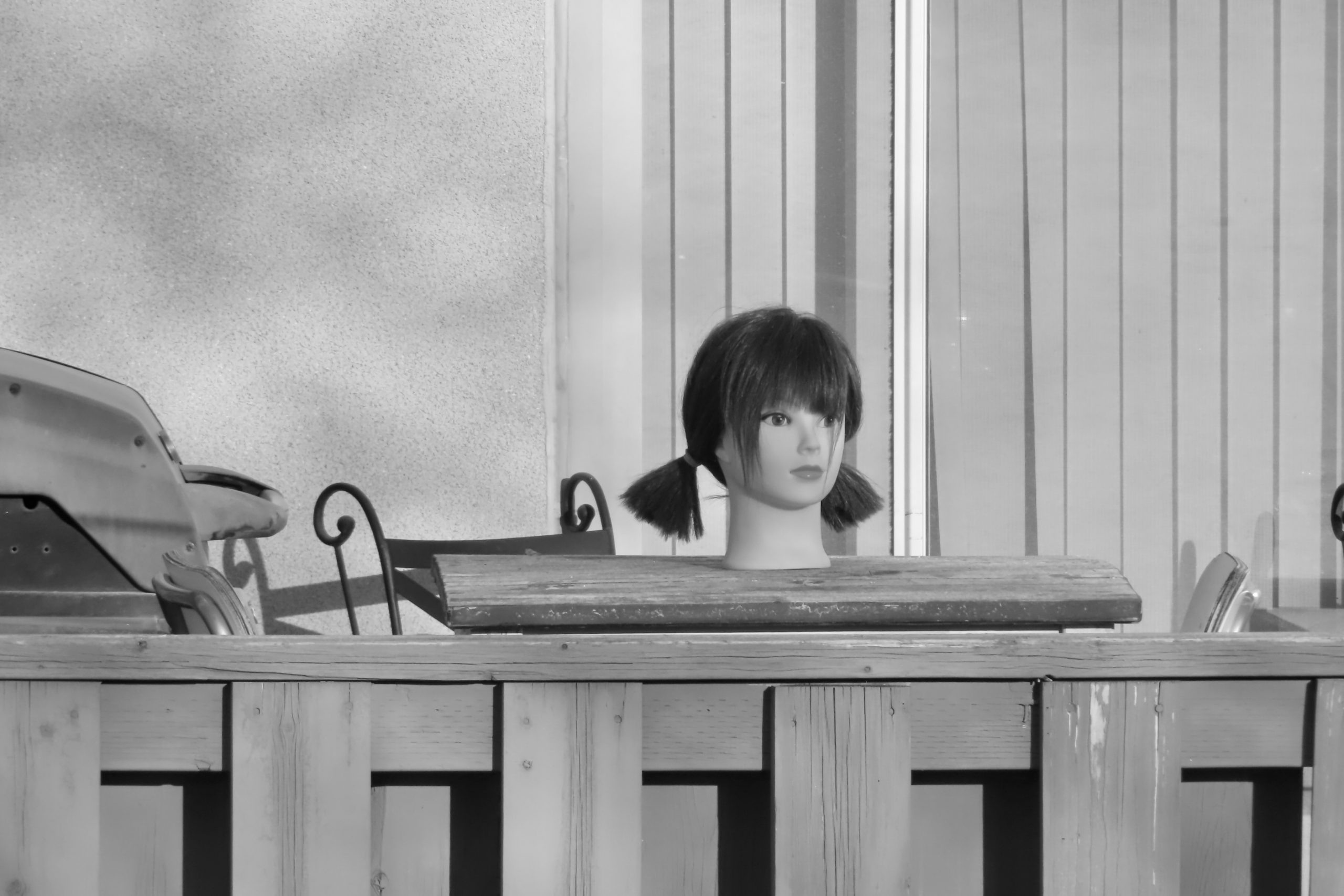
The New Flash Fiction Review runs a photograph prompt for its submissions. They share a set of images and ask you to write a flash fiction story inspired by one of them. The photograph above caught me immediately. A mannequin head placed on an outdoor table behind a wooden fence, its hair tied in two short tails, blinds closed in the window behind it. It looked staged and strange and faintly sinister, and I wanted to write the voice of the thing itself.
What I ended up with was a narrator who could only watch. A severed head with no body, observing the legs of passersby through the gaps in the fence, cataloguing details the way a predator might, while appearing completely harmless. The piece is very short but I think it does its work. The final line repositions everything that came before it, and I am pleased with how the tenderness of the watching gradually becomes something else entirely.
The editors described it as a close decision, and I believe them. Flash fiction lives or dies on its ending and I think this one lands. But the queue is the queue, and now it lives here.
The Rejection
Submitted to New Flash Fiction Review in August 2026. Submission ID 54665400 via Submittable.
Rejection · New Flash Fiction Review
Sorry to let you know that we're going to pass on this one, but we wanted to also let you know that it was a close decision for us and we'd love to see your work in our queue any time.
— Valerie, Shane, Louella, Kiki, and Cole, New Flash Fiction Review Editors
Listen — Narrated Version
Sitting Still
I sit on the table behind the wooden fence. There is a chair beside me and a barbecue against the wall. The blinds remain closed. Through the gaps in the boards I see pavement, parked cars, dogs on leads and the legs of people passing. Rain gathers in the grain of the table. Sun warms only one side of my face. My hair is tied into two short tails.
Most people notice me. Some slow down without meaning to. Some look once and then towards the house, searching for the joke. Others cross the road before they reach the gate. Children are less practised at pretending. One girl stops each morning on her way to school. She has red laces, one sock lower than the other and a scar beneath her left knee. Today she looked directly at me. Her mother always takes her by the wrist and pulls her on. The girl turns her head until the fence hides us from each other. Small children do that. They trust their interest longer than adults do. They have not yet learned which things should not be looked at.
I think about my body when the weather turns cold. I do not know where they put it, or whether they kept any part. I remember my hands better than my feet. Hands were useful. They could fasten a button beneath a chin, smooth hair from a damp forehead, lift a weight and hold it securely. I remember warmth gathering inside the fingers, how a wrist fit snugly into the circle of one hand, and how little movement remained once both hands agreed upon their work. I do miss the quiet that came after effort. They separated me. Distance, they must have thought, would undo what was already done. A head without hands looks harmless enough.
By late afternoon the light leaves the wall and the pavement turns grey. The girl comes back alone. Her red laces are loose now. She slows at the gate and looks towards the closed blinds, then at me. I cannot turn my eyes. I cannot smile. The empty chair waits beside the table, wet along one arm. She rests her hand on the gate. Her schoolbag slips from one shoulder. She does nothing. Neither do I. I have always understood patience. Sitting still was never the difficult part.
Children always came closer by themselves.
Discussion