The Story
Submitted on 7 July 2026 to Ode To Them’s Folktales open call. They claim to have received 649 submissions. An update came on 21 August saying they were still reviewing. By October it was clear the venue had moved on to running new open calls while sitting on the backlog. Withdrawn 28 October 2026. This was the only submission of the story.
It is disappointing when a platform opens its doors to hopeful writers all over the world and then betrays that invitation by failing to communicate, launching new open calls while the old one goes unanswered, and evidently treating the whole exercise as a means of driving attention to the editors themselves.
I am letting it rest because there is no obvious market for this kind of story and it therefore sits naturally among those tales I intend to do nothing further with. It is quite a cerebral story and I had to read it three times and listen to the audio narration to fully appreciate what I had been satisfied with at the time of writing. Do leave a comment.
The Rejection
Submitted to Ode To Them’s Folktales open call on 7 July 2026.
Withdrawn · Ode To Them
No rejection letter was issued. An update on 21 August confirmed submissions were still under review. No further communication was received. The venue launched new open calls while the Folktales backlog remained unresolved. Withdrawn by the author on 28 October 2026.
Listen — Narrated Version
Look Beneath The Font
The winter of 1776 took the country by the throat and throttled it.
I was then working the parishes about Wellington, where the roads hardened white by morning and the hedges stood with every thorn visible, as though God had stripped the year back to its bones. The Severn had stopped in its bed. Barges sat locked and useless. Men who had lived by coal and iron stood idle at doors they could no longer afford to open. The frost came down upon pit, yard, cottage and hall alike, and still the difference between them was maintained for as long as pride could keep its fingers moving.
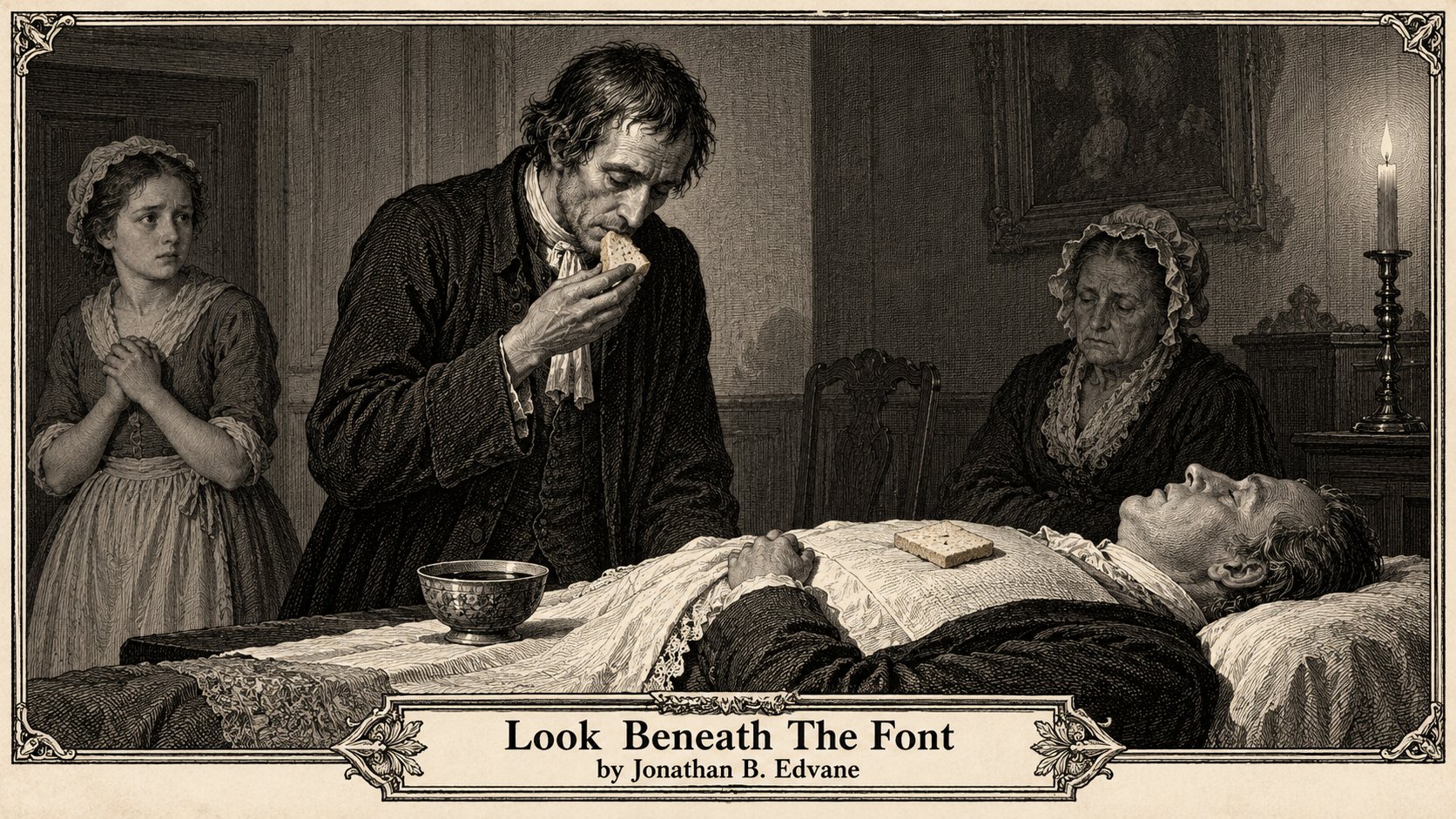
I was called where death had been. That is the honest way of saying it. A piece of bread was laid upon the breast of the dead, with salt sometimes, and a bowl beside it, and a coin near enough to be seen by those who wished to think coin explained the matter. I ate. I drank. I took what was offered. The family watched and waited for the sound.
That was my sin.
The waiting. The eating and the trade were expected.
There is a little space between the bread going down and the word coming up. I lived in that space. I had no wife, no child, no pew, no place at any table except the one where a corpse had made room for me. In that breath I came nearest to being received.
By January I was thin, pale about the mouth, and greyed under the eyes. Still I went when sent for.
Reverend Stephen Laplain never named me from the pulpit.
He had a way of keeping two accounts in his head and making neither trouble the other. On Sundays he spoke of mercy, repentance and the resurrection of the dead. On weekdays, when a house was locked in grief and the women had begun to fear the bed in the next room, he sent a boy to find me.
We had kept this arrangement longer than either of us admitted. I came by back doors. I stood in kitchens, washhouses, sculleries, passages where boots dried and old coats hung. Laplain did not invite me to sit. He did not insult me with pity. That was one of his merits. He understood use, and I understood hunger, and between those two understandings a parish can keep itself from breaking.
The people knew. Of course they knew. A town has ears in its shutters and eyes under every cap. Yet nobody spoke against it, because their dead lay quieter after I had been there. A body safely carried from bed to grave is a kind of doctrine when frost has made the earth hard and sorrow has made the living foolish.
Laplain believed in order. I was one of the instruments by which he kept it.
The first house stood in a lane off the market, with its windows shuttered and a lamp burning in the lower room before noon. A servant let me in and looked at my mouth before she looked at my eyes. They all did that by then. The mouth was the gate they both feared and paid for.
The dead man was laid in the front room, where respectable families put their grief where neighbours might imagine it. He had been a brewer’s agent, or a cousin to one, or some such useful branch upon a local tree. I remember clean linen. I remember a girl of perhaps sixteen standing with both hands shut tight in her apron, and an older woman seated so still she might have been arranged with the chairs.
Laplain was not there, but his absence had authority in it. The bread had already been placed upon the dead man’s chest. A small white piece, cut square, lying above the heart. Beside it stood ale in a little bowl, dark and flat, with a skin beginning on it from the cold.
No one spoke.
That silence was never empty. First my breathing stopped being natural. Then my eyes began their small movement between the corpse and the bread. Then each person, however proud, remembered that he had come to the true part and could do nothing now but wait.
I took the bread.
It was cold at the edges and damp underneath, where the dead had given it his last warmth in exchange for mine. I put it on my tongue. Chewed. Swallowed. The ale followed, bitter, stale, and necessary.
Then came the space.
It opened low in me, and I have no better word for it than nearness. The room drew close. The corpse was no longer only on the table. The living were no longer entirely living. For one breath all distinctions fell away to fog.
My mouth filled.
“Lilleshall,” I said.
The older woman’s face changed. Nothing dramatic. No cry. No hand to the breast. Only a small surrender around the eyes.
I took the coin and moved toward the passage. Behind me the girl spoke first, which surprised me. I had taken her for the kind that waits to be addressed.
“What is Lilleshall?”
The older woman hesitated. When she spoke, her voice was flat and final.
“It’s where men go when…” A pause. “Nothing that concerns this house now.”
“But he said…”
“I heard what he said.”
A silence followed that was longer than the one before the ritual. I let myself out by the kitchen and went back into the streets.
* * *
The workhouse death came three days later, and Laplain sent me himself. The boy who came to my lodging said the vicar wanted me at the parish house before dark. There are errands better carried in the mouth of a child who does not yet know what he is delivering.
The workhouse had filled beyond its keeping. Men from the pits sat wrapped in sacking, with their hands held under their arms. Women watched the soup as though staring might thicken it. Children lay in rows, learning young that hunger is a language not only for adults. The cold had entered the place and become part of its management.
The dead man was in a room where tools had once been stored. His name was given to me, but I did not retain it, a fact that shames me now. At the time I thought names belonged to the living and words to the dead.
The bread there was rougher than the last house had provided. Brown, old, and badly cut. There was no ale. Only water in a cracked cup. Yet I remember taking more care there than I had among the clean linen and beeswax, because poverty already strips a man of airs, and I would not be the one to finish the work.
They gathered in the doorway and along the wall. Nobody crossed himself or wept. They just waited.
I ate.
The bread dragged at my throat this time, and the water had a taste of tin. Then came the little interval, in which the dead pressed close and passed away through me.
“Thomas Eyton,” I said.
Two men near the door looked at one another.
“Thomas Eyton,” one repeated, trying the name as though it might open something. “Was that his name then? I thought he was called Morris.”
“He never said what he was called,” the other said. “He had a way of speaking though. Soft. Not from here.”
“Eyton’s the family up at the hall.”
A silence.
“He had their hands though. Long fingers. I noticed when they brought him in.”
Neither man said anything further. What would be the use.
For the first time I felt the word fall without being received. Though I understood, standing there in that cold room among those careful, exhausted people, that it had been received perfectly only by the wrong room, in the wrong winter, with no one present who could act upon it.
* * *
Laplain died before the thaw.
It was said his chest had seized and would not loose again. He had sat upright in bed and asked for a candle, though one already burned beside him. I was sent for after midnight. No one told me by whose instruction. A knock came at my door, then a hand against the glass, then the words every parish learns to spend carefully.
The vicar is dead.
I dressed in the dark. My fingers would not take the buttons. I remember that more clearly than I remember the walk. They had laid him in the room where he had received churchwardens, widows, tenants, offenders, creditors, men with petitions, and women with lies they needed blessed into truth. Death had taken from him the habit of command and left only the bone of it.
The bread was on his chest.
I stood a while before taking it because some part of me understood that Laplain had been the door by which I entered every other room, and now the door had become the room itself.
They waited.
I ate.
The bread was fine, white, and dry. It broke easily. It went down with no mercy in it. Then the space opened, colder and wider than before.
My mouth filled.
“Look beneath the font,” I said.
* * *
I set these things down as they came.
First, in the house off the market, where the linen was clean and the grief had been arranged decently.
Lilleshall.
Second, in the workhouse, where the cold had entered the boards and the poor waited for death with the patience of those who have already been much handled by authority.
Thomas Eyton.
Third, in the vicarage, with Stephen Laplain laid in his own room and every chair holding some remainder of the business he had conducted there.
Look Beneath The Font.
Discussion