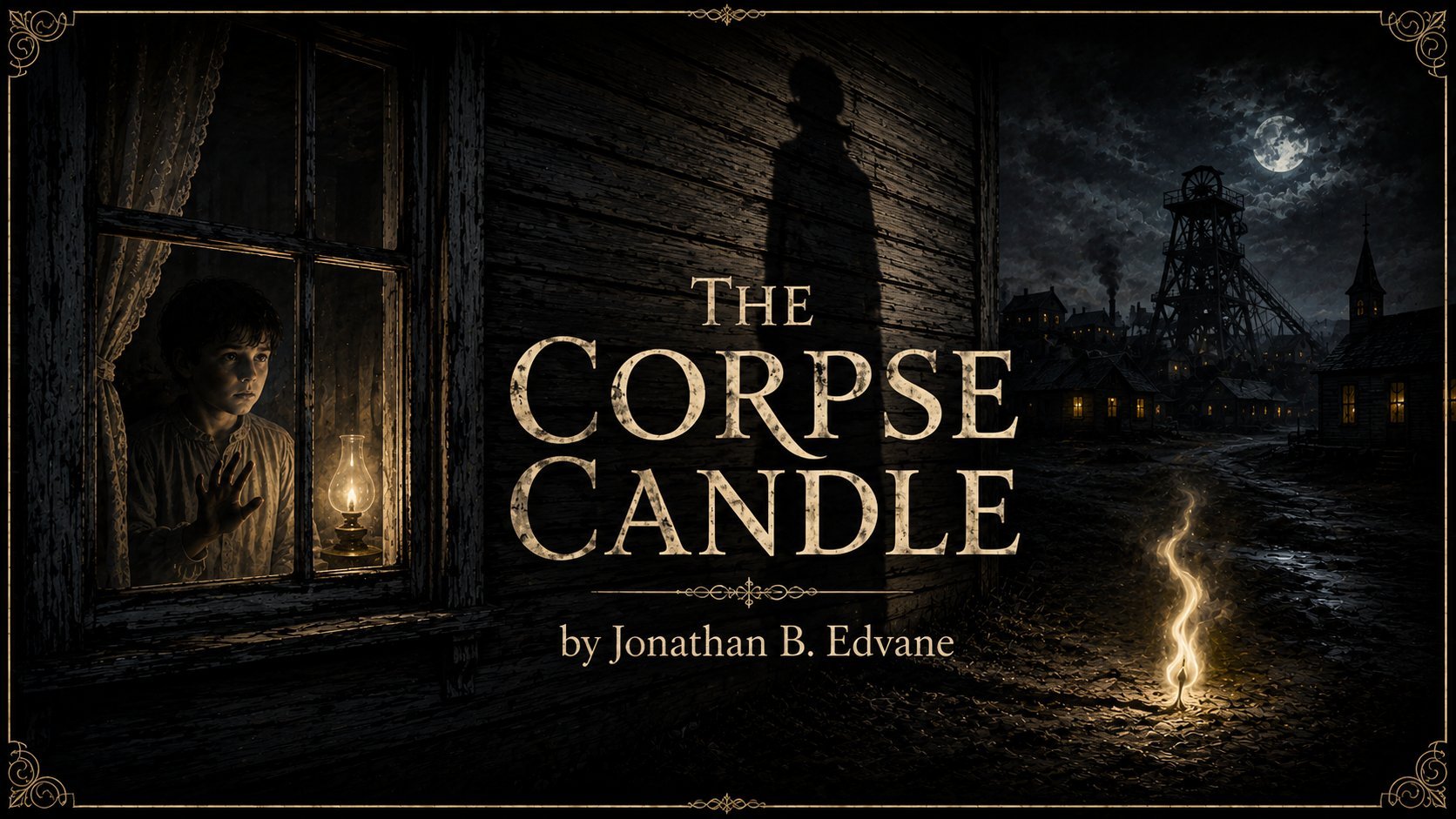
The Story
I submit this story to The Returned after being rejected for a second issue of Space & Time magazine by its editor-in-chief, Angela Yuriko Smith. I want to say first of all that I regard Space & Time as a really good publication. I was very keen to be published in it.
That said, I have decided against continuing with attempts to satisfy this editor. Rejection is something we prefer to keep hidden, but as I have said, I think it is important for everyone, both author and editor, to own it. Submissions to Space & Time are based on a prompt that invites you to contemplate the editor's personal mindset and preferences, and I realise this whole notion pulls me away from my usual register and forces me to adapt. It is a mistake to try and be what somebody else would like, and when I think of it that way, it seems obvious to me.
So here is The Corpse Candle, laid to rest forever with a goodbye and thanks to Space & Time. Readers familiar with the previous rejection may notice a remarkable similarity between the two letters.
The Rejection
Submitted to Space & Time on 1 August 2026 for the Shadows Mean Light issue (Issue 155, October 2026). The reply came on 23 August.
Rejection · Space & Time
Dear Jonathan,
Thank you for trusting me with "The Corpse Candle" and giving me the opportunity to consider it for Shadows Mean Light · Issue 155 · October 2026 of Space & Time.
After careful review, I've decided not to include the piece in this issue.
What I Liked: I really liked the restraint and atmosphere here. The corpse candle is frightening precisely because it does nothing except appear and tell the truth. I especially liked the tension between Margaret's inherited certainty about what Thomas has seen and William's attempt to dismiss it as fever and superstition because he is now "a chapel man in America." The aftermath is also very strong. Thomas never learns how to prevent what the light predicts, and the final revelation that he will see it again throughout his life turns the gift of foresight into a burden rather than a power.
Why I Passed: This came close for me. The imagery and folklore fit Shadows Mean Light beautifully, and I loved the idea of light as something dreadful because it reveals what cannot be changed. Ultimately, though, the story establishes the corpse candle's meaning very clearly and confirms that meaning by the end. For the final issue, I leaned toward stories where perception or interpretation shifted more dramatically, or where uncertainty continued to complicate what the characters thought they understood. This was a hard one to let go, and I hope you'll send me more work in the future.
I know a rejection can feel much larger than a single editorial decision, but that is all this is: one decision made for one particular issue. Building each issue involves questions of theme, balance, timing, available space, and how the selected pieces speak to one another. A pass does not define the value of your work or close the door on future submissions.
I hope you'll send me more of your work when submissions reopen.
You're also welcome to stay connected at authortunitiespress.com, where I share publishing resources, creative opportunities, classes, books, and support for writers.
Thank you again for allowing me to read your work.
— Angela Yuriko Smith, Publisher & Editor-in-Chief, Space & Time
Listen — Narrated Version
The Corpse Candle
Thomas woke before the fever released him, and for several moments he could not tell whether he had opened his eyes or dreamed the room around him. The walls seemed further away than when Margaret had settled him, and the window held only darkness.
Something moved across the clapboard outside.
He saw only its shadow first, thrown vast and upright against the wall beside the glass. It did not waver. It did not walk. It moved slowly. Thomas watched it cross the wall and felt the hairs rise on his arms. Then the flame came into view, no higher than a man's knee, burning without smoke and bending to no wind.
He knew it instantly. Every Welsh child did. The knowledge arrived in his stomach, cold and absolute, and for a moment he could not draw breath.
"Mam," he called. "Mam. Come here now."
Margaret appeared in the doorway with her shawl half fastened, and something in his face stopped her where she stood. She crossed to Thomas and gripped his arm above the elbow, hard enough that he felt it pinch. Her face did not settle for a long time. The cold came off the glass and Margaret's stillness beside him was of a kind he had not felt from her before, a stillness that was not calm.
"You have seen one," he said.
"In Tregaron," she said. "Before your Granda went."
She released his arm and went to wake William.
Thomas lay still and listened. Through the thin wall he heard Margaret's voice, then his father's, shorter each time. William's voice rose once, in the tone he used to close a discussion, and silence followed. The old country had spoken. The new country had answered.
Morning brought coal smoke and porridge and the four of them at the table. William junior sat nearest the stove, Lewis beside him, Methuselah at the end with one boot unlaced, turning his lamp over in his hands the way he always did before a shift. Margaret worked at the hearth with her back to the room and spoke to William in Welsh. The boys kept their eyes on their bowls. Thomas could see that the mood of the house had reached them, that particular morning silence that boys learn not to question. Methuselah set his lamp down and did not pick it up again. He looked once toward Thomas's doorway, quickly, and then away.
"We are expected," William answered in English.
Margaret said something more. Thomas, watching from his sickbed doorway, caught only the Welsh word for light. William set down his cup and reached for his coat. His hands worked the buckles of his lamp strap with unnecessary care, one after the other. Thomas watched his father's face and saw the thought that crossed it and was refused. It lasted no longer than a second. Then it was gone, and William was a chapel man in America with a shift to make, three sons to lead and a sick boy who had dreamed something in a fever. That was all.
"God keeps us," William said, to no one in particular.
The boys rose. William kissed Margaret but she did not lift her hands from the stove. She could not. Methuselah lifted his lamp and followed his brothers out, and Thomas watched him cross the yard until the dark took him, which was quickly, because he was the smallest.
He returned to his bed and lay with the fever moving through him in waves. From outside came the ordinary sounds of the settlement. Carts, voices, and the distant knock of the Avondale shaft. Then fewer voices. Then a woman calling out, her words carried away before Thomas could make them out. Then another voice, and running feet, and Margaret becoming still in the kitchen.
The sudden ringing of the bells did not tell Thomas anything he had not known since the flame passed his window, but his body did not know that. He pressed himself back against the headboard and listened to the sound clang across the settlement. Through his fever, he felt a cold force its way up through the mattress.
That night he stood at the window. The yard was dark. The clapboard wall held only the dim light from the room behind him, and the place where the shadow had fallen was empty, as he had known it would be. The candle had gone because its work was finished.
Margaret sat at the kitchen table. She had stopped weeping but she had not moved for a long time and Thomas did not go to her. There was nothing in him adequate to it.
He pressed his hand flat against the glass, looked at the wall and considered the fever, and whether some part of him had understood before he woke. He would never know. The candle had not come for him. He did not know yet what it had come to make him.
He would learn. In the years that followed he would see it again, once in a Pennsylvania winter and once on a crossing he should not have made. Each time it would speak truly and each time his hands would be empty. The light chose who it chose. It did not ask whether they could bear it.
Discussion