The Story
I first submitted this story to The Walnutport Review and received the wall of silence, followed by no response to a polite enquiry. Looking at their website, they got off to a decent start in April and May and have published nothing since, so I am guessing the project fizzled out. I withdrew the piece and submitted it to something more respectable that I thought might be a fit.
Remains is actually a horror publication, and I do not really know why I thought this story would be a contender there. It welcomes weird, dark, scary and supernatural, but Brotham Park does not land in any of those places convincingly enough. On reflection I think I wrote an interesting north of England asylum tale, with some atmosphere and a couple of interesting characters. Where it fails is to build motivation behind the person responsible for the main protagonist's fate. Kerner is interesting. Lethbridge is slightly mysterious and interesting. Alice Sexton is peculiar but not scary. Garrow, the superintendent, needed more depth and more personality, which I never gave him.
Remains rejected it quite quickly, and I have decided to let it rest here in The Returned. This story failed because I did not let it breathe. I took a reasonable idea and environment and satisfied a 3,000 word hard cap to its detriment.
The Rejection
Submitted to Remains in August 2026.
Rejection · Remains
Hi Jonathan,
Many thanks for sending your story, but unfortunately I don't think it's quite right for Remains. Sorry to disappoint this time but I look forward to hearing from you again soon.
Best wishes,
— Andy Cox, Remains
Listen — Narrated Version
Brotham Park
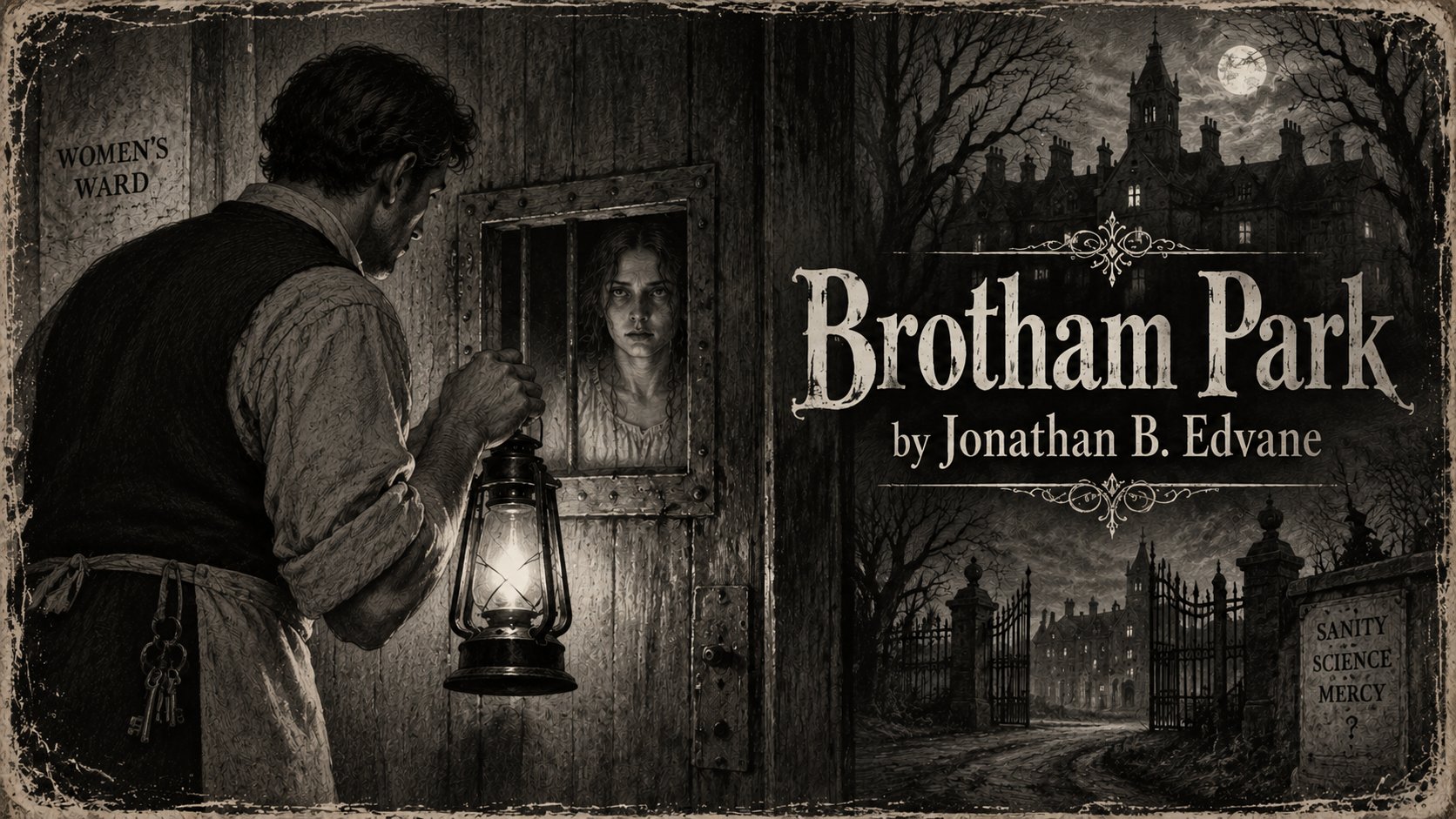
Thomas Kerner carried the lamp along the women's ward, holding it close enough to inspect each door without waking those who slept behind them. Brotham Park was quiet only by the standards of an asylum. Beneath the rhythmic tread of his boots came chatter, restless movement, the scrape of a bedstead and, further down the corridor, a persistent, tired moaning. At the first door, Kerner found a woman asleep with one arm hanging from the bed. He stepped inside, took her wrist between two fingers and counted the pulse. At the next cell he watched the rise of another patient's chest until he was satisfied that her breathing was regular.
An orderly had no cause to do either, but his hands retained the habits his name had surrendered. Even now, months after leaving London, they moved with the confidence of a physician's hands, while the man who had once possessed them had been folded away with the tribunal's judgement and the paper his colleagues refused to consider. He had come north because Brotham Park was provincial, understaffed and sufficiently removed from the capital that his disgrace had little chance of arriving before him. The night shift suited his purposes. No respectable man wanted it, and no senior officer troubled himself to supervise it closely.
The case ledger lay open, and Kerner paused beside it, although he was forbidden to read the physicians' entries, and turned back three pages until he found the name Alice Sexton. She was twenty-three, admitted from the parish of St Michael-le-Belfrey and diagnosed with religious mania. He read the entry twice. The profession used religious mania as it used a locked drawer, placing inside it whatever could not be safely classified elsewhere. When he closed the ledger and looked along the corridor towards Alice's cell, the flame of his lamp leaned steadily in the same direction, although the air around him remained perfectly still.
Alice Sexton was awake when Kerner reached her door, seated on the edge of the bed with her hands resting flat upon her knees. She had been in Brotham Park for three days, yet he had never seen her sleep. Nor had he seen her pray, rave or plead with the attendants, as patients entered under the diagnosis of religious mania so often did. She just listened.
Kerner opened the observation slot and asked whether she was in pain. Alice turned calmly towards him. There was no feverish brightness in her eyes, and no vacant submission from the laudanum. Only composure.
"It speaks with my voice," she said, "but the words are not mine."
Kerner gave no reaction and asked when she first heard it.
"It was not hearing. I thought the thoughts belonged to me. It knows things I have not told anyone. The medicine makes it quieter, but it does not make it leave."
She spoke as a patient might report the progress of a terminal illness, having passed beyond hope and wishing only that the particulars be recorded correctly. Kerner asked whether the voice had any character she could describe, whether it seemed male or female, old or young, whether it addressed her directly or spoke as though she were not present. It was the kind of structured question a physician would pose to map the boundaries of a delusion, and for a moment Alice regarded him with an expression that suggested she understood the distinction between an orderly's concern and a doctor's inquiry.
"It does not speak to me," she said. "It speaks as me. When my mother visited on the second day, it answered her questions and she did not know the difference. I sat behind my own eyes and watched it use my mouth."
The composure did not waver, but something beneath it changed. Kerner had heard the same precision before in three patients at Guy's Hospital. Their symptoms had become the foundation of the paper that ruined him, an argument that certain forms of moral insanity resisted every medical category yet corresponded disturbingly with older ecclesiastical accounts. His colleagues had refused to examine the cases and later treated his insistence as evidence against him.
Brotham Park's ledger reduced Alice to agitation, persecution, inappropriate affect and auditory phenomena. Each term was accurate, yet together they concealed the only fact that mattered.
Alice looked through the slot again, fixing her eyes upon the empty corridor just behind Kerner, and asked whether the man standing there was known to him. Kerner did not turn. He closed the slot and walked back along the corridor, and did not permit himself to look back until he reached the desk.
* * *
Kerner caught Garrow the following morning between the dining hall and his office. The superintendent walked briskly, and Kerner was obliged to match his pace while explaining that Alice Sexton's condition warranted closer examination. Garrow listened, and when Kerner had finished, he said that Brotham Park valued diligence in every member of its staff, particularly among those willing to undertake night duty. Diagnostic matters, however, belonged to the medical officers. His tone remained warm, almost paternal, but he did not slow or look at Kerner, and by the time he reached his office door the conversation had been reduced to one about an orderly exceeding his station.
Later, Kerner found James Lethbridge in the dispensary, writing beneath the familiar smell of laudanum and carbolic. The young man was barely twenty-five, careful in dress and manner, with the kind of attentive expression that could indicate either genuine curiosity or the well-bred habit of appearing to listen. He was copying dosage records from the morning round into a leather-bound notebook of his own, separate from the asylum's official casebook.
Kerner asked whether Lethbridge had examined Alice Sexton.
"Briefly," Lethbridge said. "Garrow conducted the admission interview. I observed."
"And your impression?"
Lethbridge set down his pen. He did not answer immediately, which of itself told Kerner something. A man who had noticed nothing would have said so.
"Her affect is unusual," Lethbridge said carefully. "Religious mania typically presents with agitation. Sexton is composed to a degree that seems inconsistent with the diagnosis. I noted it in my own record, though I am not in a position to contradict the superintendent's assessment."
Kerner spoke more freely than he intended. He described the pattern he had observed in Alice's speech, the precision of her descriptions, the quality of detachment that suggested she was reporting on a condition she could observe but not control. He stopped short of revealing his true identity or explaining why London mattered, but he said enough.
Lethbridge listened without interruption, then asked, "How many cases like this did you see there?"
"Three," Kerner said. "All women. All diagnosed with moral insanity or religious mania. All presenting this same lucidity where the textbooks predict confusion."
"And what became of them?"
Kerner did not answer. Two had been transferred to long-term wards from which no patient returned to public life. The third had died during a procedure he had argued against. Their fates had become part of the evidence at his tribunal, though not in the way he had hoped.
Lethbridge picked up his pen again and turned it slowly between his fingers. "There was a patient here before my appointment," he said. "A woman named Flood. I have only seen her in the case notes. She was transferred to the county asylum at Wakefield eight months ago. The entries describing her condition were remarkably brief for a patient who had been resident for two years." He paused. "I asked Garrow about the case when I first arrived. He told me there was nothing instructive in it."
He said nothing further. Kerner left the dispensary not knowing whether he had found an ally or merely a careful young man who collected discrepancies the way other men collected coins, with no intention of spending them.
* * *
Kerner waited until the ward had settled before taking the keys from their hook. He told himself he intended only to observe Alice without the interference of attendants or physicians, though he knew it was a lie before he reached her door.
The corridor stretched ahead of him, doors on both sides, each with its iron slot and its small, confined life behind it. Mrs Adler in the first cell was usually restless at this hour, turning and murmuring through dreams that the laudanum could soften but not prevent. Tonight she sat upright in her bed, facing the wall, perfectly still. Kerner paused at her slot and watched for several seconds before moving on. At the next door, a patient named Burgess, who had not spoken in three weeks, was whispering rapidly into her pillow. Kerner could not make out the words. He was not certain they were words.
The cold began halfway along the ward. Brotham Park was old, and cold gathered naturally in its stone passages, but this came in uneven pockets. One step left him shivering, the next returned him to the ordinary closeness of the night. The intervals between the pockets grew shorter as he approached Alice's cell, until the cold no longer receded. Alice's observation slot was open. Kerner was certain he had closed it during his earlier round. He remembered the sound of the metal sliding into place, and the small resistance at the end of its track. He stood before the door and listened. From inside came Alice's voice, though the sound reached him late, the movement of her mouth visible through the slot before the words arrived, as though the air between them had slowed what passed through it.
He unlocked the door. Every regulation governing the night ward forbade him from entering alone, but regulations belonged to men who believed the danger lay in the patient. He stepped inside and placed the lamp upon the floor.
Alice was pressed into the corner of the cell, her back against one wall and her shoulder against the other, with her bare feet drawn close together beneath her shift. She was not cowering. The posture was deliberate, architectural, as though she were bracing herself against a force that pressed from the centre of the room outward. Her eyes were open and fixed upon a point beyond Kerner's shoulder.
"It does not like you listening," she said, and the final word arrived from somewhere above her, near the ceiling, though her lips had shaped it at the level of her throat.
Kerner did not move. The lamp flame shrank to a blue bead no larger than a seed, and the cell darkened around it. The walls remained where they were, but the ceiling seemed to recede, drawing upward into a height the building did not possess, as though the room were opening above him into a space that had been waiting behind the plaster.
Something regarded him through Alice's eyes. Not Alice. Something that used the direction she was facing the way a hand uses a glove. The force of that attention drove the strength from his knees and locked his jaw so that the words he tried to form, clinical words, physician's words, the language of diagnosis that had always stood between him and the things he could not explain, died unspoken.
He reached for her because he had once been a doctor and the instinct survived every disgrace. Whether he fell, was struck, or suffered some convulsion of his own body, he could not afterwards determine. The flagstones rose towards him, the darkness closed, and his last confused impression was of the lamp burning steadily beside his hand, though he was certain he had watched it go out.
* * *
Kerner woke with his arms bound across his chest and the taste of laudanum at the back of his throat. For several seconds he could not understand the softness beneath his head or the strange deadening of every sound he made. Then he recognised the padded walls and knew the room. He had passed its door a hundred times, sometimes hearing a patient strike the other side until exhaustion or sedation brought silence.
Garrow stood near the foot of the bed, explaining matters to someone beyond Kerner's sight. The collapse had been regrettable, he said, though hardly inexplicable. Night duty placed unusual demands upon the constitution, and certain predispositions could remain concealed during an inadequate hiring process. His voice carried the measured kindness of a physician delivering a conclusion that had already become fact.
Kerner tried to raise himself, but the straitjacket tightened around his shoulders. He wanted to say that Alice had not been alone in the cell, that something had looked at him through her and spoken from a place no voice could occupy. Yet he understood what those words would become once entered in the ledger. Every asylum held men who knew what they had seen. Certainty was often the first symptom and insistence the second.
He remained silent.
Garrow leaned closer, studying him with an expression that held neither surprise nor disbelief. For an instant Kerner saw recognition there, the weary caution of a man who had encountered such things before and survived by naming them otherwise. It was not cruelty. It was the institutional equivalent of drawing the curtains, an act so practised it no longer required thought. Garrow remarked that the sedative appeared effective, noted Kerner's silence with satisfaction, and withdrew.
Some time later the observation slot opened and Lethbridge appeared beyond it. He was not holding the leather notebook Kerner had seen in the dispensary. In his hand was a single sheet of paper, folded twice and bearing a printed header Kerner recognised at once, because he had seen its kind before. It was a circular from the Commissioners in Lunacy, the sort distributed to county asylums when a physician was struck from the register and considered a risk to institutional order.
Lethbridge unfolded it and held it where Kerner could read it through the slot. There, beneath the commissioner's seal, was a name Kerner had not heard spoken aloud in months. His own.
He looked from the circular to Lethbridge's face and understood. Garrow had known from the beginning. The warm dismissal in the corridor, the measured language at his bedside, the straitjacket itself, none of it had been a response to what happened in Alice's cell. It had been waiting for him since the day he arrived, needing only a pretext, and he had provided one.
Kerner could not read Lethbridge's face. Was it the fear of a man confronting something he did not understand or the detachment of one recording a colleague's decline? Lethbridge was standing at the edge of a decision that would determine the kind of man he would become. The young man folded the circular, placed it in his jacket, and closed the slot without speaking.
Kerner lay alone, a man buried twice. Once by whatever had looked at him through Alice and once by the institution that had been waiting to receive him. At last a woman began speaking somewhere, calmly reciting words that might have belonged to Alice, though the voice no longer seemed entirely hers.
Discussion