The Story
This is an example of a Podcast story contest submission. My experience is that such podcasts seem to feel that informing the unsuccessful entrants is not in their remit. No notification was received. The October newsletter announced that winners had been chosen and their stories would air during Haunting Season. There was no contact with unsuccessful entrants. This matches my Wyrd Folk Podcast experience. My conclusion is that podcasts use writing competitions primarily to generate content for their own programming. The deal is that the winners get recorded and published. Everyone else gets silence. I don’t necessarily object to it, although I do think that a form rejection would not be too much to ask. If you are going to be affronted by wall of silence then avoid these.
On rereading, I am less satisfied with this one than I was at submission. The story is well constructed but the climax underdelivers. The buildup earns a grimmer encounter than it gets. The marginal note, the hare’s nightly approach, the smell, the realisation it is tracking the amulet. All of that works. But the ghost is observed rather than suffered. The confrontation resolves too quickly and too cleanly.
I am not reworking it now. It is a viable story for submission, but I am resting it here in The Returned for you to judge. Do leave a comment.
The Rejection
Submitted to the Three Ravens Podcast Ghost Story Writing Competition 2026, Theme III: Ghosts of Sacred Spaces.
No Response · Three Ravens Podcast
No rejection letter was issued. The competition results were announced in the October newsletter. Winners were contacted directly. Unsuccessful entrants received no notification.
UPDATE — I am far more satisfied with the audio narration than the reading of this tale. It delivers it much better.
Listen — Narrated Version
A Note in the Margin
The road to South Yewham rose gently from the last of the market villages between hedges already darkened by autumn rain. Reverend George Eardley watched the country gather itself into smaller shapes as the trap climbed. Fields gave way to paddocks, paddocks to neglected closes, and then the hamlet appeared, little more than a scattering of roofs around a shallow bend in the road.
South Yewham had the look of a place that had once expected to become larger. Further up the rise, beyond a stone wall, the chapel stood apart from the houses.
Eardley noticed the tower first.
It was short and square, built chiefly of rough fieldstone, with later repairs in a paler limestone. The upper courses were plainly Norman, but the lower angles arrested him. Long upright stones alternated with shorter horizontal blocks in a deliberate pattern. Even from the road he recognised the method. Long-and-short work. Saxon masonry surviving beneath the later fabric.
This sight pleased him more than the rectory had.
He leaned forward slightly as the trap turned through the gate. The chapel possessed none of the prettiness that brought artists into country churchyards with stools and paint boxes. Its roofline was crooked, and the south wall bulged. Two lancet windows had been altered at different periods, and a blocked doorway showed beneath the render near the western end. Several stones in the lower courses differed in colour and grain from those around them.
Eardley read these details with the satisfaction another man might have found in opening a rare volume. Here was alteration without explanation, one age laid over another and imperfectly concealing it. South Yewham Chapel had not been designed, it had been accumulated.
The yew stood on the north side of the churchyard. Its trunk had divided low to the ground and twisted back upon itself, leaving a hollow black enough to resemble an opening. The branches spread over several leaning stones and cast a dense shade even beneath the weak afternoon light. Eardley judged it older than the chapel, though he knew such estimates were commonly exaggerated.
The rectory stood a short distance away. It was larger than he required and colder than he had expected. His housekeeper had left the rooms aired and a fire laid in the study, then departed before his arrival. By dusk his trunks had been carried upstairs, his books stacked in uneven rows, and his writing case placed upon the desk beside the window.
From there he could see the tower above the churchyard wall.
He opened a fresh notebook, wrote the date, and beneath it placed the words South Yewham Chapel.
For the first time since accepting the living, he felt wholly content.
◆ ◆ ◆
Eardley began with the registers because they were the least demanding part of his survey. The earlier volumes had suffered from damp, insects and indifferent storage, but the entries remained mostly legible. Baptisms, burials and marriages passed beneath his eye in hands that grew larger, smaller, steadier and more careless with each succeeding incumbent.
He made notes of names associated with repairs to the chapel and marked several references to storms, subsidence and damage to the roof. Near the end of a register begun in 1679, he found three pages left blank between the burial entries and the accounts for church linen. One of these carried a narrow block of writing pressed into the outer margin.
The hand was small and controlled. The ink had browned unevenly, yet the words remained clear.
In the year 1686, after a great rain had loosened certain stones before the altar, there was found beneath the north part of the chancel a hollow place, being of old work and not known to any then living. Within it lay a small thing of yellow metal wrapped in linen, much decayed, the likeness of a hare sitting close upon itself.
I removed the same for examination and kept it one night in the parsonage. What trouble followed I will not here set down, save that it came looking for what had been taken, and that no prayer spoken by me had power to turn it.
The object was restored on the following morning and placed beneath the marked stone lying three feet north of the altar step. I have caused the stone to be set firm and charge any man who reads this not to disturb it again.
Eardley read the last passage a second time, then sat back.
The account interested him, though not in the manner its author had intended. Country clergy had often combined learning with superstition, and the seventeenth century had supplied both in abundance. The reference to old work beneath the chancel was useful. The hare, if accurately described, might be older than the chapel itself. He copied the note into his notebook, preserving its wording but not its urgency.
Before closing the register, he underlined the location. Three feet north of the altar step. The following morning, he decided, he would find the marked stone.
◆ ◆ ◆
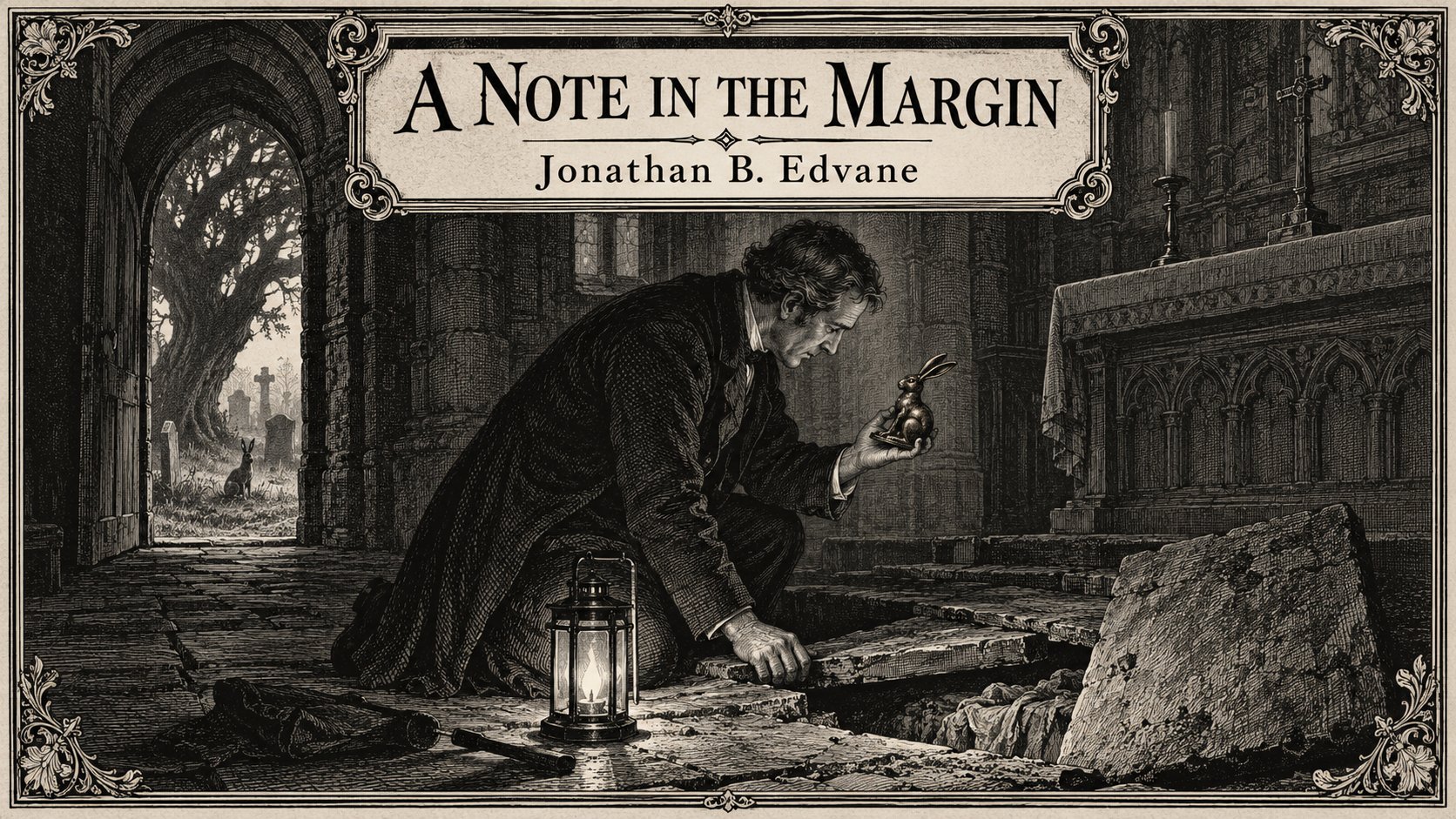
It revealed itself only after Eardley had measured twice from the altar step and cleared a film of dust from the chancel floor. It was narrower than the surrounding slabs and bore, near one corner, a shallow cut resembling a broken cross. The mark had been worn almost smooth. He knelt beside it, passed the edge of his knife through the old mortar, and worked carefully until the blade found a loosened seam.
The stone rose with difficulty. Beneath it lay a cavity no wider than a bread oven, lined with rough masonry. The air within carried a stale, mineral smell, like earth shut away from weather. For a moment he saw nothing. Then the lantern light reached a fold of brown material at the bottom.
He lowered his hand.
The linen came apart at his touch. What remained had once been wrapped around a small object, but the fibres had collapsed into fragile strips that clung to the metal beneath. Eardley lifted it free and sat back upon his heels.
The hare fitted easily into his palm.
It was cast in bronze, darkened almost to black except where corrosion had left green along the haunches and beneath the belly. The animal crouched with its legs drawn close, its ears pressed flat along its back. The modelling was economical but exact. A slight ridge marked the spine. The forepaws rested together beneath the breast. The eyes were no more than two shallow depressions, yet the creature appeared alert, every part of it gathered inward.
Eardley turned it beneath the lantern. It was not Saxon. Of that he felt certain. Nor did it resemble any Roman provincial work he knew. The form suggested something earlier, and its finish was finer than he would have expected. The weight pleased him. So did the balance. It had been made to be carried and handled.
South Yewham had already rewarded him beyond expectation. He carried the amulet back to the rectory and spent the afternoon drawing it, noting its dimensions, beginning a letter to the county archaeological society.
The cavity stayed open through the night.
◆ ◆ ◆
Eardley first saw the hare on the third evening after lifting the stone. It sat beneath the yew, close to the hollow in the trunk, with its body gathered tightly upon the damp grass. He noticed it from the rectory path while returning from the chapel and stopped because it had not moved at his approach. The distance between them was perhaps twenty yards. Near enough for flight. Yet the animal remained where it was, facing the chapel door. Eardley watched for a moment, then struck the path sharply with his walking stick. One ear shifted. Nothing more. He told himself that hares were less timid when sick.
The following evening it was there again, in precisely the same place. The light was failing, and its colour had flattened into the grey of the churchyard stones, but the outline remained distinct. Its ears lay back. Its head was raised. It neither grazed nor cleaned itself.
On the fifth evening he crossed the grass towards it. The hare allowed him to come within ten paces before it turned and passed behind the yew. There was no sudden leap, or panic in its movement. It went quietly, almost without haste. When Eardley reached the tree, the ground beyond lay empty. He found no burrow.
The chapel had altered too, though the changes resisted description. The chancel seemed colder than the nave, which was not unusual in itself, but the cold remained even when sunlight lay across the floor. He felt it most strongly near the open cavity, where each breath appeared to require a little more effort than the last.
There was also a smell. At first he thought it came from the exposed earth beneath the slab. He brought lime and swept the cavity. The odour persisted. Not decay, or mould. Something with a vague animal warmth, though nothing living had entered the chancel.
He began closing the chapel earlier. This he attributed to the season. The days were shortening rapidly, and little could be learned from masonry by lantern light. Yet once dusk had settled, he found reasons not to return. His notes needed ordering. The amulet required another drawing. His unfinished letter demanded attention.
At night, the chapel windows were visible from his study. Twice, while working at his desk, he looked towards the chapel and thought he saw movement behind the chancel window. Each time, when he went to the glass, there was nothing there.
On the seventh evening the hare was not beneath the yew. It stood beside the chapel wall, directly below the chancel window. Its head was turned towards the glass.
◆ ◆ ◆
The disturbance came sometime after midnight, while Eardley was reading beside the fire in his study. He could not afterwards have said that he heard a definite sound. There was only a brief displacement in the quiet, so slight that he might have ignored it had it occurred anywhere but in the direction of the chapel. It left him with the conviction that something had altered there, though the darkness beyond the window showed him only the tower, the churchyard wall and the upper branches of the yew.
He took his lantern and crossed the garden. Inside, the smell in the chancel met him at once. Stronger now, close and unmistakably animal. He searched the nave, then stood at the chancel step with the lantern raised. Nothing had changed. Yet he found he did not wish to approach the cavity. The flame burned steadily, but the chapel felt deprived of everything by which an empty place usually declared itself empty.
He returned to the rectory and opened the parish register at the marginal note. He read again the account of the object being taken to the parsonage.
What trouble followed I will not here set down, save that it came looking for what had been taken.
His earlier attention had fallen upon the bronze hare and the cavity beneath the floor. He had treated the rest as the language of superstition. Now the construction of the sentence troubled him. The rector had not written that anything had issued from the object, nor that the object itself had caused him harm. Something had come in search of it.
Eardley looked towards the amulet beneath its cloth on the far side of the desk. It no longer appeared to him as something concealed, but as something placed with purpose. The stone, the hollow and the chapel raised above them seemed for one moment to belong to a single intention which he had mistaken for accident.
A slight movement in the garden drew him to the window. The hare sat below it among the dead autumn plants, much closer to the house than he had ever seen it before. It faced the glass without fear, its body perfectly still while its nostrils moved rapidly and without pause. Eardley stood behind the curtain and understood that it had not been watching the chapel. It had been following the amulet.
◆ ◆ ◆
Eardley waited until the house was silent before taking the amulet from his desk. He wrapped it in a fresh cloth and placed it inside his coat.
The path from the rectory was familiar, but the night had altered its distances. The chapel appeared further away than it had by day, and the yew was black against it. He looked for the hare beneath the branches and saw nothing, yet the absence did not reassure him. He had begun to feel that whether it showed itself or not was a choice made for his benefit.
The key turned easily in the lock. Inside, the lantern light reached no further than the nearest pews. He closed the door behind him and stood until his eyes adjusted, listening. The chapel gave him nothing. Even the flame seemed to burn without movement.
He went forward slowly.
The smell reached him before he had crossed half the nave. It was no longer background, no longer a thing he could push to the edge of attention. It filled the air between the pews with a dense animal warmth entirely at odds with the cold of the building. His eyes began to water, but he raised the lantern and kept walking.
At the chancel step he stopped.
She was standing before the altar.
He could not have said when she had come to be there. She was simply present, the way cold is present. A woman, or the shape of one, close to the open cavity, her hands at her sides. Her face was turned toward him but she was not looking at him. She was not looking at anything. He was not something she needed to look at.
He raised the lantern. He wished immediately that he had not.
Her hair lay flat against her skull and down her back as though it had never been cut, as though it had been growing in the dark for longer than the chapel had stood above it. Her hands were at her sides, fingers perfectly still. Her feet were bare on the chancel flags.
Her nostrils moved. Narrow and wide, narrow and wide, rapid and without pause. She was finding him in the dark. The nostrils were not searching. They were confirming.
At her feet the hare sat with its ears flat and its nose working in the same rhythm and Eardley looked from one to the other and his mind drew back from what it was being asked to do. He did not look again.
He did not remember crossing the chancel. He was aware of the cold stone through the knees of his trousers, and of his own hands shaking as he unwrapped the bronze hare, and of the familiar weight of it as he lowered it into the cavity. Behind him the chapel was silent. His hands found fragments of the old linen and arranged them without his instruction. Then the slab. It slipped twice before he managed to lower it flat. He worked mortar into the seams with his knife blade and pressed until no open line remained.
Only when the stone was secure did he raise his head. The chancel was empty. The smell was already gone.
◆ ◆ ◆
He carried the lantern back to the rectory and set it on the study floor. The parish register lay open where he had left it. For some time he stood over the desk, reading the words written more than two centuries before, until at last he dipped his pen and added three lines beneath them.
This place was opened in October of 1893, and the object described above removed.
It has been returned beneath the marked stone, three feet north of the altar step.
Let it remain there.
The final word wandered slightly upward. Eardley blotted the ink, closed the register and returned it to the cupboard.
From that morning onward, he entered the chapel before breakfast and knelt beside the marked stone. He ran his fingers over the mortar, testing each seam, and did not leave until he was satisfied that nothing had shifted beneath his hand. He never again crossed the churchyard after dusk.
On the morning after the sealing, the hare sat beneath the yew. It faced the chapel, motionless upon the wet grass. Eardley watched from the rectory window until it lowered its head and passed behind the trunk.
It did not appear again.
Discussion