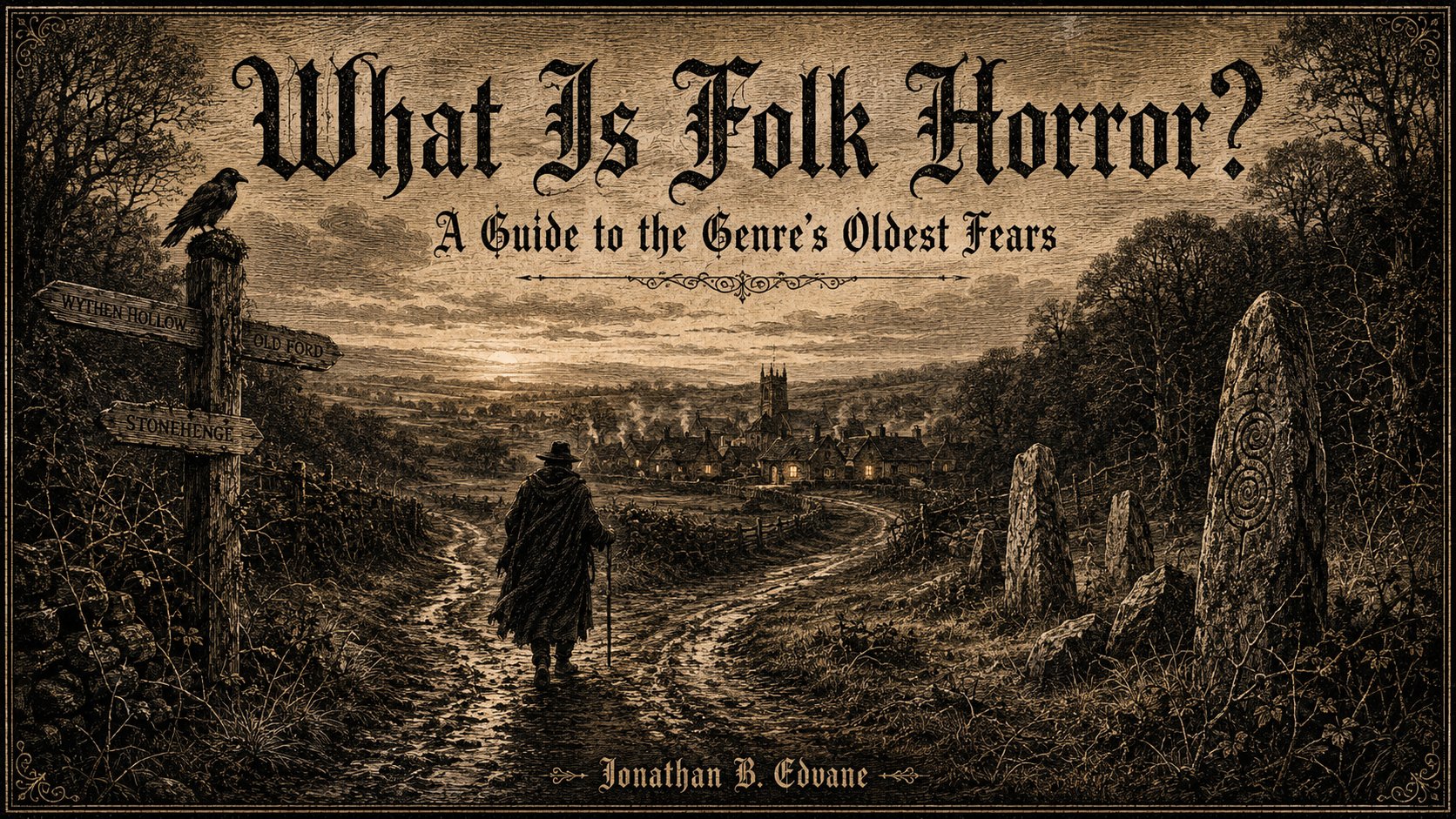
Folk horror is one of those terms that carries more meaning than it can easily explain. Ask ten readers what it means and you will get ten answers, most of them accurate, none of them quite sufficient. It tends to be defined by atmosphere rather than mechanics, by what it feels like rather than what it does. Which is understandable, but it leaves the door open to confusion.
This is not a definitive guide to folk horror. I am not sure one exists, and I am not certain one would be useful if it did. What follows is an account of what folk horror means to me, and how that understanding shapes the stories I write. Others approach the genre differently, and some of those approaches involve visceral horror that I have no instinct for and do not practise. The tradition is large enough to hold all of it.
What I will say is this. Folk horror, at its core, is about what the land remembers, what the community conceals, and what happens when something very old is woken by the wrong person at the wrong time.
Where folk horror begins
The term itself is relatively recent, though the thing it describes is not. Most accounts trace the modern use of it to a loose grouping of British films from the late 1960s and early 1970s, with The Wicker Man sitting at the head of the tradition as its most enduring example. A policeman arrives on an island community, encounters folk belief so embedded in the land and its people that it has become indistinguishable from daily life, and discovers too late what the community has planned for him. The horror is not supernatural in any grand sense. It is the horror of the group, of ritual, of a world with its own rules that the outsider never fully reads until it is already too late to leave.
But the literary tradition runs much deeper. Arthur Machen was writing folk horror in all but name in the 1890s. His England is a country where ancient presences have not gone away, they have merely gone underground, and the surface of ordinary rural life rests on something that predates it entirely. The horror in Machen is not about monsters. It is about the realisation that the world is older than the people walking through it, and that some of what is buried beneath it is still awake. That understanding is the bedrock of the genre, and it has not changed.
What folk horror is not
Folk horror is sometimes confused with rural horror, which is a broader and less specific thing. Rural horror simply requires a remote setting and uses isolation and unfamiliar landscape to generate threat. Folk horror needs the community. The countryside in folk horror is not incidentally frightening. It is frightening because of what the people who live in it believe, practise, and conceal. Remove the community, the inherited knowledge, the tradition and the ritual, and you have something else.
It is also sometimes confused with supernatural horror more generally. Folk horror can contain the supernatural, and often does, but its horror is not primarily about the supernatural event. It is about the human structures that allow the supernatural to function. A creature that haunts a forest is horror. A community that has always known the creature is there and arranged its behaviour accordingly, that is folk horror. The creature is almost incidental. The arrangement is everything.
The community as instrument
Alan Garner has spent a lifetime writing about the places in England where the old world and the present one have not yet finished arguing with each other. His landscapes are not backdrops. They are participants. The things buried beneath the surface of Cheshire or the Welsh border country exert pressure on the people living above them, and that pressure does not release when the story ends. Garner's communities carry inherited knowledge that they can neither fully use nor set down, and the result is a horror that is inseparable from a sense of place.
That community pressure is the element I find most compelling and often the most difficult to replicate. In Gossia's Garden, a traveller stops at a crossroads alehouse and receives a warning he does not take seriously. The locals know something. Their knowledge is communal, lived-in, and entirely useless to someone who arrives from outside and treats it as superstition. When the traveller takes the forest path anyway and encounters Gossia in her clearing, the horror is not only in what she has planned for him. It is that everyone at the alehouse already knew what she might do, and that this knowledge has shaped every decision those people make about which paths they walk and when. The community has organised itself around a truth the traveller refused to accept. He is not undone by the supernatural. He is undone by his own dismissal of what the community knows.
This is the mechanism folk horror tends to run on. The outsider, or the insider who reaches too far, fails to read the community's knowledge correctly. The price is paid in consequence.
What the land holds
Robert Aickman wrote what he called strange stories, a category he invented because no existing one was accurate enough. His fiction sits at the edge of folk horror, in the zone where the uncanny refuses to be explained. What makes Aickman relevant here is not the supernatural content of his stories but the relationship between his characters and their environments. Places in Aickman remember things. The past does not recede in his fiction. It accumulates, quietly, until a character walks into it and finds it still there. It is a compelling technique.
In Shall I Come Away?, a curate in Exeter makes the mistake of naming a folk devil from the pulpit in an attempt to warn his congregation against it. He thinks he is denouncing superstition. What he actually does is give the thing a congregation of its own. The horror that follows is partly supernatural but primarily structural. Ralph Travers is trapped between the ordinary world he inhabits as a churchman and a folk tradition he understands just enough to misuse. The community's children carry the rhyme he tried to suppress. The land beneath Exeter holds what the rhyme calls. Ralph's position as a man of the established church does not protect him from what lives in the old city's passages. It makes him more useful to it.
The ending of that story is not something I will give away here. What I will say is that it turns on the oldest folk horror principle of all. You do not control what you summon by pretending you have not summoned it.
The horror without blood
I do not write gore. That is a deliberate choice, and I want to concede it clearly because folk horror's literary tradition does not require it. Machen's most disturbing passages contain almost no violence. Aickman's strange stories are almost bloodless. What they do well is generate dread through implication, through the gap between what the reader understands and what the character knows, through the slow recognition that the rules of a story have been different all along from what the reader assumed.
Mistress Grimshaw's Purse contains no violence and no blood, yet it is one of the most uncomfortable things I have written. A woman of property uses a supernaturally obedient purse to force the poor of her parish to publicly name her as their benefactress before receiving charity. The horror is the mechanism, the humiliation made systematic, the complicity of both the community and their spiritual leader, the way the purse understands want with more precision than any of its human observers. When the reckoning comes, it comes through the same mechanism as the cruelty. The purse knows what Mistress Grimshaw wants most, just as it knew what Judith Cox needed. That recognition, that the instrument of power can be turned by the thing it was used to suppress, is folk horror's oldest shape. The powerful name something into being, and the thing they name eventually names them back.
What folk horror keeps asking
The question underneath all of these stories is the same question folk horror has always asked. What did this place do before you arrived, and what will it do when you are gone?
The community in folk horror has usually already made its arrangements with whatever lives alongside it. The arrangements may be cruel or strange or incomprehensible to an outsider. But they are arrangements, nonetheless, and they have been tested by time and repetition. The newcomer, the sceptic, the person of authority who arrives with better explanations, these figures are folk horror's most reliable protagonists, not because they are wrong, exactly, but because they are late. The community has already had this conversation with the land. The land has already replied.
Folk horror keeps that answer in the ground, waiting to be rediscovered by the next person who thinks they know better.
If you'd like to follow Jonathan B. Edvane, you can do so here.
Discussion