
There is a technique available to the fantasy writer that I have rarely seen used well, and I find it surprising. It is the object as narrator. The thing that outlasts every hand that claims it, that watches without judgement, and that remembers everything. When it works, it does something no human narrator can do. It removes the consolation of perspective, giving you no escape from the moment.
I should say at the outset that the central premise of The Yellowstone Ring is not mine. I borrowed it, with full awareness, from Tibor Fischer's 1997 novel The Collector Collector, in which an ancient Sumerian bowl narrates its own history across millennia of owners. Fischer's novel is a remarkable formal invention, and I enjoyed it, though I will not pretend it is an easy read. It is long, and the bowl's voice, erudite and sardonic and in love with its own digression, tests the patience of the reader in ways that divided critical opinion sharply. Some found it brilliant. Others found it a conceit extended well past the point of comfort. Both responses are understandable. I persisted, and I was glad I did, because what Fischer understood about the technique is worth understanding.
What a human narrator cannot do
Every human narrator has a relationship with meaning. Even an unreliable one. Even one who is dying or mad or deliberately withholding. They want something, or they wanted it once, or they are trying to make sense of wanting and failing at it. That relationship with meaning gives to all they notice, emphasise, and allow themselves to understand. The reader feels this. Even in the coldest, most controlled prose, the human narrator is always, at some level, building a case.
An object has no case to build.
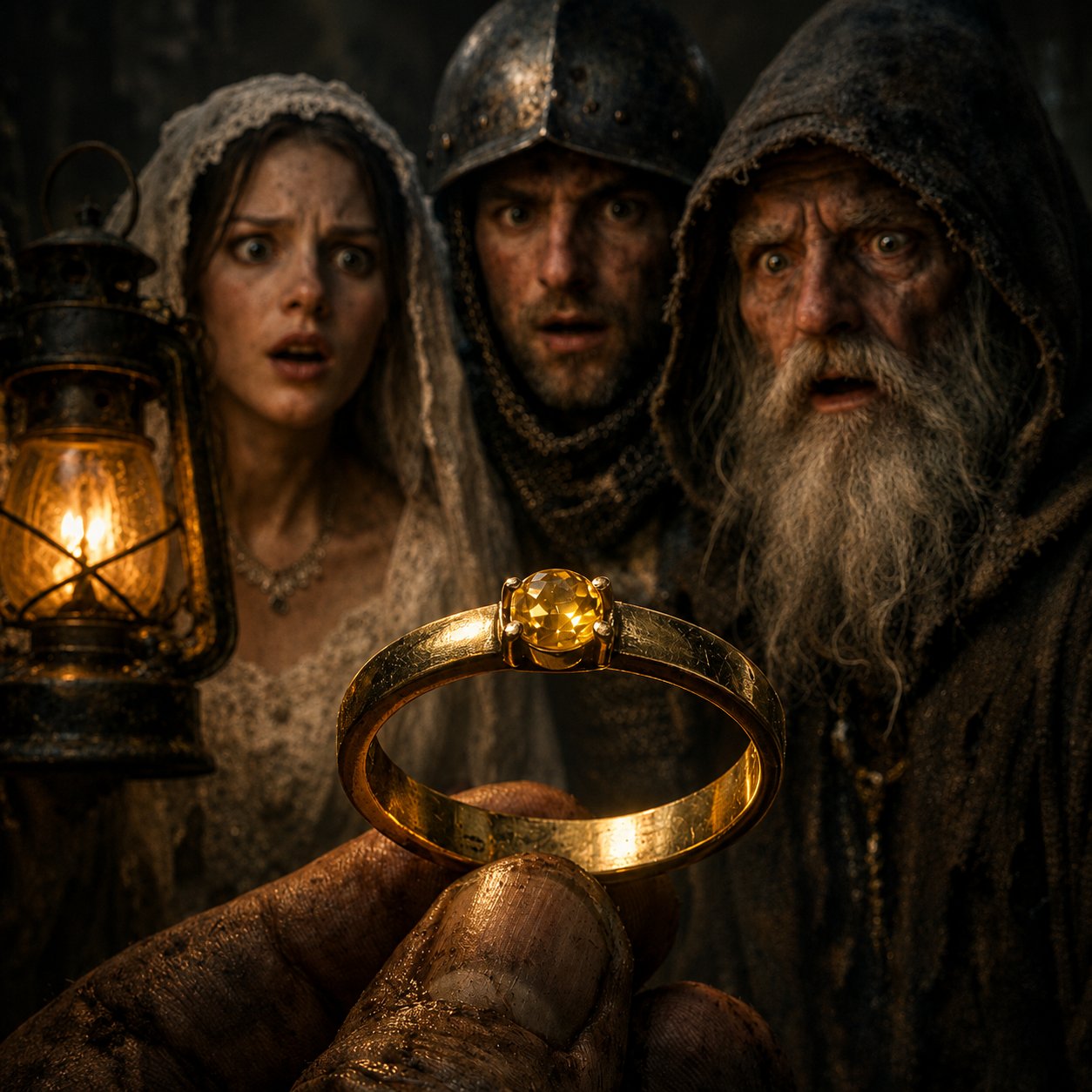
The Yellowstone Ring does not care about the bride who trembled when she slid it on, or the soldier who tapped it against his sword before battle and told himself it was luck, or the widow who carried it on a cord under her dress through cold streets with empty hands. It records them, notes what they were when they wore it, and does not draw conclusions. When the soldier drowns in a river battle, the ring adds it to the archive. Then it stopped. No drama. Just the end of his efforts. And moves on. The absence of grief is not cruelty. It is the nature of the thing. Gold does not need to mourn.
This is what the technique makes possible. The reader supplies the grief. The reader supplies the moral response. The object confines itself to the record, and the accumulation of that record becomes something the reader has to sit with rather than be guided through.
Rid yourself of the notion that this is the One Ring
It is nothing of the sort. Tolkien's Ring is an object of absolute singular meaning. It was made for domination, it corrupts toward that purpose in every hand, and the entire architecture of The Lord of the Rings is built around the question of what to do with a thing that means only one thing, always. That Ring does not accumulate. It imposes. Every owner is bent toward the same destination, and the tragedy of the story lies precisely in that inevitability.
Excalibur is the same kind of object from a different tradition. It designates. It chooses. It means kingship, and only kingship, and it confers that meaning on whoever draws it. These are objects with a purpose built into them by their makers, and that purpose does not change regardless of whose hand they pass through.
The Yellowstone Ring was made to be worn. That is all. Its maker pressed the claws into the jewel in silence, without blessing it, or treating it as anything other than a thing made to be worn. When a wizard later lays a function on it, a charm that makes the wearer more fully themselves in moments of danger, he does so under the misapprehension that it is empty. He does not know what it already holds. He does not ask. That assumption, the ring notes, did not offend it. It was just his arrogance.
The distinction matters to how you write such an object. A destined object pulls the story. An accumulating object will move through it alongside other actors, and the story happens to them.
What Crowley understood about patient things
John Crowley's Little, Big is not narrated by an object, but it understands object-time, again in a way that very few fantasy novels do. The oldest things in that novel, the house, the cards, certain furniture, are not the most powerful. They are the most patient. They have outlasted enough human meaning to have stopped being impressed by it. They will outlast whatever meaning is currently being projected onto them, and they know it, and they wait.
That patience is a specific quality, and it is difficult to write. The temptation, when giving an object a voice, is to make it wise. To let its age become authority, its experience become judgement. Fischer resists this with his bowl's wit, which keeps the voice alive but still risks becoming its own kind of performance. The Yellowstone Ring resists it differently. The ring is not wise. It simply has a longer memory than anyone who wears it, and it knows that continuity is not a virtue. It is simply a habit that lasts until it cannot.
That line belongs to the ring. It took years of owned and discarded human lives to earn it.
The technique in practice
Writing in an object's voice requires a specific act of subtraction. You remove much of the interiority. No desire, no fear, no hope. You remove moral framing. No judgement of the bride's accommodations, the soldier's brutality, the wizard's vanity. You remove the usual scaffolding of narrative sympathy that tells the reader who to care about and why.
What you are left with is observation and sequence. The object notes what happens. It records what the wearer was. It moves on.
The discipline of this is harder than it sounds, because the writer's instinct is always to reach for meaning, to shape what the observation implies. In the ring's account of the bride, there is no sentence that tells the reader her marriage was a failure. There is only the ring, left on the table the morning after the wedding, and the bride who picks it up in silence, and the servants who move around the omission as they do the furniture. The failure is in the space between those observations. The reader closes it.
This is what I believe that object narration can do at its best. I am trusting the reader to feel what the narrator will not say.
What the ring carries now
The Yellowstone Ring ends the story buried under leaves in the Woldwood, waiting. It expects recurrence, it notes. That is not hope. It is only the way it was made.
Readers who want to know what the ring encounters next will find it in The Durn Yew, Book One, The Shivering Vale, when that novel becomes available. The ring does not stop. It is not in its character to stop.
Discussion