
Many dark fantasy settings look impressive and feel insubstantial. They have ruins, towers, invented names, old laws and gloomy weather. They are atmospherically correct. But they do not seem to exert any real pressure on the people who move through them. They are, in the end, scenery.
The problem is usually a question of the wrong question. Worldbuilders tend to ask what does this place look like. The more useful question, the one that separates a setting from a stage set, is what does this place do.
The Farewell Chamber, the eighteenth story in my Tales from the Woldwood sequence, is a useful place to test this. It is a room beneath the Yewdeep, built for a specific purpose. Parting. Made for mercy, for bodies, for words spoken carefully at the edge of distance. It is not a dramatic location in the obvious sense. There is no throne, no altar, no magical weapon mounted on the wall. It is a room built to hold a function, and that function is what makes it work. And then what breaks it.
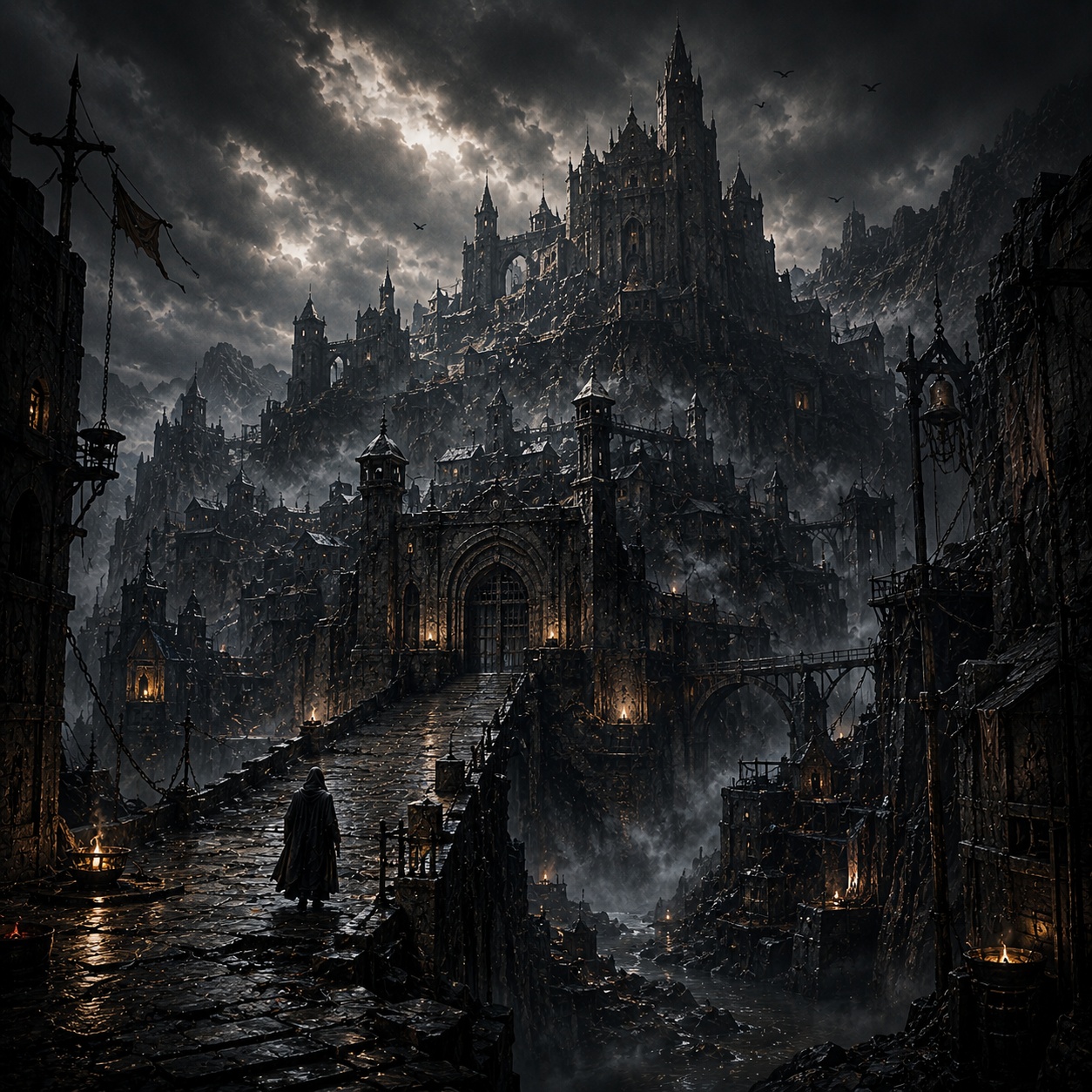
Give the place a purpose before you give it an atmosphere
Retta, the custodian who tends various chambers and passages in the Yewdeep, knows the Farewell Chamber before the reader does. He recognises it by smell, by the cold edge in the air, by the way the roots there are smoother and grown with more care than in other places. He does not discover it. He has been returning to it for seasons, watching it change, watching it begin to resist being disturbed.
That approach does the worldbuilding quietly. The reader learns that this is not a discovered place or a mysterious ruin waiting to be unlocked by a protagonist. It is a working part of a living system. It has neighbours, other rooms, other functions, other duties. The Farewell Chamber exists within an order.
This is the first craft principle. A fantasy place becomes real when the reader understands what it was made for.
Compare this with Moria in Tolkien. The mines are not just an underground ruin. They were a kingdom, a trade route, a feat of engineering, a memory and, by the time the Fellowship arrives, a warning. The darkness is not merely physical. It carries the burden of an entire civilisation that made something extraordinary and then lost it entirely. Moria feels old because it had a purpose before the story arrived, and that purpose is now visible only as damage.
A place with a job to do, and evidence of what happens when the job goes wrong.
Make the place feel old through use, not through timeline
The temptation in worldbuilding is to establish age through backstory, a paragraph, a legend, a character who explains that this chamber has stood for three hundred years. That information is rarely what makes a place feel old. What makes a place feel old is the accumulation of habit around it.
In The Farewell Chamber, the sense of age comes from Retta's behaviour. The first thing he always does is listen for the quality of the silence. He moves through the room according to inherited knowledge. He checks what needs checking. He notices what has changed. He understands the rules without needing them explained because he has been living by them. The chamber feels old because someone has already been tending it for longer than this story has been running.
Susanna Clarke does something similar in Piranesi, though in an entirely different register. The House, a vast, impossible structure of halls, statues and tides, feels real because the narrator inhabits it through routine. He records the tides. He names the statues. He tracks the movements of fish through the lower halls. The setting is understood through daily practice, and that practice makes the world feel older than the plot. The world precedes the plot.
A place feels old when characters behave as if they have inherited its rules.
Let the setting have rules, and make the rules severe
The Farewell Chamber listens to promises.
That is its governing logic. It was made for final words, and so it keeps faith with what it hears. When a promise is made inside the chamber, the room retains it structurally. The dead who promised and never returned begin to gather in the walls, pulled back by the room's own fidelity. It does not know what else to do with what it has been given.
This detail, which Retta has been watching worsen across multiple visits before the story opens, is what elevates the location from atmosphere to worldbuilding. The supernatural logic is simple but severe. A promise made here is a burden the place inherits. And the chamber, built for mercy, begins to fracture under mercy it cannot complete.
The fae in the story understands this instinctively, or has known it long enough. When the mortal swears he will return, the fae tells him not to swear here, because this room remembers too well and does not understand when you do not return. That is a character delivering worldbuilding through fear. He is not explaining the chamber to the reader. He is trying to protect the mortal from it.
A fantasy setting deepens when its rules have consequences that nobody intended because it is doing exactly what it was designed to do, and design, over time, meets circumstances it was never made for.
A dark fantasy place is often cruellest when it is doing exactly what it was made to do.
Use a custodian, not a tour guide
Retta is the right viewpoint character for the Farewell Chamber because he is not there to explain it. He has work to do. He is present so the room can do what it was meant to do and not tear itself apart while it does it. He understands the chamber as a professional understands a workplace, with the particular alertness of someone responsible for its condition.
This avoids one of the weakest modes of fantasy exposition. The newcomer who asks questions while someone patient explains the lore. That structure can work, but it tends to make settings feel like exhibits. The world is presented to the reader rather than inhabited.
When the mortal asks who Retta is, Retta does not offer his name. He does not explain the Yewdeep. He says only that the room will close and if they have words left they should speak them carefully. That is all the reader needs, because that is all the moment requires.
Tolkien partly resists the tourist guide problem in Moria. Gandalf knows more than he reveals, and the Fellowship learns the history of the place through encounter. Doors that remember. Silence that implies catastrophe. The gradual revelation of what happened pressed into the architecture itself. The place speaks through its damage, not through its explainer.
When your viewpoint character already belongs to the setting, readers learn it the way they learn anything inhabited rather than visited. Through the character's habits, hesitations and assumptions. The worldbuilding becomes behaviour rather than description.
Give the reader someone with duties, not someone with a tourist brochure.
Let the setting reach a limit, and stay there
The detail that matters most in The Farewell Chamber is not what the room does. It is what Retta has to do to stop it.
He seals the room from inside.
That is not a small distinction. It means that closing the chamber is not an administrative act performed at a safe distance. It is an act of presence, of decision and of permission, as Retta himself thinks of it. He places both palms on the root-wall and says enough to the room, not to the ghosts. He watches the dead release and dissolve. And then he walks out through what is already ceasing to be a doorway, and does not know for sure that the Yew will let him leave.
The room does not survive the story intact. Where there had been an opening there is now a shallow dead end. The Farewell Chamber simply is no longer a room. And Retta walks away imagining the farewells that will now be spoken elsewhere, in corridors not meant to hold them, in rooms grown for other purposes, and he wonders how many farewells the Yewdeep will be forced to absorb before it begins closing more than just rooms.
The event alters the world. Not just the chamber. The Yewdeep itself has lost a function, and loss of function has consequences that will spread into the system around it.
Gormenghast in Mervyn Peake's trilogy understands this principle at scale. The castle is not a backdrop against which characters act. It is a participant. Its rituals shape behaviour. Its scale diminishes ambition. Its continuity is itself a kind of cruelty, the castle keeps going regardless of who suffers inside it. Gormenghast's damages, rituals and accumulated pressures are not easily shaken off. The castle never feels like a resettable stage set.
The Farewell Chamber ends in the same logic. It has reached the limit of what it was built to carry. Sealing it is not a resolution. It is a new kind of damage, and Retta knows it.
A fantasy place feels real when the story leaves a mark on it.
What all of this adds up to
I believe The Farewell Chamber works as a dark fantasy setting because it combines things that decorative worldbuilding tends to keep separate. Purpose, use, rule, custodian, memory, damage and limit. None of those elements is spectacular on its own. Together they produce a place that existed before the story arrived and continues, along a different path, after it ends.
The chamber is frightening because it was built for mercy, and mercy has become too heavy for it to carry. The presences in the walls are not the work of malice. They are the work of fidelity. The room kept faith with every promise spoken inside it, and that faithfulness is what broke it.
That is the model worth carrying into your own work. Not a thousand years of invented history. Not a map full of names. Not weather that signals mood. One room, built for a purpose, used imperfectly by people under pressure, tended by someone who understood it, and finally sealed from the inside by the person who cared enough to stay.
Dark fantasy worlds feel real when a single place behaves as if it has been trusted, damaged and quietly, permanently changed.
The Farewell Chamber is part of Tales from the Woldwood, a series of standalone dark fantasy stories set in the world of the Marchlands. Read it on Substack.
Discussion