In May this year, the Guardian ran a story celebrating the return of choughs to Tintagel. The red-billed birds had been absent from the castle for the best part of a century, and their reappearance was treated as a kind of homecoming. English Heritage called it a rare moment where nature and myth seemed to meet. The myth in question was this.
King Arthur's soul lives on in the form of a chough, its red beak and feet marking his violent end at Camlann.
It is a good story. It sits well against the cliffs. But I went looking for where the connection came from, and what I found was more interesting than the legend itself.
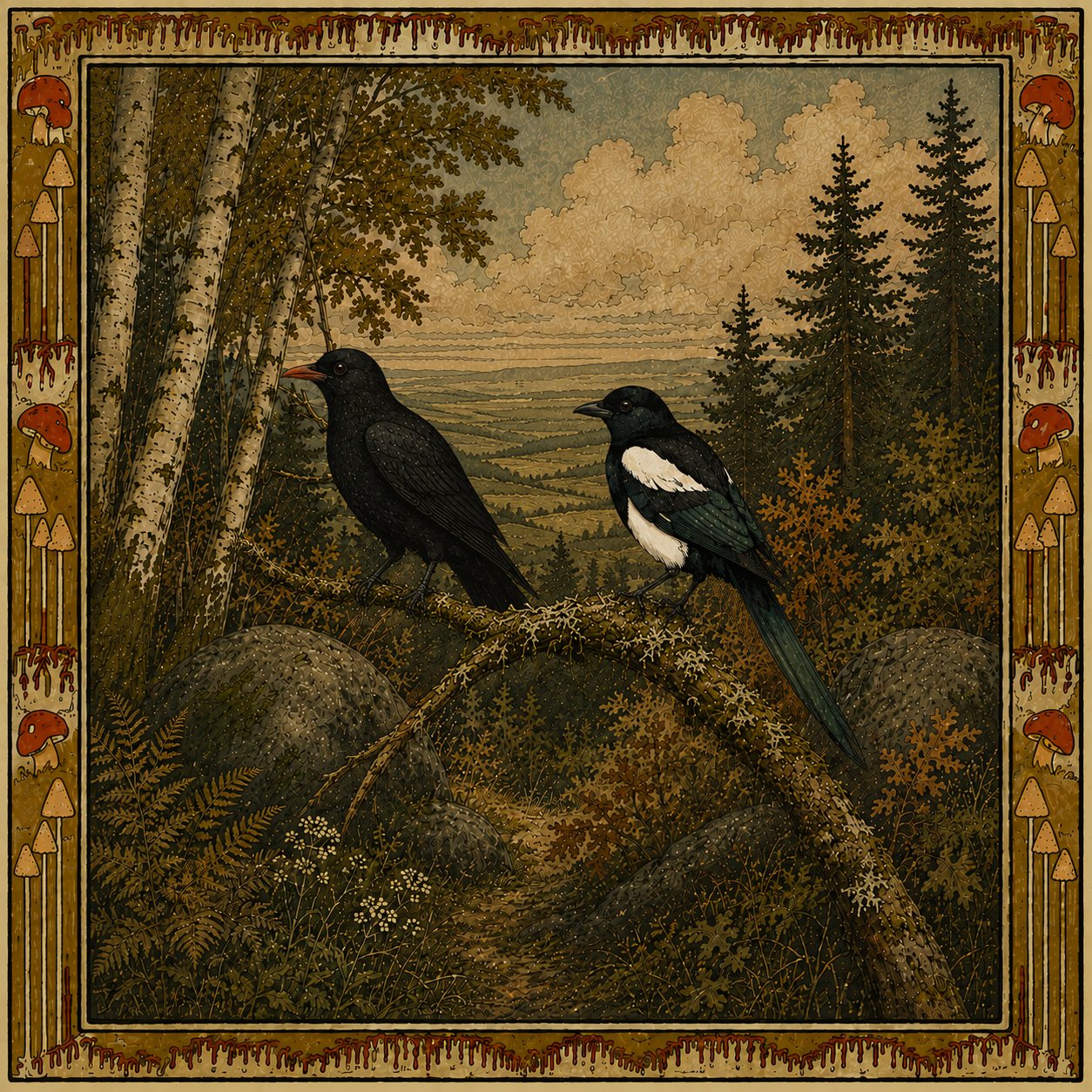
Robert Hunt's Popular Romances of the West of England, published in 1865, records the tradition, though not quite the one the Guardian described. Hunt was quoting a letter from Edgar MacCulloch in Notes and Queries, who in turn cited Don Quixote, where Cervantes has his knight say that no Englishman has killed a raven since Arthur's soul passed into one. MacCulloch's father had been told the same thing in Cornwall around 1800, and the bird in that telling was still a raven. Hunt then spent the autumn of 1863 walking through Tintagel and Camelford, questioning people in every part of Cornwall where Arthur was reported to have lived or fought. Nobody mentioned the raven. What they told him instead was that bad luck would follow the man who killed a chough, because Arthur was transformed into one of those birds.
The legend migrated from raven to chough, nobody recorded the moment it did so, and Hunt fixed it in place by writing it down. Now the Guardian and English Heritage repeat it as though it were always there.
This does not make the chough legend false. It makes it folklore. And folklore, by its nature, is up for grabs. It has always been up for grabs. It is made, remade, transferred, adapted and adopted, and the people who carry it forward are not troubled by the question of whether they found it or made it. That distinction belongs to scholars. Folklore belongs to whoever can make it stick.
Marina Warner understood this as well as anyone writing about it from the outside. In From the Beast to the Blonde, she demonstrated that fairy tales were never fixed objects passed down intact from some ancient oral tradition. They were made by their tellers, shaped for their audiences, and reshaped by the next teller who found them useful. The old woman by the fire was not a passive vessel. She was an author, and the tale she told belonged to her as surely as it belonged to whoever had told it before her. What survived was not a text. It was a method.
That method is what I rely on in my own work, and it is what I want to describe here.
What a rhyme becomes when a story earns it
Odd Man Dodd begins with a real entry. In G. F. Northall's English Folk-Rhymes, published in 1892, there is a note on the snail. Children across the English counties addressed it by many names, and in Essex and Suffolk it was the Dodman or the Odmandod. They held it to candle flames and chanted verses at it. Northall recorded the words. He did not record what the rhyme had once been for.
I have imagined an answer. In the story, three deaths cross three townships in the parish of Ruyton of the Eleven Towns. A midwife narrates, and she watches a man named Dodd move between each death while the community finds reasons to be grateful for each one. The children assemble a rhyme about him, verse by verse, one verse per township, without any child being able to say where it came from. By the final section, my aim was that the completed rhyme would sound inherited, as though it has always been part of the game. The reader knows it has not.
What the story does is give a folk rhyme a history feasible enough to explain its survival. The rhyme outlasts every person in the story. The midwife's confession will not survive her. The parish's silence will not be spoken of. But the children's game will pass from one generation to the next, carrying the name of a man the parish would not accuse, in a song the parish pretends it never made.
I did not find that rhyme's meaning in Northall. I made it. And once made, it belongs to the story as completely as the Odmandod belongs to the folk record.
What a counting rhyme knows before you arrive
The Magpies of Hagley Stile takes a different approach. The "One for sorrow" magpie counting rhyme is one of the most widely known pieces of English folklore, and it needs no introduction. Everyone already has it. What I wanted to do was add flesh to seven bony lines.
Seven tales, one for each number, each set in the same village, each built around a moral failing that the magpie count witnesses rather than causes. A churchwarden who seizes a widow's blanket and loses his own child. A man who rejoices at his neighbour's ruin and finds joy choosing against him. A father who tries to cast off an unwanted daughter. A parish clerk who steals secrets from the dead. In each case, the counting rhyme is not a decoration. It is the oldest and most honest record the community possesses.
George Mackay Brown worked with this understanding throughout his career, though his material was Orkney rather than the English Midlands. He took the folklore, the saga fragments, the local memory of his islands and turned them into fiction that honoured the source without pretending to be a faithful reproduction of it. His Orkney is not the Orkney of the archives. It is the Orkney of the stories he built from what the archives left him.
That is what I am attempting with the magpie rhyme. I am not retelling what "One for sorrow" means. I am writing the stories that make you believe it was always a warning, that the counting was never idle, and that Hagley Stile has been watching its magpies for longer than anyone alive can remember. The fact that Hagley Stile does not exist and the stories are mine matters less than whether the reader, by the seventh tale, has begun to count magpies differently. I am not a superstitious person, but I can tell you I greet the heck out of every magpie I see.
What a charm answers when you ask it
The Even Ash is built from a real folk practice. The even ash leaf, a leaf with an equal number of paired leaflets and no terminal spear, was a genuine charm in English folk tradition. You folded it three times and spoke a rhyme. The rhyme survives in several regional variants.
I took that charm and gave it to Mother Greenwood, an itinerant herb-seller who appears at Yorkshire fairs. She hands the leaf to women who are asking questions about love, and the charm answers exactly what was asked, never what was meant. A lonely girl asks to be chosen and loses the part of herself that wanted. A proud girl asks for love and finds the debt she left unpaid. A poor girl asks for shelter and nearly vanishes into a house that erases its wives. A clever girl asks whether a man is single and discovers that some are single because they stand outside mankind.
The charm is real. Mother Greenwood is not. The fairs are real Yorkshire places. The stories are entirely mine. Yet the result, I hope, reads as though the folk practice always carried this warning, as though the rhyme was always about the gap between what you say and what you need.
This is what Christina Rossetti understood in Goblin Market, though her invention was more radical than mine. She built a piece of folklore that never existed, the goblin merchants with their cries and their fruit, and gave it the texture and the moral weight of something that had been passed down through generations of women warning one another. It was published in 1862 and sounded ancient on arrival. It drew on the tradition of forbidden fairy food, but it did not copy any specific tale. It made one, and the making was so complete that the poem has been treated as folklore ever since.
Why none of this is forgery
There is a distinction to be made, and it is an important one. What I am describing is the practice of writing folklore the way folklore has always been written. By people who needed a story to do a particular job and made one that could.
The chough legend was not forged. It migrated from raven to chough through the ordinary workings of oral tradition, and Robert Hunt happened to be the man who wrote it down at the moment the transfer had settled. The Odmandod was not forged. Northall recorded a children's game and stopped where the children's memory stopped. I continued where he left off, which is what any storyteller would have done had the story still been alive today.
Folklore does not always belong to the past. It belongs to whoever can give it new life. The only test is whether the story earns its place in the tradition, whether it sounds as though the material has always known what the writer is now saying aloud. If it does, the question of who made it first becomes the least interesting thing about it.
The choughs are back at Tintagel. The legend says Arthur lives in them. The legend was probably a raven once, and a Spaniard wrote about it before any Cornishman did. Few care deeply about that, and the rest are right not to.
Discussion