Dark fantasy is often misunderstood as a sub-genre. Turn up the gore. Darken the weather. Kill someone the reader likes. Add a villain with no redeeming features and a magic system with a body count. The assumption is that darkness is a decorative layer you apply to fantasy the way you apply a filter to a photograph.
But darkness in fiction is not a filter. It is a structural principle. And the difference between a story that feels genuinely bleak and one that merely performs bleakness is not the quantity of misery on the page. It is the weight of consequence behind every choice.
Zaria's Choice, the eighth story released in my Tales from the Woldwood sequence, offers a precise illustration of how this works. There is no monster charging through Ironreach. There is no magical battle on the shore. There is a pale, carved bone wand, a scorned woman, a harbour town full of suspicion, and a girl who follows uninvited. That is enough to build something genuinely dark because of what it costs and because of what it asks.
Start with a burden, not a spectacle
The story begins with an object returned by the sea. A bone wand, carved with a sigil, laid in a cradle of weed on the shingle. It is not dramatic when it arrives. It just waits.
This is the first craft principle at work. The wand is not introduced as cool magic. It is introduced as something Zaria has already reckoned with and lost. The reader understands immediately that the object carries history, and that it has been used, feared, and deliberately surrendered to the tide. When it comes back, the story is not asking what can this object do? It is asking what does this object still want from her?
That shift from capability to accountability is the move that makes dark fantasy dark. A weapon that can destroy armies is fantasy. A weapon you already tried to return to the sea is dark fantasy.
Think of how Ursula K. Le Guin handles the Ring of Erreth-Akbe in The Tombs of Atuan. Its power matters less, dramatically, than what it asks Tenar to surrender in order to return it to the world. Or consider the One Ring, which Tolkien presents not merely as a weapon but as a moral test that cannot be safely passed by claiming power for oneself. In both cases, the darkness lies less in what the object does to enemies than in what it reveals, demands, or corrupts in the person who holds it.
A dark fantasy object should carry more than power. It should carry guilt, debt, memory or judgement.
The setting should narrow choices, not just look grim
Ironreach is not backdrop. It is pressure.
The town has already named Zaria before the reader fully understands her. She is the Salt-Wife when people want to sound harmless and the Sea-Witch when they want to be cruel. The harbour groans. The air tastes of salt and furnace smoke. The fishmonger's wife spits a slur without breaking stride. Nobody will mourn her. The town's indifference is described, at one point, as a kind of mercy because at least it will not stop her.
This is the second craft principle. A dark fantasy setting should not merely look grim. It should limit the character's options. Ironreach does not provide Zaria with allies, alternatives or escape. It provides grime, public scorn and rented rooms behind the quay. Every lane she walks through has already made its judgement.
Think about the function of the Dying Earth in Jack Vance's work, or the exhausted empire of M. John Harrison's Viriconium sequence. The setting is not inert scenery. It actively participates in the story's moral atmosphere. These landscapes press back against the characters, judging, diminishing, or distorting their ambitions. That sense of the world answering the protagonist, not only containing him, is part of what makes such settings so oppressive.
A dark fantasy setting should narrow the character's choices. The place should have an opinion.
Magic should force a question, not provide an answer
In lesser dark fantasy, magic solves problems violently, and expensively. But still it solves them. The hero reaches for power and the power responds.
In Zaria's Choice, the wand returns and Zaria does not reach for it. She stands with her hands by her sides and stares. When she finally touches it, she does so carefully, testing whether it still recognises her. She is not wondering what the wand can do. She is wondering what she owes.
That reorientation from what can I do with this? to what does having this demand of me? is the third craft principle. The magical object in dark fantasy is often less important for its capabilities than for the choice it forces. Does Zaria keep it? Use it? Sell it? Give it to the girl? Deny it? Return it? Each of those options would tell a different story about who she is. The story only needs her to make one of them. But the weight of all the others is present in the choosing.
I have read a little Dostoevsky, I felt obliged, and I came away with this understanding of moral fiction. That character is revealed not in what people do under normal circumstances but in what they do under pressure, when the cost is real. Dark fantasy, at its best, is interested in exactly that kind of pressure.
Magic becomes darker when it forces choice rather than enabling action.
A witness can be more powerful than an opponent
The girl who follows Zaria along the breakwater is not a villain, an obstacle or a source of exposition. She is a witness.
She is crucial because her presence transforms Zaria's decision. Without the girl, the story is about private guilt and private reckoning. With her, it becomes what gets passed on. What the next generation inherits. Whether the damaged adult, by the act they choose in front of the child, teaches something survivable or something poisonous.
The girl never fully understands what she is watching. She knows enough to say don't, but not enough to know why Zaria continues anyway. That gap in her understanding is part of the point. She will carry what she saw without being able to fully translate it. The reader, placed alongside her on the breakwater, is in a similar position.
Dark fantasy tends to reach for antagonists when it wants to raise the stakes. But antagonists only threaten the protagonist's survival. A witness threatens something more lasting, and that is legacy. What the protagonist chooses to demonstrate, by action, to someone who will remember.
A witness can turn a personal reckoning into a moral inheritance.
Let the right choice still cost something
This is the principle most commonly avoided.
In conventional fantasy, moral courage is rewarded. The character makes the hard choice and survives it. Changed, perhaps scarred, but intact. The darkness is a crucible that produces a stronger person.
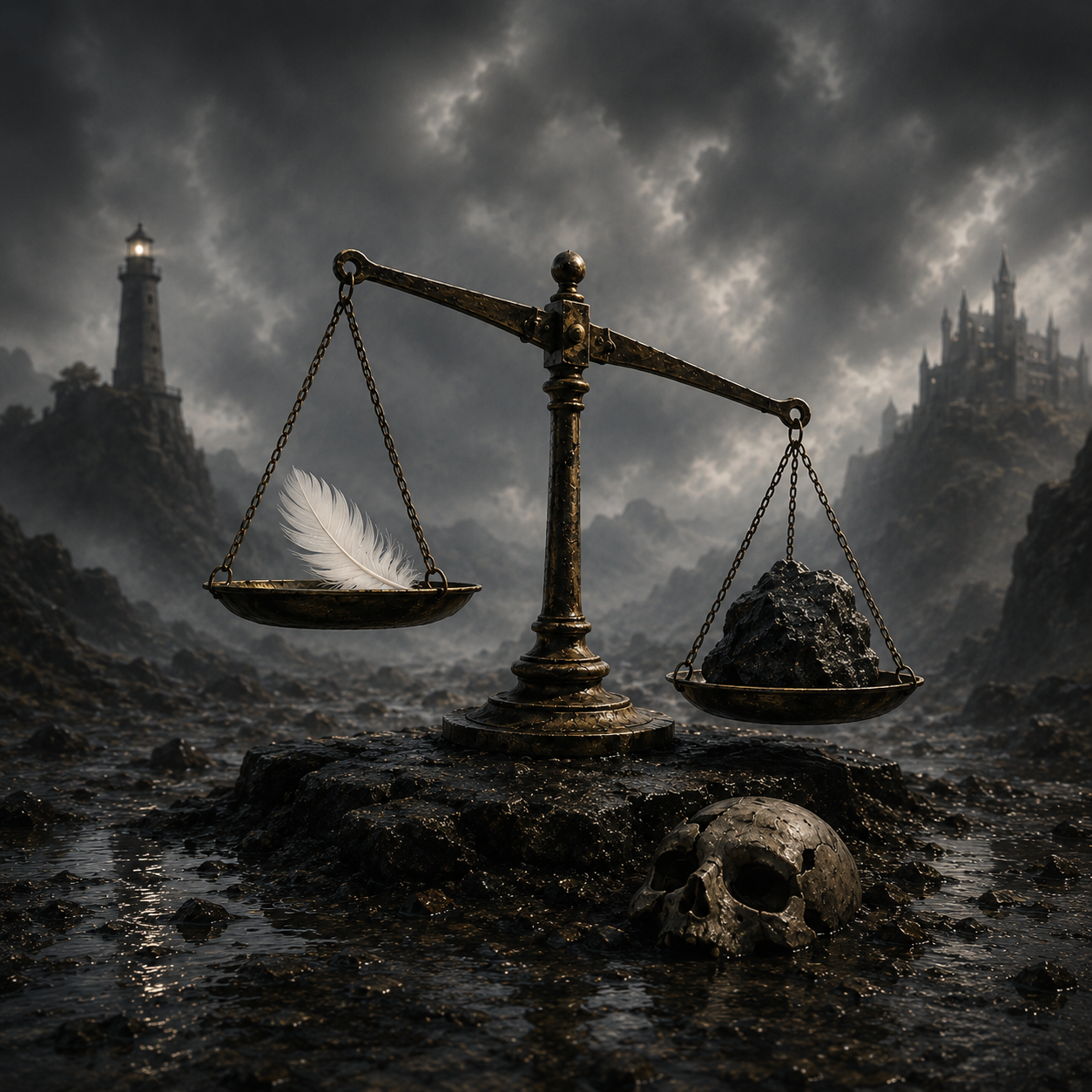
In Zaria's Choice, the right choice and the fatal choice are the same choice. Returning the wand to the sea is the correct act. It refuses power, it honours the debt, it stops the inheritance of something ruinous. It is also the last act. The story does not offer her a path that is both courageous and survivable. It offers her courage, and nothing else.
If your dark fantasy can be resolved at a discount, it is probably not as dark as you think it is.
A dark fantasy can allow moral courage while refusing easy rescue.
What all of this adds up to
Dark fantasy does not need to shout. It does not need to decorate every scene with horror or announce its intentions in blood. Sometimes all it needs is a returned object, a place that remembers, a witness who does not yet understand, and a choice that costs more than survival.
The genre earns its darkness not through what happens in it but through the logic underneath what happens. That the past continues to press on the present, that power arrives with responsibility, that the right thing and the safe thing are not the same thing, and that a person can be seen clearly. By a place, by a girl, by a reader and precisely in the moment when all of that becomes undeniable.
If you are writing dark fantasy, those are the pressures worth building. The weather, the blood, and the body count can follow. But they will not, by themselves, make anything dark.
Zaria's Choice is part of Tales from the Woldwood, a series of standalone dark fantasy stories set in the world of the Marchlands. Read it on Substack.
Discussion